What Is a Hot Stick, and Why Is It Tested?
A hot stick (live-line tool) is an insulating pole — almost universally a fiberglass-reinforced plastic (FRP) foam-filled tube with a universal tool head at the working end — that lets an electrical worker manipulate energized conductors and equipment from a safe distance. It is the worker's primary electrical protection: the insulation of the stick itself, between the live part and the worker's hands, is what prevents shock. That role is what makes testing mandatory rather than optional. Hot stick testing is the periodic verification that the stick's dielectric integrity along its entire working length is still intact, governed in North America by OSHA 29 CFR 1910.269(j)(2) and IEEE 516 (the guide for in-service maintenance of live-line tools, with IEEE 978 as the older companion), with ASTM F711 setting the design spec for new FRP rod and tube. In China the product standard is GB 13398-2008 (带电作业用空心绝缘管、泡沫填充绝缘管和实心绝缘棒, modified adoption of IEC 60855 and IEC 61235), and the in-service preventive-test regime runs through DL/T 976 (带电作业工具预防性试验规程) and DL/T 1476 (电力安全工器具预防性试验规程). A hot stick is not a tool you "use until it breaks" — its dielectric failure is invisible and lethal, so the standard treats it as a re-testable safety appliance on a short periodic interval.
What Does OSHA 1910.269 and IEEE 516 Actually Require?
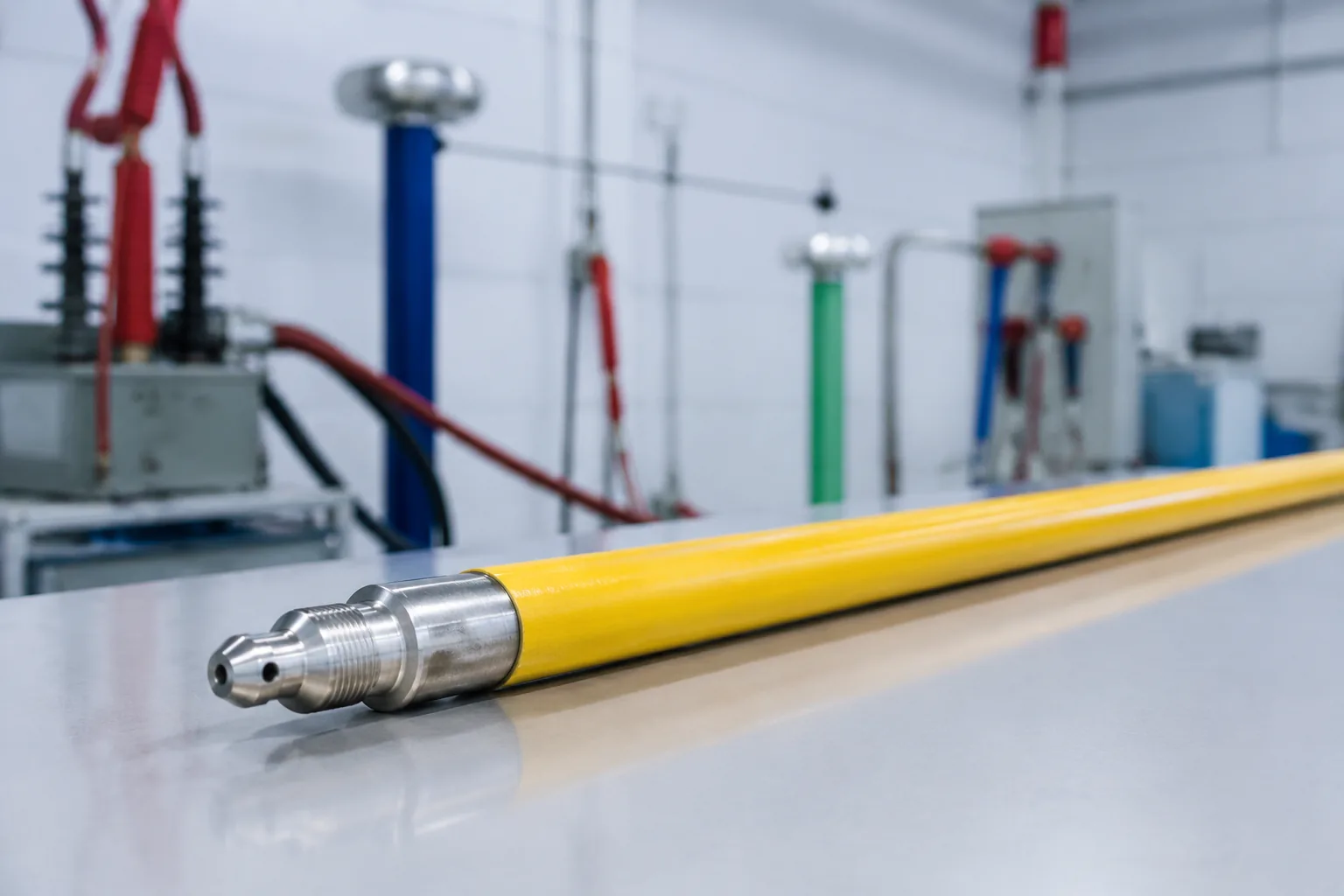
The regulatory backbone is OSHA's condition-of-tools rule, 29 CFR 1910.269(j)(2), reinforced by IEEE 516-2021. Three obligations flow from it:
- Daily wipe and visual inspection before each use (1910.269(j)(2)(i)–(ii)), using a silicone-impregnated cloth; any defect or contamination found after wiping removes the tool from service.
- Periodic examination, cleaning, repair and testing of all live-line tools used for primary employee protection — at intervals not exceeding 2 years under OSHA (1910.269(j)(2)(iii)), and annually (≤ 1 year) under China's DL/T 976 / DL/T 1476, which is stricter.
- Test after any repair or refinishing, regardless of cycle.
The OSHA test voltage itself is unambiguous (1910.269(j)(2)(iii)(E)): 75,000 volts per foot (≈ 2461 V/cm) of length for 1 minute for fiberglass tools, or 50,000 volts per foot for 1 minute for wood tools. The test method is left to IEEE 516 §5.3 (High-Potential AC Test Method) and IEEE 978, which fix the wet-water conductivity, application method, and the acceptance criterion of a steady or decreasing leakage current at full voltage. Note the design margin: a new FRP tool is type-tested to 100,000 V/ft for 5 minutes under ASTM F711, so the 75 kV/ft in-service test runs well below the design ceiling — the margin is what allows a tool that "passed the lab test" to degrade in service yet still be caught before it becomes dangerous.
How Is the Wet Test Performed, and Why Wet?
For FRP tools the in-service test is a wet test at 75 kV/ft for 1 minute. The stick is laid horizontally in a test fixture, demineralized water of defined conductivity is sprayed as a mist along the test section, and the high voltage is applied between electrodes — typically clamping a 1-foot (300 mm) section at a time, walked along the full working length of the tool. The pass criterion is no flashover, and leakage current that is stable or decreasing at full test voltage.
Why wet? Because the dominant failure mode of an FRP hot stick is surface, not internal. The surface takes all the abuse — scratches, dents, loss of gloss, dirt, oil, creosote, moisture — and when the gloss is gone, water no longer beads up but wets out (sheets) across the surface, creating a continuous conductive film for leakage current. The wet test deliberately provokes exactly this condition: a glossy stick beads the water and passes; a dull, scarred stick sheets the water and either flashes over or shows climbing leakage. Field data from the major manufacturers' comparison trials (Chance's 243-test study) are explicit: all rejections were wet-test failures of used sticks; no dry test ever rejected a used or new stick, and no wet test ever rejected a new stick — proving the wet test is a surface-condition test, and that internally-sound tools fail it only through their surface.
How Does the Dry Test Complement the Wet Test?
The wet test catches surface defects. The dry test catches the internal defects the wet test misses — and a competent program runs both, because each detects what the other cannot. Internal conductivity can rise from moisture ingress through a wall crack (mechanical over-stress), voids in the foam core (manufacturing or impact damage), or dielectric deterioration. These defects fill with moisture from the air and increase leakage, but they are invisible from the surface and may be masked by the dominant surface current in a wet test.
The dry test applies the voltage without water, so the only leakage path is through the bulk of the material — making it sensitive to internal defects. The trade-off, per EPRI's 2002 Criteria for Development of an Improved Insulating Tool Tester study, is that the dry-test reading is also confounded by capacitive current between the electrodes and by corona above ~20 kV RMS, which is why portable testers and lab tests can disagree on marginal sticks. EPRI's design guidance — detect the resistive component (reject the capacitive), keep the electrode voltage below the corona threshold, and set electrode spacing between 3 and 5 inches — is the basis of the modern portable tester.
What Are the Leakage-Current Criteria?
The standards define the method but the industry has converged on practical current thresholds, derived from decades of full-scale test data:
| Reading | Interpretation | Source |
|---|---|---|
| Stable / decreasing leakage at 75 kV/ft, < 75 µA | Pass (wet) | Conservative cutoff with ~4:1 safety factor below flashover |
| Climbing or unstable leakage above ~200 µA | Imminent flashover — reject | Empirical pre-flashover signature from full-scale tests |
| Stable but > 200 µA at full voltage | Marginal / transitional zone — reject under stricter criterion | IEEE 516 requires only stability; many labs apply the 200 µA ceiling as well |
| Dry-test leakage above the new-pole limit | Internal defect suspected — investigate, refinish or retire | IEEE/ASTM/IEC new-pole dry limits |
The 200 µA figure is not arbitrary: it is the level above which leakage readings historically became unstable and were followed by flashover. The 75 µA wet-acceptance cutoff builds in roughly a 4:1 safety factor below that point, so a tool that passes has substantial margin.
Portable Testers vs Laboratory Full-Voltage Testing — What's the Boundary?
This is the most-debated point in the field, and the answer is: portable testers are a screening supplement, not a substitute for laboratory testing when it is required. Portable testers (A.B. Chance, Hastings) operate on Ohm's law: they apply ~1800–2500 V AC across closely-spaced electrodes (Hastings 6-inch, electrode spacing ≥ 2× tool diameter), measure the leakage, and extrapolate to what 75 kV/ft would produce. The Chance comparison study found 94% agreement (229 of 243 tests identical) with the IEEE lab test; where they disagreed, the portable tester was slightly more critical (11 rejects vs 3), and all disagreements were in the transitional pass/fail zone.
The boundary matters because the portable tester does not reproduce the high-voltage stress of the lab test:
- No corona stress above ~20 kV — the portable tester cannot induce the corona-related stress that the lab test applies, so it can pass a marginal section the lab test fails.
- Close electrode spacing increases local sensitivity but reduces the integrated whole-stick test — a section that fails at one probe position may pass 6–8 inches away, so segment results must be interpreted, not read literally.
- OSHA's "other equivalent test" clause (1910.269(j)(2)(iii)(E)(3)) is the legal hook for portable testers, but the employer must demonstrate equivalency by following the manufacturer's protocol, maintaining calibration, and training operators. Portable testers are explicitly not authorized for the post-repair / post-refinish full-length test.
What Belongs in a Test Record and Cycle?
A compliant hot-stick test program documents:
- Tool identification — type, serial, length, FRP variant (solid / hollow / foam-filled), manufacturer.
- Test method — wet or dry, electrode spacing, voltage, duration, and the standard referenced (IEEE 516 §5.3 / DL/T 976).
- Section-by-section results — each 1-foot or probe-length section's leakage reading and pass/fail, not just a single overall verdict.
- Surface conditioning — as-received / cleaned / waxed / refinished, because surface state drives the wet-test result.
- Test date and next-due date — OSHA ≤ 2 years; DL/T 976 / DL/T 1476 ≤ 1 year.
- Action taken — returned to service, waxed, refinished, or retired.
For the broader electrical-insulation test cluster, see our Insulating Oil Testing; for the high-altitude PPE cluster, Safety rope testing; and for the FRP material background of the stick itself, Composite material testing.
FAQ
How often must a hot stick be tested?
Under OSHA 29 CFR 1910.269(j)(2), live-line tools used for primary protection are tested at intervals not exceeding 2 years, plus after any repair or refinishing. China's DL/T 976 / DL/T 1476 set a stricter annual (≤ 1 year) cycle. A daily wipe-and-visual-inspection is required regardless of the electrical-test cycle.
Why is the in-service test 75 kV/ft when new sticks are tested at 100 kV/ft?
New FRP tools are type-tested to 100,000 V/ft for 5 minutes under ASTM F711. The 75 kV/ft-for-1-minute in-service test (OSHA / IEEE 516) deliberately runs below the design ceiling, so a tool that has degraded in service can still be caught — the 25% voltage margin is the safety allowance for in-service condition.
Is a portable hot stick tester an acceptable substitute for a lab test?
For routine in-service checks, yes, as OSHA's "other equivalent test" clause allows it — provided the employer follows the manufacturer's protocol, maintains calibration, and trains operators. For the post-repair / post-refinish full-length test, no — the full-voltage lab test is required. Portable testers are a screening supplement that catch surface contamination and gross defects; they cannot reproduce the corona stress of the lab test.
What makes a hot stick fail the wet test?
Loss of surface gloss. A glossy surface makes water bead up; a dull, scarred surface lets water sheet across it and create a conductive film. Manufacturer comparison data show that all wet-test rejections were on used sticks with poor surface condition — none on new sticks, and no dry test ever rejected a used stick. The fix is waxing (if the surface is basically sound) or complete epoxy refinishing (if scarred).
What is the difference between a hot stick test and a rubber glove test?
Both are electrical-safety-tool tests, but a hot stick is the primary insulating barrier (the stick's FRP body), tested at 75 kV/ft along its length every 1–2 years. Rubber insulating gloves are personal protective equipment, tested at their class voltage (up to 40 kV, Class 00–4) every 6 months to ASTM D120/F496. They are complementary layers of protection, tested on different cycles and to different standards.
Our Testing Capabilities
As an ISO/IEC 17025-accredited third-party laboratory, Beijing ZKGX Research provides hot stick and live-line tool testing aligned to GB 13398-2008, DL/T 976, DL/T 1476, IEEE 516 / IEEE 978, ASTM F711 and the OSHA 1910.269 framework:
- Wet high-potential AC test at 75 kV/ft for 1 minute (fiberglass) / 50 kV/ft (wood), section-by-section along the full working length, with leakage-current monitoring against the 75 µA acceptance / 200 µA rejection thresholds.
- Dry high-potential AC test for internal-defect detection, with the more sensitive dry-scale limits.
- Type / acceptance testing of new FRP tools to 100 kV/ft for 5 minutes per ASTM F711 / GB 13398.
- Mechanical examination — wall cracks, foam voids, end-fitting integrity, surface defects.
- Periodic preventive-test reporting per DL/T 976 (≤ 1 year cycle) and DL/T 1476, with section-by-section data, surface-condition record, test date and next-due date.
Sample types include solid and foam-filled FRP hot sticks, telescopic and shotgun sticks, switch sticks, Grip-All sticks, and auxiliary arms. If you have a specific tool type, voltage class, or compliance target (OSHA / IEEE / GB / DL), contact the laboratory to confirm the exact test set and reporting format.