What Does "Insulated Boots (Shoes) Testing" Actually Mean?
"Insulated boots" has two completely different meanings, and the distinction is the first thing a test report must get right. In outdoor-gear retail it means thermally insulated winter boots — built to retain foot warmth in snow, with PrimaLoft fill, sealed seams and grippy outsoles. In electrical-safety PPE — which is what a testing laboratory is asked to certify — it means electrically insulating footwear (dielectric boots/shoes), footwear whose job is to block current from travelling through the wearer's body to earth during live electrical work. The two share nothing but the word "insulated", and the relevant tests are poles apart: thermal insulation is measured in warmth/comfort terms, while electrical insulation is measured in withstand voltage (kV) and leakage current (mA) against IEC, EN, ASTM and GB dielectric-footwear standards. This article covers the electrical-insulation meaning, because that is the one that carries a certification mark and a mandatory periodic retest.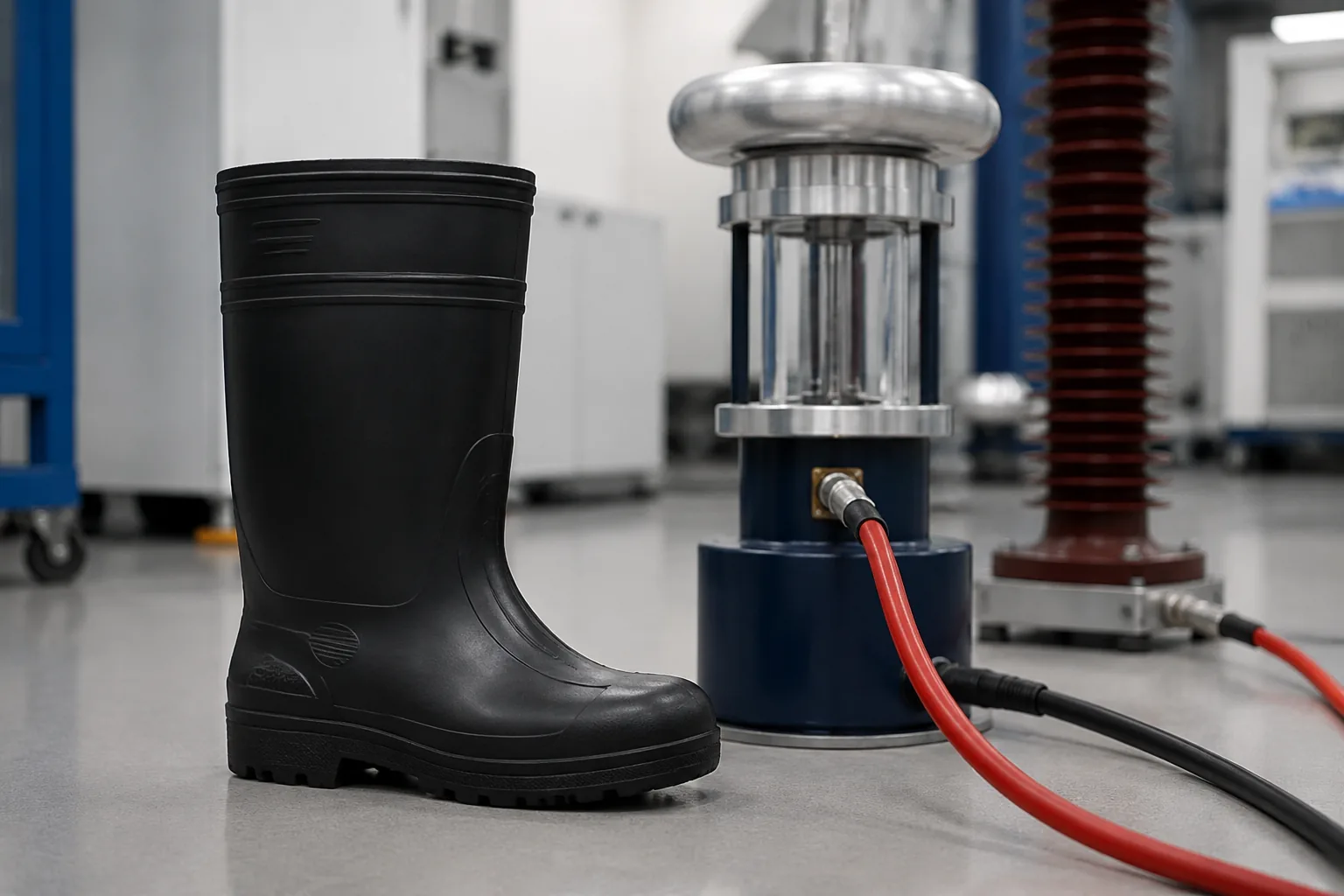
Why Electrical Insulation Footwear Is Treated as a Safety Appliance
An insulating boot or shoe is classed as an auxiliary electrical safety appliance (辅助安全用具), not ordinary PPE. It is the last line of defence against step-and-touch potential and against inadvertent contact with live parts, and it works by presenting a high electrical resistance between the wearer's foot and ground. Because that resistance can fail through moisture uptake, sole puncture, material ageing or contamination, the standards treat these products as re-testable appliances with a short periodic interval — typically 6 months for high-voltage boots (>10 kV class) and up to 12 months for lower classes — not as "fit and forget" clothing. A boot that passed its factory dielectric test is not certified for use six months later without a retest; the certification is dated.
What Are the Governing Standards?
The dielectric-footwear test framework is split across regional standards that are conceptually parallel:
- GB 21148-2020 足部防护 安全鞋 (Foot protection — safety footwear) — the current Chinese national standard, which integrated and superseded the older standalone GB 12011-2009 足部防护 电绝缘鞋. GB 12011 is now withdrawn; its dielectric-class requirements (the 6 kV / 15 kV / 20 kV / 30 kV class table) are carried into GB 21148 as the electrical-insulation additional requirement.
- EN 50321 — European standard for insulating footwear for live working on electrical installations up to 36 kV AC; the basis for CE marking of dielectric boots in the EU.
- EN ISO 20345 — general safety-footwear standard (impact, compression, slip) that dielectric boots also meet for the mechanical side.
- ASTM F2413 (US) — safety footwear with the EH (Electrical Hazard) rating, providing supplementary insulation against electric shock; ASTM F2414 covers the test method.
- DL/T 976 and DL 5009.2 — Chinese power-industry codes for preventive testing of live-working tools/appliances and for electrical-construction safety, which govern the in-service retest regime in the power sector.
A complete procurement or audit specification names both the safety-footwear standard (mechanical) and the dielectric standard (electrical), because a boot can be a certified safety shoe and still carry no electrical rating.
How Is the Dielectric Withstand Test Performed?
The core test is a power-frequency (50/60 Hz) withstand voltage test with simultaneous leakage-current measurement. The footwear is filled with a conductive medium (water/conductive balls or a conductive inlay) as the internal electrode, the external surface (or an external electrode tray) is the other electrode, and voltage is applied between them through the sole and any insulated upper.
- Voltage ramp — raise from zero to 75 % of the specified test voltage, then continue up to the full specified voltage for the declared class.
- Hold — maintain the full test voltage for the specified duration (typically 1 minute for routine/in-service tests, 3 minutes for type tests).
- Monitor leakage current — the current flowing through the footwear must stay at or below the class limit (e.g. ≤ a few mA, commonly ≤ 2.4 mA at the class voltage for leather-shoe classes).
- Pass criterion — no breakdown (puncture/flashover) of the insulation, and leakage current within limit throughout the hold. Any breakdown is an automatic fail; the boot is destroyed as a test sample and must not be returned to service.
The test is destructive by design for the failure case, which is why in-service boots are tested as intact units (the boot survives if it passes) but a failed unit is scrapped.
How Do the Voltage Classes Compare?
The class number is the declared AC withstand voltage the boot must hold. The table below is the GB 21148 / ex-GB 12011 class structure (leather-shoe and rubber-boot classes differ, with rubber insulating boots reaching the higher classes):
| Class (test voltage) | Typical product | Leakage-current limit context |
|---|---|---|
| 6 kV | Insulating leather safety shoe | ≤ 2.4 mA at 6 kV — the common "electrician's shoe" |
| 15 kV | Insulating boot / heavier-duty shoe | Stricter leakage limit at higher voltage |
| 20 kV | Insulating rubber boot | For medium-voltage live work |
| 30 kV | High-voltage insulating rubber boot | For substation / high-voltage live work |
Two points that catch buyers out. First, the class voltage is a withstand voltage, not a working voltage — a 6 kV class shoe is not rated for use on a 6 kV circuit; the usable voltage is a fraction of the test voltage, set by the safety code (DL/T 976 / the live-working standard). Second, leather-shoe classes top out at 6 kV under the current GB framework — only rubber/plastic insulating boots carry the 15 kV / 20 kV / 30 kV classes, because leather's insulation is moisture-dependent and cannot be guaranteed at higher voltages.
What Distinguishes Insulating, Anti-Static and Conductive Footwear?
These are three mutually exclusive electrical categories, and specifying the wrong one is a common — and dangerous — error:
- Electrically insulating footwear — resistance high enough to block current; for live electrical work. Resistance is far above 1000 MΩ.
- Anti-static (ESD) footwear — resistance engineered into a controlled band of 100 kΩ ≤ R ≤ 1000 MΩ (per GB 21148 / GB/T 20991 5.10). It bleeds static charge to ground to protect electronics and prevent spark ignition, while still protecting the wearer from a mild shock. It is not a substitute for insulating footwear — its resistance is some ten orders of magnitude lower.
- Conductive footwear — resistance below the anti-static floor, designed to keep the wearer firmly grounded; used where static discharge is the hazard and mains voltage is not present. Wearing conductive footwear on live work would be lethal.
A boot tested as insulating cannot be re-labelled anti-static, and vice versa — the test methods and pass bands are different, and a single pair of footwear cannot meet both.
What Else Is Tested on an Insulating Boot?
A dielectric boot is also safety footwear, so the mechanical requirements of EN ISO 20345 / GB 21148 apply alongside the electrical test:
- Impact resistance (200 J) and compression resistance (15 kN) of the toe cap — note GB 21148-2020 prohibits metal toe caps that rely on insulation treatment; non-metallic (composite) caps are required where electrical performance must be guaranteed.
- Puncture resistance of the sole — a metal-free requirement for the same reason; a steel midsole that pierces the insulating layers destroys the dielectric rating.
- Slip resistance — on ceramic/steel, wet/dry, per the standard's friction methods.
- Upper and sole integrity — tear, abrasion, flex; any sole delamination is a dielectric failure risk, not just a comfort issue.
- Water absorption/penetration — because moisture is the single biggest destroyer of dielectric performance; leather uppers absorb water and the leakage current climbs.
For the broader safety-footwear test background shared with these items, see our Safety shoe testing capability, and for related dielectric-oil insulation testing see Insulating Oil Testing.
How Should an In-Service Boot Be Managed and Retested?
Because the dielectric rating degrades with use, the in-service regime matters as much as the factory test:
- Establish a register — every insulating boot/shoe logged by serial, class, issue date and last-test date.
- Pre-use visual check — cuts, punctures, sole delamination, chemical swelling, contamination; any visible sole damage removes the boot from service regardless of test date.
- Periodic dielectric retest — at the interval the safety code sets for the class and voltage: 6 months for high-voltage (>10 kV) boots, up to 12 months for lower classes (DL/T 976 / the power-sector preventive-test code). The retest is the same withstand-voltage-and-leakage test, performed as an intact-unit test.
- Clean and dry before test — contamination and moisture cause false fails and real degradation; cleaning per the manufacturer's instruction is part of the test procedure.
- Retire on age/overhaul — even boots that keep passing are retired at the manufacturer's maximum service life, because material ageing (rubber ozone-cracking, leather fat degradation) lowers the dielectric margin invisibly.
FAQ
What does the "6 kV" or "20 kV" mark on an insulating boot mean?
It is the power-frequency AC withstand test voltage the boot must hold for one minute without breakdown, with leakage current within limit. It is not the circuit voltage the boot may be used on — the usable voltage is a fraction of the test voltage, set by the live-working safety code. Higher numbers mean a higher-voltage class, and only rubber insulating boots carry the 15/20/30 kV classes; leather shoes top out at 6 kV.
Why must insulating boots be retested every 6–12 months when they look fine?
Dielectric performance degrades through moisture uptake, sole flexing, ozone cracking of rubber, chemical contamination and material ageing — none of which are visible. The periodic withstand test is the only way to confirm the insulation is still intact; a boot can look new and still fail. The 6-month interval for high-voltage boots reflects how quickly the margin can erode in service.
Is an anti-static (ESD) shoe the same as an insulating shoe?
No — they are opposite electrical functions. An insulating shoe has very high resistance to block current during live work. An anti-static shoe has controlled resistance of 100 kΩ–1000 MΩ to bleed static charge to ground for electronics/spark protection. An anti-static shoe offers essentially no protection against mains voltage and must never be worn for live electrical work.
Why does GB 21148-2020 restrict metal components in insulating footwear?
Metal toe caps and metal midsoles that "rely on insulation treatment" are prohibited because any puncture, wear or ageing of that treatment creates a conductive path through the sole, destroying the dielectric rating without warning. Composite (non-metallic) toe caps and puncture-protection layers are required so the electrical insulation does not depend on a coating that can fail.
Can I wear insulating boots instead of using an insulating mat or gloves?
No. Insulating footwear is an auxiliary protective measure — it reduces risk from step-and-touch potential and inadvertent contact, but it is not a substitute for the primary insulating appliances (insulating gloves, mats, live-working tools) or for de-energising and locking out where that is possible. The standards are explicit that footwear alone does not qualify a worker for live work.
Our Testing Capabilities
As an ISO/IEC 17025-accredited third-party laboratory, Beijing ZKGX Research provides dielectric (electrically insulating) footwear testing aligned to GB 21148-2020, EN 50321 / EN ISO 20345 and ASTM F2413 (EH):
- Power-frequency withstand voltage test — 6 kV / 15 kV / 20 kV / 30 kV classes, ramped to 75 % then full voltage, with simultaneous leakage-current measurement (≤ class limit, e.g. ≤ 2.4 mA at 6 kV for leather-shoe class), no-breakdown pass criterion.
- Routine and in-service retest of intact boots per the class interval (6-month for HV, up to 12-month for LV), per DL/T 976 and the power-sector preventive-test code.
- Electrical resistance classification — distinguishing insulating, anti-static (100 kΩ–1000 MΩ) and conductive footwear.
- Mechanical safety-footwear tests — 200 J impact / 15 kN compression (composite toe cap verification), puncture resistance (non-metallic midsole), slip resistance, sole flex, upper/sole integrity, water penetration.
- Type-test and certification support with documentation of class, test voltage, leakage current, environmental conditions and pass criterion.
Sample types include insulating leather safety shoes (6 kV class), rubber/plastic insulating boots (15–30 kV), anti-static and conductive safety footwear. If you have a specific standard, voltage class or target market, contact the laboratory to confirm the exact test set and reporting format.