What Does "Lifting Sling Testing" Mean?
A lifting sling is the load-bearing link between a crane hook and the load — and "lifting sling testing" is the mechanical qualification and periodic verification of that sling's load-bearing performance. It is not a single measurement but a structured set of tests covering proof load (verification load), breaking force, and where applicable fatigue and environmental performance, governed in North America by OSHA 29 CFR 1910.184 and ASME B30.9 (Slings), in Europe by the LOLER 1998 regime (Lifting Operations and Lifting Equipment Regulations) with BS EN 1492/1677 series, and in China by GB/T 16762 (一般用途钢丝绳吊索特性与技术条件), GB/T 24811 (起重机钢丝绳选择), GB/T 25853 (8级非焊接吊链) and JB/T 8521.1/.2 (合成纤维吊装带). The single most important idea: a sling is a periodically re-tested safety appliance, not a use-until-broken consumable, because a sling that fails in service drops its load. It is distinct from testing the wire rope or chain material itself (the wire-rope or chain breaking-force test) — here the assembled sling (rope/chain/webbing plus end fittings) is the subject.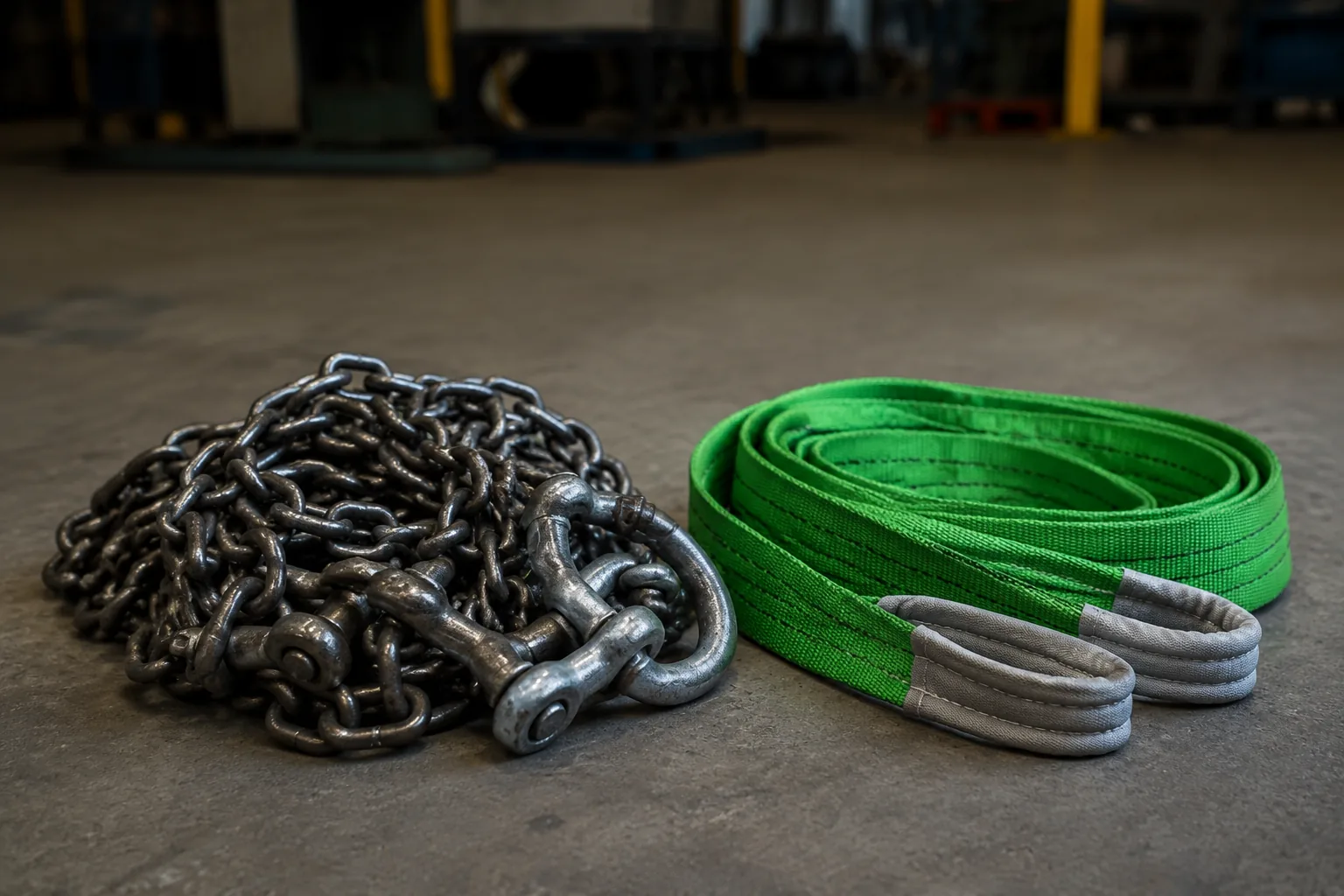
What Are the Four Sling Types and Why It Matters for Testing?
The same test framework applies differently to four distinct sling materials, because each fails by a different mechanism. A test plan that ignores the material is generic and wrong:
- Wire rope slings — built for high load and rough handling; inspect for broken wires, kinks, crushed sections, corrosion, birdcaging and worn end fittings. A cluster of broken wires in one lay length weakens the sling far more than the count suggests. Governed by GB/T 16762 / ASME B30.9.
- Chain slings (alloy steel) — tolerate heat, dirt and sharp edges that destroy synthetics; inspect for stretched links, cracks, severe wear, distorted hooks. A 5 % link elongation beyond manufacturer spec is an automatic remove-from-service criterion. GB/T 25853 (grade 8 chain).
- Synthetic web and round slings — gentle on finished surfaces but vulnerable to cuts, UV, chemicals and heat; inspect for fraying, broken stitching, burns, discoloration and embedded debris. JB/T 8521.1/.2 (flat / round).
- Metal mesh (chain-link) slings — survive hot materials and sharp edges; inspect for broken welds, distorted mesh, worn fittings.
A "pass" on a wire-rope sling tells you nothing about a synthetic sling of the same rated capacity, because the failure modes are unrelated. Each material has its own inspection checklist, its own retirement criteria, and — through its safety factor — its own relationship between rated load and breaking force.
How Do Proof Load and Breaking Force Relate to the Safety Factor?
Every sling carries a declared working load limit (WLL), and the test program verifies that the sling meets both a proof load (a non-destructive overload it must survive in service) and a breaking force (the ultimate load at destruction, which sets the safety factor). The two are linked through the safety factor — the ratio of breaking force to WLL — and that ratio differs by material:
| Sling type | Standard | Proof (verification) load | Min. breaking force | Effective safety factor |
|---|---|---|---|---|
| Wire rope sling | GB/T 16762 / YB/T 4507 | 1.22 × WLL (non-destructive) | per rope grade | embedded in the 1.22 proof factor + rope design factor |
| Alloy chain sling (grade 8) | GB/T 25853 | ~2 × WLL | 4 × WLL | 4:1 |
| Synthetic flat/round sling | JB/T 8521.1/.2 | 2 × WLL (cover/case must not break) | 6 × WLL (sample must withstand 6× WLL) | 6:1 (minimum); 7:1 / 8:1 for higher-grade |
| Metal mesh sling | ASME B30.9 | per manufacturer | 5 × WLL | 5:1 |
Two engineering points competitors gloss over. First, the proof load is deliberately below the breaking force — the proof proves the sling can survive its service overload without damage, the breaking test proves the safety margin above that. A sling that takes its proof load but breaks at 5× WLL has only a 5:1 factor and a thin margin if the proof was 2×. Second, synthetic slings carry the highest safety factor (6:1 minimum) precisely because their failure mode (cut, UV, chemical) is harder to predict by inspection than a chain's — the larger factor is the compensation for inspection uncertainty, not an indication that the material is stronger.
How Does the D:d Bend Ratio Reduce Sling Efficiency?
A sling almost never fails at its midpoint — it fails at the attachment, where the rope or web bends around a pin, hook or shackle. That bend concentrates stress, and for high-modulus fibre and wire the strength loss is dramatic. The ratio of pin/hook diameter (D) to sling diameter (d) — the D:d ratio — directly sets the sling efficiency (the percentage of straight-pull strength retained through the bend):
- D:d = 1 (pin diameter = sling diameter) — severe bend; the break moves to the back of the eye at the pin, and efficiency drops sharply even if the rope itself is sound.
- D:d = 4–8 — moderate bend; most of the straight-pull strength is retained.
- D:d ≥ 20 — effectively a straight pull; bend loss negligible.
For grommets (endless slings), the industry recommendation is a grommet strength of 1.6–1.8 × single-rope strength, not the theoretical 2× — because the bend around the pin plus the splice loss means an endless sling never delivers twice a single rope's strength. For single-leg slings, the recommended attachment geometry is D:d ≥ 2, at which the sling efficiency can exceed 1× rope strength (i.e. the eye splice retains full rope strength). The practical testing consequence: a breaking-force test that uses the wrong pin diameter will report a falsely low efficiency, so the test rig's pin/hook D:d must be recorded alongside the result.
How Does Sling Configuration Affect the Test and Rated Load?
A sling's rated WLL is stated for a vertical hitch. Every other configuration reduces the effective capacity, and the test program must apply the proof/breaking loads to the configuration the sling is rated for. The four standard configurations, in descending efficiency:
- Vertical (90°) — 100 % of WLL. The baseline against which all reductions are quoted.
- Basket — up to 200 % of vertical WLL when the legs are vertical (load cradled), reducing with leg angle. The basket multiplier can exceed 1× because both legs share the load.
- Choker — 75–80 % of vertical WLL; the choke reduces capacity through the bend around the load.
- Angled (multi-leg bridle) — tension per leg rises as the leg angle from vertical decreases. At 30° from horizontal (60° from vertical is the normal minimum), each leg carries roughly 2× the load weight; the standard rule is to rate multi-leg bridles assuming only two legs carry the full load, because perfect equal sharing cannot be guaranteed in the field.
A proof-load test on a choker-rated sling must apply the choker-reduced load, not the vertical load — otherwise the test overloads the sling relative to its rated use and may falsely fail a sound sling.
What Are the In-Service Inspection and Retirement Criteria?
Because a sling is a re-testable safety appliance, the in-service regime is as important as the factory test. OSHA 1910.184 and ASME B30.9 require:
- Shift inspection — visual check before each shift by a competent person: broken wires/strands, kinks, crushing, corrosion, cuts, fraying, melted fibres, distorted fittings.
- Periodic inspection — by a qualified person at intervals set by service severity (annual is typical; more frequent for severe service — marine, chemical, high-temperature, heavy-cycle). Includes link elongation measurement for chain (5 % = remove), identification tag legibility, and proof-load re-verification where required.
- Remove-from-service criteria — missing or illegible tag; cuts, broken wires, severe abrasion; hooks distorted, cracked, or with throat opening increased >5 %; chain links elongated >5 %; synthetic slings with chemical/heat/UV damage (UV can reduce tensile strength by up to 50 %); corrosion reducing >1/3 of wire diameter.
- Documentation — written records of every inspection (date, findings, inspector) retained for the sling's service life; OSHA/ASME and LOLER all require this audit trail.
For the load-bearing material testing that underpins the sling's wire rope or chain, see our Steel wire rope testing; for the fittings side, Fastener testing; and for failure investigation of failed slings, Fracture analysis of metals.
FAQ
What is the difference between proof load and breaking force in sling testing?
Proof load (verification load) is a non-destructive overload the sling must survive without damage — e.g. 1.22× WLL for wire rope slings (GB/T 16762), 2× WLL for synthetic slings. Breaking force is the load at which the sling fails (destructive test), and it sets the safety factor: a synthetic sling that breaks at 6× WLL has a 6:1 factor. Proof proves service margin; breaking proves the safety factor above it.
What safety factor do synthetic lifting slings require?
Under JB/T 8521.1/.2 (and the incoming JB/T 8521.1-2025, effective 2026-02-01), synthetic flat and round slings require a minimum breaking force ≥ 6× WLL (a 6:1 safety factor), with 7:1 and 8:1 used for higher-grade or special-service slings. The cover/case must separately withstand 2× WLL without breaking.
Why does a grommet not deliver twice the single-rope strength?
Because of bend and splice loss. An endless (grommet) sling loops back through itself, so at the pin each leg carries ~½ the load but bends around the pin and through the splice. Industry testing recommends a grommet strength of 1.6–1.8× single-rope strength, not the theoretical 2×, because the bend concentration and splice inefficiency consume the margin.
Does a choker hitch reduce the rated capacity?
Yes. A choker hitch retains only 75–80 % of the vertical WLL because the sling bends around the load and chokes itself. The proof-load and breaking tests on a choker-rated sling apply to the reduced capacity, not the vertical rating.
How often must a lifting sling be inspected?
A visual inspection before every shift, and a periodic inspection by a qualified person at intervals set by service severity (typically annual for normal service, more frequent for severe). Chain links elongated >5 %, hooks with >5 % throat distortion, missing/illegible tags, and UV/chemical/heat damage are all immediate remove-from-service criteria.
Our Testing Capabilities
As an ISO/IEC 17025-accredited third-party laboratory, Beijing ZKGX Research provides lifting-sling testing aligned to GB/T 16762, GB/T 24811, GB/T 25853, JB/T 8521.1/.2, OSHA 29 CFR 1910.184, ASME B30.9 and the LOLER framework:
- Proof load (verification load) testing — 1.22× WLL (wire rope per GB/T 16762), 2× WLL (synthetic cover/case), per material standard; controlled loading rate (typ. 0.1–100 mm/min) to avoid shock loading and false fails.
- Breaking force (destructive) testing with safety-factor verification — 4:1 (chain), 5:1 (mesh), 6:1 minimum (synthetic) — with the D:d ratio of the test pin/hook recorded alongside the result.
- Configuration-specific testing — vertical, basket, choker and angled multi-leg bridle, applying the proof/breaking load to the configuration the sling is rated for.
- In-service periodic verification and retirement assessment — link elongation (chain 5 % limit), hook throat distortion, broken-wire counts, UV/chemical/heat damage evaluation, tag legibility.
- failure analysis of failed or retired slings — fracture mechanics, fatigue, corrosion — in support of incident investigation.
Sample types include wire rope slings, alloy chain slings, synthetic flat and round slings, metal mesh slings, and multi-leg bridle assemblies. If you have a specific material type, WLL, configuration, or compliance target (GB / OSHA / ASME / LOLER / EN), contact the laboratory to confirm the exact test set and reporting format.