What Does "Safety Helmet Testing" Actually Cover?
A safety helmet (hard hat) is the primary piece of head-protection PPE on a work site, and "safety helmet testing" is the standardized set of mechanical tests that prove it will protect the wearer's head from falling or projected objects. A complete evaluation is built around three core performance tests — shock absorption (how much impact force is transmitted to the headform), penetration resistance (whether a pointed striker punches through the shell), and retention-system strength (whether the chinstrap keeps the helmet on the head) — plus optional tests for lateral rigidity, electrical insulation, flame resistance, low-temperature performance and dielectric strength depending on the declared class. The tests are governed by regionally distinct but conceptually parallel standards: GB 2812.1 (China), EN 397 / EN 14052 (Europe), ANSI/ISEA Z89.1 (USA) and EN 12492 (mountaineering). The single most important variable across all of them is where on the helmet the impact is delivered: an industrial helmet is qualified mainly on the crown, whereas high-performance and mountaineering helmets are qualified on the front, rear and sides as well.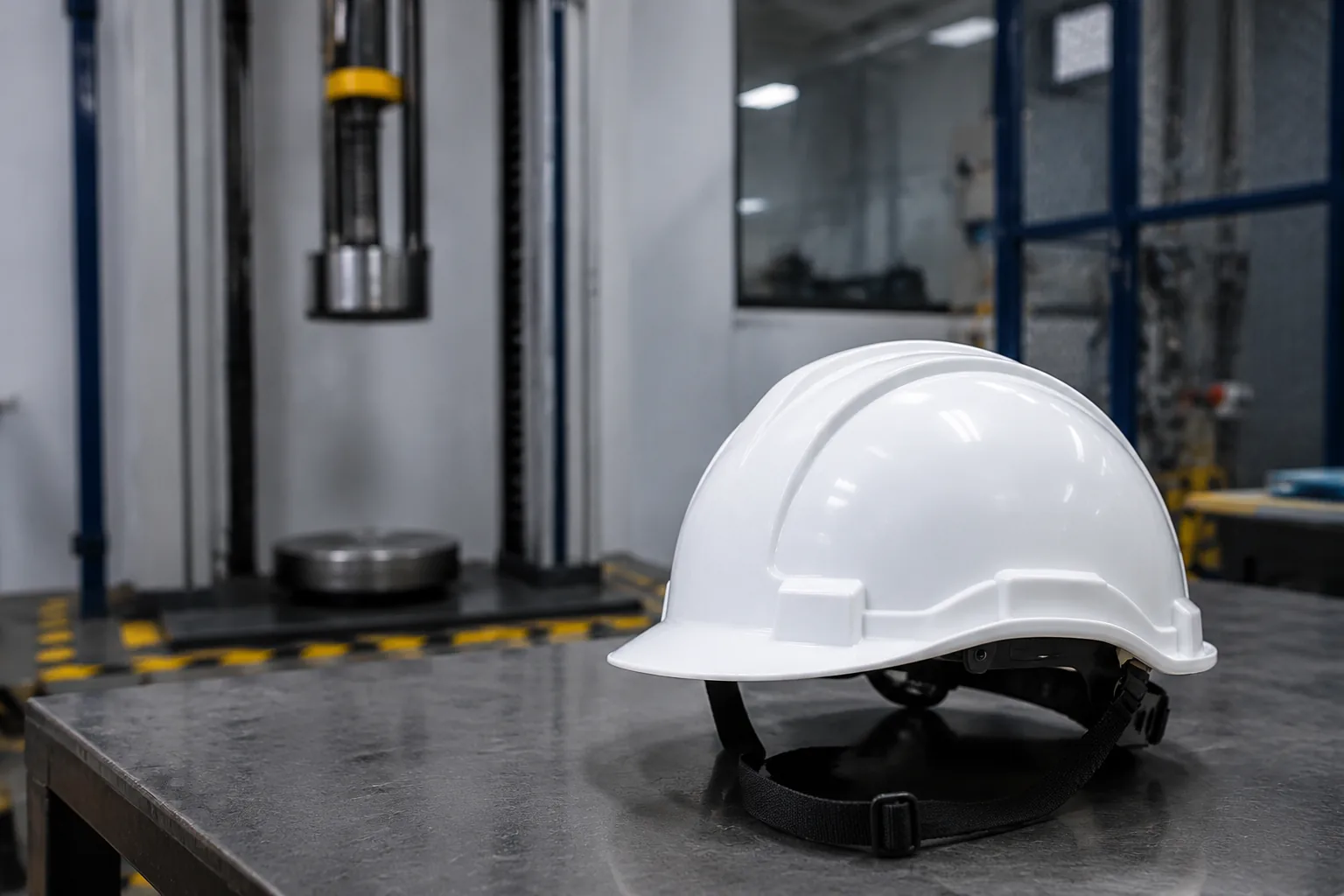
What Are the Core Test Methods and Pass Criteria?
Shock absorption (impact) test
The helmet is fitted to a rigid test headform instrumented with a triaxial accelerometer and dropped, guided by a low-friction rail, onto a flat (and sometimes kerbstone) anvil. The peak acceleration recorded at the headform's centre of gravity is the reported result. The pass criterion is always expressed as either a maximum transmitted force (kN) or a maximum peak acceleration (g) that the headform may experience.
Penetration resistance test
A pointed or blade-shaped striker of defined mass is dropped from a defined height onto the shell at the test point. The helmet passes only if the striker does not make contact with the headform (verified by a stop-contact indicator, typically putty or an electrical contact), and in some standards the transmitted force must also stay below a ceiling.
Retention-system (chinstrap) strength test
The chinstrap is fastened under the headform's chin; a weight is dropped onto a cable attached to the strap. The test measures both the dynamic displacement (maximum stretch on impact) and the residual displacement (settlement two minutes after rebound) of the retention system.
How Do GB 2812.1, EN 397, EN 14052 and EN 12492 Compare on the Same Helmet?
The fastest way to see what each standard demands is to put the key tests side by side. The numbers below are the crown (top) test conditions — the one location all four standards have in common.
| Standard / scope | Striker mass | Drop height | Impact energy | Crown shock absorption pass |
|---|---|---|---|---|
| GB 2812.1 (industrial, China) | 5 kg hemispherical | 1 m | 49 J | Transmitted force ≤ 4900 N (≈ 4.9 kN) |
| EN 397:2012 (industrial, Europe) | 5 kg hemispherical | 1 m | 49–50 J | Transmitted force ≤ 5 kN |
| ANSI/ISEA Z89.1 (Type I, USA) | 3.6 kg (8 lb) impactor | ~1.5 m | — | Peak acceleration ≤ 150 g |
| EN 14052:2012 (high-perf. industrial) | 5 kg hemispherical | 2 m | ~100 J | Transmitted force ≤ 5 kN |
| EN 12492:2012 (mountaineering) | 5 kg hemispherical | 2 m | ~100 J | Transmitted force ≤ 10 kN |
A few patterns matter for procurement and compliance. GB 2812.1 and EN 397 are essentially aligned on the crown test (both use a 5 kg hammer from 1 m, and the 4.9 kN / 5 kN difference is rounding rather than substance) — so a helmet type-approved to EN 397 generally meets the GB crown criterion and vice versa, subject to documentation. EN 14052 raises the bar by doubling the drop height to 2 m (≈ 100 J) while keeping the same 5 kN ceiling, and by adding front/rear/side tests with the headform tilted 60° and a 300 g acceleration limit. EN 12492 uses the same 2 m / 100 J energy but tolerates twice the force (10 kN) — because a mountaineering helmet must also be light and ventilated enough to wear for hours, the standard trades off a looser force ceiling against multi-impact coverage.
What Are the Penetration and Crown-Test Differences?
Penetration requirements diverge sharply between the industrial and high-performance standards, and this is where buyers most often mis-specify.
- GB 2812.1: 3 kg conical striker dropped from 1 m onto the crown; striker must not contact the headform.
- EN 397:2012: 3 kg conical striker dropped from 1 m onto the crown; striker must not contact the headform.
- EN 14052:2012: 1 kg blade striker dropped from 2.5 m onto the crown (must not contact, transmitted force ≤ 5 kN) and from 2 m onto the tilted (60°) front/rear/side (must not contact, transmitted force ≤ 15 kN). The blade geometry and higher energy make this the most aggressive penetration regime of the four.
- EN 12492:2012: 3 kg pointed striker dropped from 1 m, two strikes within a 50 mm radius of the crown; must not contact the headform.
The EN 397/GB lateral-rigidity (side crush) test is worth distinguishing from a side impact test: it is a slow, progressive force load on opposite sides of the shell, followed by measurement of deformation — it does not simulate a falling-object side impact. EN 14052 is the standard that genuinely qualifies side impact, by dropping the hammer onto the tilted shell.
What Optional Performance Markings Are Tested?
The base standard qualifies a helmet against falling objects at room temperature. Real work sites add heat, cold, electricity and fire, so each standard defines optional markings that the helmet must separately pass — a helmet marked only "EN 397" has not been tested for these.
- Very low temperature (−20 °C or −30 °C) — shock absorption and penetration repeated after conditioning at the marked cold temperature.
- Very high temperature (+150 °C) — for hot-work environments.
- Electrical insulation (dielectric) — EN 397 optional Class E-equivalent markings; ANSI Z89.1 Class E tests at 20,000 V, Class G at 2,200 V, Class C (conductive, no dielectric protection).
- Flame resistance — the shell must self-extinguish; relevant for welding, foundries and offshore.
- Lateral deformation (HD) — EN 397 optional for high-deformation environments.
- Molten metal splash — EN 397 optional marking "MM".
A helmet sold for an electrical-arc or live-work application must carry the correct class marking on the shell; the base shock-absorption pass alone is not evidence of dielectric protection. For the underlying impact-test methodology shared with these tests, see our drop-ball impact testing capability.
What Does the Retention-System Test Look For?
A helmet that comes off in a fall offers zero protection, so the retention (chinstrap) system is tested both for strength and for stability. The strength test drops a defined weight onto the fastened chinstrap and limits the dynamic displacement (maximum stretch on impact) and residual displacement (settlement after rebound). Motorcycle-standard data illustrate the principle: under UN ECE Regulation 22.06 a 10 kg mass dropped from 75 cm must produce dynamic displacement ≤ 35 mm and residual displacement ≤ 25 mm. Industrial-standard retention tests use analogous drop-energy principles scaled to the declared use. The stability (rolloff) test attaches a hook to the rear of the helmet and drops a mass to confirm the helmet does not rotate beyond a limit (e.g. ≤ 30°) or come off the headform — this is what stops a helmet from being pushed off the back of the head in a fall.
How Should a Test Report Be Read?
A compliant report names the standard, the helmet type/class, every optional marking claimed, and the individual test result (not just an overall pass). Practical points to check:
- Which headform size was used (the same helmet can record different forces on a J vs M vs O headform).
- Whether impact was tested at front, rear, sides and crown, or crown only — this is the Type I vs Type II distinction and tells you whether the helmet is qualified for side impact.
- The conditioning temperature (ambient, −20 °C, +150 °C) — a pass at room temperature is not a cold-weather pass.
- The actual transmitted force or peak g, not just a pass mark — a helmet passing at 4.2 kN has more headroom than one scraping the 4.9 kN ceiling.
- The optional markings actually tested versus those merely moulded into the shell.
FAQ
What is the difference between a safety helmet (EN 397) and a bump cap (EN 812)?
A bump cap protects against knocking the head on a stationary object (low-energy, no falling loads); a safety helmet protects against falling or projected objects. EN 812/EN 812-style bump caps have a much lower impact-energy threshold and are explicitly not a substitute for an EN 397 industrial helmet where falling objects are a risk.
Does a helmet pass GB 2812.1 also satisfy EN 397?
For the core crown shock-absorption and penetration tests, the criteria are closely aligned (5 kg from 1 m; ≤ 4.9 kN vs ≤ 5 kN; 3 kg penetration, no contact). A separate certification to each standard is still required for legal placing-on-the-market in each market, but the engineering evidence largely transfers.
Why does EN 14052 allow the same 5 kN ceiling as EN 397 at twice the drop height?
EN 14052 is the high-performance industrial standard: it raises the impact energy to ≈ 100 J (2 m drop) while keeping the 5 kN force ceiling, meaning the helmet must absorb roughly twice the energy of an EN 397 helmet to pass. It also adds genuine side-impact qualification (headform tilted 60°) and a more aggressive blade-type penetration test.
What is the difference between Type I and Type II under ANSI Z89.1?
Type I protects the top of the head (crown impact) only; Type II protects the top and sides and includes a chinstrap. Both are then classified by electrical class: G (General, 2,200 V), E (Electrical, 20,000 V) or C (Conductive — no electrical protection). Selecting Type I vs II and the electrical class is the most common specification error.
Is a mountaineering helmet (EN 12492) acceptable as an industrial safety helmet?
Not automatically. EN 12492 tests front/rear/side as well as crown, but it tolerates a higher transmitted force (10 kN vs 5 kN for EN 397) and is not designed for the same falling-object hazards or optional electrical/fire markings. It may be used where a site risk assessment accepts it, but it is not a drop-in substitute for an EN 397 industrial helmet.
Our Testing Capabilities
As an ISO/IEC 17025-accredited third-party laboratory, Beijing ZKGX Research provides safety-helmet and hard-hat testing aligned to GB 2812.1, EN 397, EN 14052, EN 12492 and ANSI/ISEA Z89.1:
- Shock absorption on instrumented headforms (triaxial accelerometer), crown and multi-point (front/rear/side tilted) impacts, flat and kerbstone anvils.
- Penetration resistance with conical and blade strikers to the relevant drop-energy regime.
- Retention-system strength and stability: dynamic/residual displacement and rolloff to the declared standard.
- Optional performance tests: lateral rigidity, electrical insulation / dielectric (ANSI Class G/E/C), flame resistance, low- and high-temperature conditioning, molten-metal splash.
- Type-approval and certification support with full documentation of headform, test points, conditioning and actual measured values.
Sample types include industrial safety helmets, high-performance industrial helmets, mountaineering helmets, and bump caps. For other PPE in the head-to-foot protection cluster, see our Safety shoe testing and Safety rope testing services. If you have a specific standard, helmet type/class or target market, contact the laboratory to confirm the exact test set and turnaround.