Table of Contents
- What is silicone implant testing?
- The standard stack: ISO 14607, FDA, ASTM, YY/T 0647
- ISO 14607:2024 (4th edition) — the eleven key changes
- Mechanical testing per ISO 14607 Annex B–J
- Fatigue testing: the ISO 2×10⁶ vs FDA 6.5×10⁶ divergence
- biocompatibility testing per ISO 10993 and FDA breast-implant guidance
- Silicone gel diffusion, low-molecular-weight siloxanes, and metal residues
- Surface characteristics and the 4 µm roughness class
- Particulate contamination (Annex J, new in 2024)
- FDA 510(k) / PMA: the device-class-3 pathway and the IDSE 10-year core study
- NMPA breast-implant registration: YY/T 0647 and the 2024 review guideline
- BIA-ALCL, BII, and the regulatory response
- FAQ
- Our silicone implant testing capabilities
What is silicone implant testing?
Silicone implant testing is the measurement and validation of a silicone breast implant (or other silicone long-term implant — testicular, calf, pectoral) against the safety, mechanical, biocompatibility, chemical-characterisation, and clinical standards that govern its placement on the market as a Class 3 long-term implantable medical device. The output is a regulatory submission package that supports FDA Premarket Approval (PMA) in the United States, CE marking under EU MDR 2017/745 in the European Union, and NMPA registration in China — three of the most demanding regulatory pathways in medical devices, because the device is implanted in healthy women for a clinical lifetime of 10–20 years and its failure modes (silent rupture, gel bleed, capsular contracture, BIA-ALCL, BII) are slow, diffuse, and only partially understood.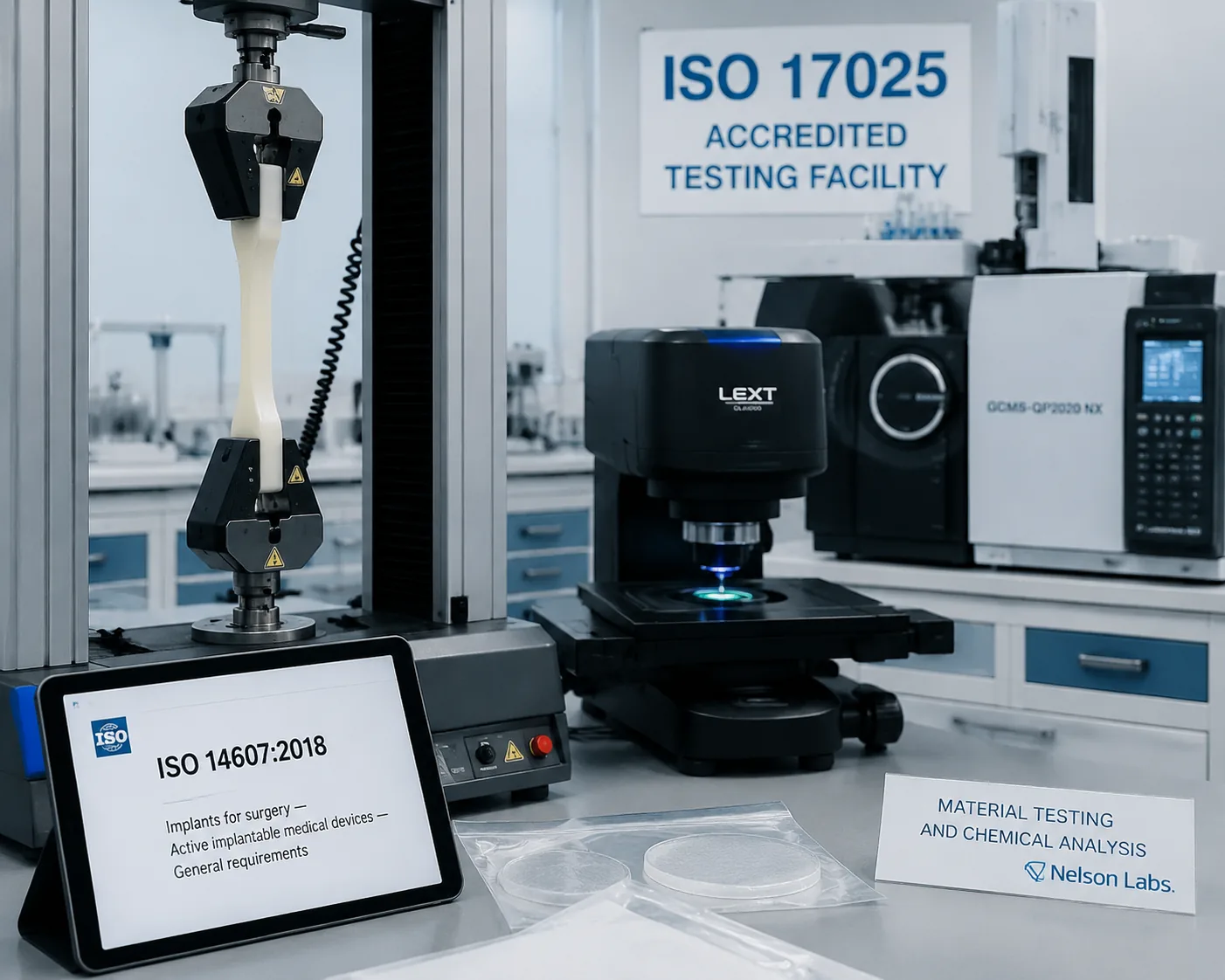
A modern silicone breast implant is a single-lumen silicone elastomer shell filled with cross-linked silicone gel, manufactured under controls that include shell mandrel-imprinting for surface topography, a low-diffusion barrier layer with blue pigment, optional embedded microtransponder for post-operative identification, ethylene-oxide or gamma sterilisation, and double-barrier packaging. Each of these design choices is governed by a specific clause of ISO 14607:2024 (the international standard for mammary implants, 4th edition), tested by methods in the standard's Annexes B–J, and cross-referenced to the FDA Guidance "Saline, Silicone Gel, and Alternative Breast Implants" (2020), ASTM F703-22 (the US material specification), ISO 10993 series (biological evaluation), and in China YY/T 0647-2021 (the Chinese equivalent of ISO 14607) plus the NMPA Breast Implant Product Registration Review Guideline (2024 revision). A silicone implant placed on any major market without a complete type-test dossier against this stack is non-compliant and subject to recall.
The standard stack: ISO 14607, FDA, ASTM, YY/T 0647
A complete silicone implant testing project draws on a stack of international, US, and Chinese standards. The stack is unusually deep because the breast implant is one of the most regulatorily scrutinised medical-device categories in existence — every PMA submission since 1992 has been reviewed by an FDA advisory committee, every device has a mandated 10-year post-approval study, and the BIA-ALCL crisis of 2016–2019 led to textured-implant bans in France, Canada, and Australia that reshaped the standard.
| Family | Standard | Scope |
|---|---|---|
| ISO 14607:2024 (4th edition, December 2024) | Non-active surgical implants — Mammary implants — Specific requirements | The international mammary-implant standard; mechanical tests in Annexes B–J; surface classification; trace elements; biological evaluation; clinical evaluation |
| ISO 14630:2023 | Non-active surgical implants — general requirements | Level-1 standard; invoked by ISO 14607 |
| ISO 14949:2001/Amd 1:2016 | Implants for surgery — silicone elastomers — long-term implantation | The silicone-elastomer material standard, used by the shell manufacturer |
| ASTM F703-22 | Standard specification for implantable breast prostheses | US material specification; complements ISO 14607 |
| FDA Guidance | Saline, Silicone Gel, and Alternative Breast Implants (September 2020) | The FDA's device-specific guidance; calls for more robust fatigue testing than ISO 14607 |
| FDA Guidance | Use of International Standard ISO 10993-1 (September 2023) | The FDA's biological evaluation framework; applies to breast implants |
| ISO 10993 series | Biological evaluation of medical devices | Biocompatibility endpoints; ISO 10993-1 matrix drives the test battery |
| ISO/TS 10993-20:2006 | Immunotoxicology testing | FDA partially recognises (Annex C excluded) |
| USP <88> | Biological reactivity tests, in vivo (Class I–VI plastics) | US Pharmacopeia; complementary to ISO 10993 for the US market |
| YY/T 0647-2021 (China) | Non-active surgical implants — particular requirements for mammary implants | Identical adoption of ISO 14607; the Chinese mandatory standard |
| YY/T 0640 (China) | General requirements for non-active surgical implants | Level-1 Chinese standard; invoked by YY/T 0647 |
| GB/T 16886 series (China) | Biological evaluation of medical devices | The Chinese equivalent of ISO 10993 (21 parts) |
| NMPA Breast Implant Product Registration Review Guideline (2024 revision) | Technical review guidance for NMPA breast-implant registration | Issued by NMPA's Yangtze River Delta centre for medical-device evaluation |
The single most consequential fact for a Chinese manufacturer is that YY/T 0647-2021 is the Chinese mandatory equivalent of ISO 14607, and the NMPA 2024 revision of the registration review guideline has substantially tightened the technical review — requiring, in particular, the full mechanical Annex B–J test battery, the GB/T 16886 biological evaluation, and a Chinese-clinical-evidence package that was less rigorously enforced under the 2017 guideline.
ISO 14607:2024 (4th edition) — the eleven key changes
ISO 14607 was revised in December 2024, replacing the 3rd edition (2018). The 4th edition introduced eleven material changes, and a manufacturer holding a 3rd-edition type-test report must update to the 4th edition to maintain regulatory conformity in the EU and (under FDA's partial recognition) the US.
| # | Change | Clause/Annex |
|---|---|---|
| 1 | Trace elements subclause revised — tighter requirements on heavy metals and catalyst residues (Pt, Sn) measured by ICP-MS | 6.4 |
| 2 | Biological evaluation and risk-management language expanded in pre-clinical evaluation | 7.2.1 |
| 3 | "Contamination" subclause renamed to "particulate contamination" and completely revised — particles counted by microscopy and laser-particle-counter on the shell surface | 7.2.3.8 |
| 4 | Requirements regarding implantation studies added — local tissue response testing per ISO 10993-6 made normative | 7.2.5 |
| 5 | Clinical evaluation requirements expanded — longer follow-up, more patient-reported outcomes | 7.3 |
| 6 | Surface category added to label requirements — manufacturer must declare the roughness class on the label | 11.3 |
| 7 | Annex C (mechanical tests in implantable state) expanded and revised | Annex C |
| 8 | Fatigue resistance testing method (Annex C.1 and C.3) revised and expanded — clarified loading geometry and cycle count | Annex C.1, C.3 |
| 9 | Annex F (silicone gel penetration / diffusion) re-structured and language clarified | Annex F |
| 10 | Annex G (silicone diffusion in vitro) deleted — the test method was judged inadequate; replaced by chemical characterisation under ISO 10993-18 | (former) Annex G |
| 11 | (New) Annex G — Test for surface characteristics — promoted from informative to normative; surface roughness classes Macro / Micro / Smooth / SmoothSilk (4 µm) added | (new) Annex G |
| 11b | (New) Annex J — Tests for surface particulate contamination — newly added | Annex J |
The two most consequential changes for the test laboratory are the surface-characteristics classification (new normative Annex G) and the particulate-contamination test (new Annex J). The former forces every manufacturer to declare a roughness class on the label — directly relevant to the BIA-ALCL risk stratification, because the 4th edition formally recognises that the SmoothSilk/Smooth class (< 10 µm) carries a different (lower) BIA-ALCL risk than the Macro class (> 100 µm) that triggered the 2016–2019 recalls. The latter introduces, for the first time, a quantitative particle count on the finished sterile shell surface, addressing the concern that manufacturing debris (silicone flakes, pigment particles) could migrate to lymph nodes.
Mechanical testing per ISO 14607 Annex B–J
The mechanical test battery is defined in ISO 14607 Annexes B through J and is the engineering backbone of the silicone implant type test.
| Annex | Test | Method summary |
|---|---|---|
| B | Shell integrity — tensile strength, elongation, tensile set, tear resistance, strength of joints/seams/seals | ISO 37 / ISO 34-1 / ASTM D412 / ASTM D624 on shell dumbbell specimens; 5 specimens per test |
| C | Valve competence (saline implants) and injection-site competence (adjustable implants) | Pressure hold at 18 kPa above atmospheric for 1 h, no leakage |
| C.1 / C.3 | Fatigue resistance | See dedicated section below — ISO and FDA diverge |
| D | Silicone gel cohesion | Gel cohesivity index measured by gel-sample rheometry or by the shell-removal gel-flow test |
| E | Impact resistance and static rupture resistance | Drop a 500 g mass from 1 m onto the implant in a rigid fixture; record rupture; static load to rupture |
| F | Silicone gel penetration / diffusion (silicone-filled only) | Long-term incubator test in bathing fluid with sensitive analysis (GC-MS, LC-MS) |
| G (new normative) | Surface characteristics | Non-contact profilometry per ISO 21920-2; classification into Macro / Micro / Smooth / SmoothSilk (4 µm) classes |
| H | Silicone release assessment | Long-term silicone release rate in saline at 37 °C, weeks to months |
| J (new) | Particulate contamination | Microscopy and laser-particle-counter on the finished sterile shell surface |
The shell integrity tests (Annex B) are the most often re-run in the laboratory, because they are the first to flag a manufacturing drift in the shell cure. A drop in elongation below the 400 % typical for a medical-grade silicone elastomer indicates over-cure; a rise in tear-strength variability indicates cure non-uniformity. The cohesion test (Annex D) catches gel-formulation drift: a low cohesion index means the gel will flow on shell rupture, increasing extracapsular spread.
Fatigue testing: the ISO 2×10⁶ vs FDA 6.5×10⁶ divergence
The single most consequential difference between ISO 14607 and the FDA guidance is in the fatigue test cycle count and loading geometry. The two standards are not interchangeable, and a manufacturer targeting both markets must run both tests.
| Parameter | ISO 14607 (Annex C.1 / C.3) | FDA Guidance (Saline, Silicone Gel, and Alternative Breast Implants, 2020) |
|---|---|---|
| Cycle count | 2 × 10⁶ cycles (2 million) | 6.5 × 10⁶ cycles (6.5 million) — minimum, with additional testing to establish the failure point |
| Loading geometry | Implant compressed between two flat plates at preset thickness | No compression plates — a contoured fixture that mimics "real life" anatomical loading |
| Displacement | 40 mm total, fixed | Monitored continuously; either load or displacement held constant (the other measured) |
| Frequency | 3.3 Hz | Not specified; typically 2–4 Hz |
| Loading mode | Lateral shear | Compressive + shear combined |
| Output | Pass/fail at 2 × 10⁶ cycles | Endurance load curve — number of cycles to failure as a function of applied load; the Wöhler (S-N) curve of the implant |
| Pass criterion | No rupture at 2 × 10⁶ cycles | No rupture at 6.5 × 10⁶ cycles at the endurance load |
The FDA test is markedly more demanding on three counts: the cycle count is 3.25× higher; the contoured fixture (no flat plates) does not spread the load and concentrates stress at the implant pole, which is the most fatigue-prone location in clinical ruptures; and the requirement to generate an endurance-load curve means the laboratory must test multiple implants at multiple loads until each fails — typically 12–30 implants per design. A modern silicone implant of good design passes the FDA test with an endurance load that exceeds the worst-case in vivo compression by a safety factor of 3–5; a marginal design passes ISO and fails FDA.
Biocompatibility Testing per ISO 10993 and FDA breast-implant guidance
The biocompatibility evaluation is governed by the ISO 10993 series (international) and the GB/T 16886 series (Chinese equivalent), applied within the framework of ISO 10993-1 (or GB/T 16886.1) and the FDA guidance on its use. For a breast implant — long-term implant in contact with breast tissue, with cumulative exposure > 30 days — the ISO 10993-1 Annex A matrix triggers the full biocompatibility battery.
| Endpoint | Standard | Method summary |
|---|---|---|
| Cytotoxicity | ISO 10993-5 | L929 / Balb/3T3 fibroblast extract elution, 70 % viability criterion |
| Sensitisation | ISO 10993-10 | Guinea pig maximisation test (GPMT) or LLNA |
| Irritation | ISO 10993-23 | In vitro RhE (reconstructed human epidermis), 50 % viability criterion |
| Systemic toxicity (acute / subacute / subchronic / chronic) | ISO 10993-11 | Mouse / rat extracts (polar and non-polar) by IV and IP routes |
| Genotoxicity | ISO 10993-3 | Ames (OECD TG 471 / GB 15193.4), in vitro chromosomal aberration in CHO cells, in vivo peripheral-blood micronucleus in mice |
| Carcinogenicity | ISO 10993-3 | Tg.rasH2 transgenic mouse, 26-week subcutaneous implantation, histopathology of all major tissues |
| Reproductive / developmental toxicity | ISO 10993-3 | Triggered only for specific concerns |
| Local effects after implantation | ISO 10993-6 | Subcutaneous implant in rat or rabbit, 1–12 weeks, histopathology of capsule |
| Hemocompatibility | ISO 10993-4 | Triggered only if blood contact (not typical for breast implants) |
| Immunotoxicity | ISO/TS 10993-20 | 28-day rat implantation with peripheral-blood and spleen immunophenotyping (CD45, CD3, CD4, CD8, CD45RA, CD161a) |
| Chemical characterisation | ISO 10993-18 | Extractables and leachables by GC-MS, LC-MS, ICP-MS, HS-GC-MS |
| Toxicological risk assessment | ISO 10993-17 | Compound-specific and TSL-based (120 µg / 600 µg) |
The Mora-Leiva et al. study (Biomedical Systems, 2026) — the first published ISO 10993 dataset for a breast implant — provides the template for this evaluation. It reports negative results across Ames (5 strains TA98/TA100/TA1535/TA1537/WP2uvrA), chromosomal aberration in CHO cells, peripheral-blood micronucleus in mice, a 26-week Tg.rasH2 carcinogenicity study with 30 animals per group, and a 28-day immunotoxicity study with peripheral-blood and spleen immunophenotyping — all conducted under GLP in independent accredited laboratories. The genotoxicity Ames test within this battery links directly to our dedicated Ames test article.
Silicone gel diffusion, low-molecular-weight siloxanes, and metal residues
The chemical-characterisation piece of the evaluation (ISO 10993-18) is where the silicone implant differs most from other long-term implants. The silicone elastomer shell and the silicone gel filler are both polydimethylsiloxane (PDMS) networks containing residual low-molecular-weight cyclic siloxanes — D3, D4, D5, D6 (hexamethylcyclotrisiloxane, octamethylcyclotetrasiloxane, decamethylcyclopentasiloxane, dodecamethylcyclohexasiloxane) — and platinum from the Speier catalyst used in the cure, plus tin from any dibutyltin dilaurate cure accelerator.
| Analyte | Source | Method | Typical limit |
|---|---|---|---|
| D3, D4, D5, D6 cyclic siloxanes | Incomplete cure; residual monomer in PDMS | HS-GC-MS or GC-MS of the implant extract | Per ISO 14607 Annex F (diffusion rate reported) |
| Platinum (Pt) | Speier catalyst (chloroplatinic acid) | ICP-MS of the extract, sub-ppb detection limit | Per ISO 14607 trace elements clause 6.4 |
| Tin (Sn) | Dibutyltin dilaurate cure accelerator | ICP-MS | Per ISO 14607 trace elements clause 6.4 |
| Zinc, iron, lead | Pigment, manufacturing contamination | ICP-MS multi-element screen | Per ISO 14607 trace elements clause 6.4 |
| Benzene, toluene, xylene | Residual solvents | HS-GC-MS | Per ISO 10993-18 |
| Silicone oil (PDMS) gel bleed | Diffusion through intact shell | Annex F — long-term incubator test, GC-MS of bathing fluid | Diffusion rate reported |
The gel-diffusion test (Annex F) is the long-duration chemical test of the silicone implant evaluation: the intact implant is incubated in a simulated body fluid at 37 °C for weeks to months, and the bathing fluid is analysed at intervals by GC-MS for silicon-containing species. A well-designed shell with a low-diffusion barrier layer reduces the gel bleed by 1–2 orders of magnitude relative to a legacy single-layer shell — a key design verification point that the 4th-edition Annex F test was revised to capture more rigorously.
Surface characteristics and the 4 µm roughness class
The 4th-edition promotion of the surface-characteristics test (new normative Annex G) is the regulatory response to the BIA-ALCL crisis. The classification is by average surface roughness measured by non-contact profilometry per ISO 21920-2:
| Class | Average roughness | BIA-ALCL risk |
|---|---|---|
| Macrotextured | > 100 µm | Highest — majority of BIA-ALCL cases; banned in FR / CA / AU for many brands |
| Microtextured | 10–100 µm | Intermediate |
| Smooth | < 10 µm | Lowest |
| SmoothSilk (or "SmoothSilk / NanoSmooth") | ~ 4 µm | Lowest — distinct class recognised in ISO 14607:2024 |
The 4 µm SmoothSilk class, distinct from the < 10 µm Smooth class, is the design response to BIA-ALCL: the surface is rough enough to avoid the displacement problems of pure smooth shells but smooth enough to avoid the chronic inflammation, biofilm, and lymphoma association of macrotextured shells. ISO 14607:2024 requires the manufacturer to declare the surface class on the label (clause 11.3), and the laboratory verifies the declaration by non-contact profilometry on the finished sterile shell.
Particulate contamination (Annex J, new in 2024)
The newly added Annex J addresses the concern that manufacturing debris — silicone flakes from shell trimming, pigment particles from the blue barrier layer, fibres from packaging — could migrate from the finished implant to regional lymph nodes. The test methods are microscopy (optical or SEM) and laser-particle counting on the shell surface after sterile unpacking, with results reported as particle count per cm² and particle size distribution. The acceptance criteria are set against the manufacturer's risk-management file (ISO 14971); there is no universal numerical limit, but the trend is towards sub-100 particle/cm² on the finished sterile shell.
FDA 510(k) / PMA: the device-class-3 pathway and the IDSE 10-year core study
A silicone breast implant in the US is a Class 3 device under 21 CFR 878.3540 (silicone-gel-filled) or 878.3530 (saline-inflatable), product codes FTR and FWM respectively. The Class 3 designation means the device requires a Premarket Approval (PMA) application — not a 510(k) — and the PMA must include:
- The complete ISO 14607 Annex B–J mechanical test battery, run under the FDA's stricter fatigue protocol (6.5 × 10⁶ cycles, contoured fixture)
- The full ISO 10993 biocompatibility battery, with FDA's modifications (in vivo irritation per FDA guidance, not ISO 10993-23 in vitro)
- Chemical characterisation and toxicological risk assessment per ISO 10993-18 / 17
- A clinical evaluation — historically a prospective, multi-centre IDE study of typically 450–500 primary augmentation patients followed for 10 years (the "IDSE" — Investigational Device Exemption Study)
- The patient decision checklist required by FDA's 2020 guidance, signed by both patient and surgeon
- Labelling including the boxed warning, the patient brochure, and the surgeon's directions for use
The IDSE 10-year core study reports six primary complication endpoints by Kaplan-Meier risk rate at 5, 7, and 10 years:
| Complication | Typical risk rate at 5 years (modern implant) |
|---|---|
| Capsular contracture Baker III/IV | 0.5–10 % |
| Suspected or confirmed rupture | 0.6–8 % |
| Breast pain | 1.2–10 % |
| Infection | 0.9–5 % |
| Implant removal (with or without replacement) | 3.1–20 % |
| BIA-ALCL | 0 for SmoothSilk-class implants; up to 1:3000 for legacy Macrotextured |
The SmoothSilk-class implant's IDSE 5-year rates (capsular contracture 0.5 %, rupture 0.6 %, removal 3.1 %, BIA-ALCL 0 after 4 million implants) are the lowest in the published literature; the legacy Macrotextured implants' IDSE rates drove the regulatory action of 2016–2019.
NMPA breast-implant registration: YY/T 0647 and the 2024 review guideline
In China, a silicone breast implant is regulated by NMPA as a Class 3 implantable medical device. The technical file must satisfy:
- YY/T 0647-2021 — the Chinese equivalent of ISO 14607 (Annex B–J mechanical test battery)
- YY/T 0640 — general requirements for non-active surgical implants (Level-1)
- GB/T 16886 series — biological evaluation (equivalent to ISO 10993)
- NMPA Breast Implant Product Registration Review Guideline (2024 revision) — issued by NMPA's Yangtze River Delta centre for medical-device evaluation; tightened requirements on clinical evidence, post-market surveillance, and biocompatibility relative to the 2017 guideline
- GB/T 16886.1 risk-management-driven biological evaluation matrix
- A Chinese-clinical-evidence package — typically a prospective multi-centre trial in Chinese patients
The NMPA pathway is closed to foreign clinical evidence in the absence of an Asia-specific bridge study; a foreign manufacturer targeting China must either run a Chinese trial or accept substantial review delay. The CMA- and CNAS-accredited laboratory test reports on YY/T 0647 and GB/T 16886 form the technical core of the submission, and NMPA's reviewers specifically examine the Annex C fatigue data, the Annex G surface class, and the GB/T 16886.3 carcinogenicity and reproductive-toxicity results.
BIA-ALCL, BII, and the regulatory response
The BIA-ALCL crisis (breast implant-associated anaplastic large cell lymphoma) of 2016–2019 is the dominant regulatory driver of the current silicone implant testing landscape. The disease, a rare T-cell lymphoma arising in the periprosthetic capsule, is statistically associated with macrotextured implants (median time to onset 8 years post-implantation) and has driven:
- The 2018-2019 textured-implant recalls and bans in France (ANSM), Canada (Health Canada), and Australia (TGA)
- The 2020 FDA guidance update requiring the patient decision checklist and the boxed warning
- The EU MDR's stricter requirements on implantable devices, including the 10-year post-market clinical follow-up
- ISO 14607's 2024 promotion of surface characteristics to a normative Annex with class declaration on the label
The closely related "Breast Implant Illness" (BII) — a patient-coined term for systemic symptoms attributed to breast implants without a confirmed mechanism — is not yet a regulatorily defined disease, but it has driven the requirement for immunotoxicity testing (ISO/TS 10993-20) and for the long-term chemical characterisation that captures the low-molecular-weight siloxanes and catalyst residues. A silicone implant testing laboratory that can demonstrate a clean ISO 10993 / ISO 14607 dossier — including negative Tg.rasH2 carcinogenicity, negative immunophenotyping, and quantified low extractables — provides the manufacturer with the regulatory and reputational defensibility that the post-BIA-ALCL market demands.
FAQ
What is the difference between ISO 14607 and ASTM F703?
ISO 14607:2024 is the international standard for mammary implants, with the full Annex B–J mechanical test battery and surface-classification requirements. ASTM F703-22 is the US material specification for implantable breast prostheses, which complements ISO 14607 with material-level requirements on the silicone elastomer. A US submission invokes both; an EU or NMPA submission invokes ISO 14607 / YY/T 0647 alone.
What is the difference between ISO 14607:2018 (3rd edition) and ISO 14607:2024 (4th edition)?
The 4th edition introduced eleven material changes, the most consequential being: (a) promotion of surface characteristics to a normative Annex with class declaration on the label, (b) addition of the particulate-contamination test (Annex J), (c) revision of the fatigue-test method (Annex C.1 / C.3), (d) deletion of the in vitro silicone-diffusion Annex and replacement by ISO 10993-18 chemical characterisation, and (e) tightened trace-elements requirements. A type-test report to the 3rd edition must be updated.
How many fatigue cycles must a silicone breast implant survive?
Per ISO 14607 Annex C, the implant must survive 2 × 10⁶ cycles of lateral-shear loading between flat plates. Per the FDA guidance, the implant must survive 6.5 × 10⁶ cycles of compressive + shear loading in a contoured fixture (no flat plates), with an additional endurance-load curve generated by testing to failure. The two tests are not interchangeable.
Why is the surface roughness class declared on the label?
Because the BIA-ALCL risk is stratified by surface roughness. ISO 14607:2024 Annex G recognises four classes — Macrotextured (> 100 µm), Microtextured (10–100 µm), Smooth (< 10 µm), and SmoothSilk (4 µm) — and requires the manufacturer to declare the class on the label (clause 11.3) so that the surgeon and patient can make an informed choice.
Does NMPA accept an FDA PMA submission for a silicone breast implant?
Partially. NMPA requires the YY/T 0647 and GB/T 16886 test battery from a CMA/CNAS-accredited laboratory, a Chinese-clinical-evidence package (typically a prospective trial in Chinese patients), and conformity to the NMPA Breast Implant Product Registration Review Guideline (2024 revision). The FDA PMA dossier supports but does not replace the NMPA submission.
Our silicone implant testing capabilities
Beijing ZKGX Research (ISO/IEC 17025 accredited, CMA- and CNAS-accredited testing laboratory) provides complete silicone breast implant type testing against the international, US, and Chinese standard stack:
- ISO 14607:2024 (4th edition) Annex B–J mechanical battery — shell integrity (Annex B), valve and injection-site competence (Annex C), fatigue resistance (Annex C.1 / C.3, ISO 2 × 10⁶ protocol), gel cohesion (Annex D), impact and static rupture resistance (Annex E), gel penetration / diffusion (Annex F), surface characteristics by non-contact profilometry (new normative Annex G), silicone release assessment (Annex H), particulate contamination (new Annex J).
- FDA Saline, Silicone Gel, and Alternative Breast Implants Guidance — FDA-protocol fatigue testing at 6.5 × 10⁶ cycles in a contoured fixture, generating the endurance-load (S-N) curve; FDA-modified biological evaluation per the FDA's Use of ISO 10993-1 guidance; PMA documentation support.
- ASTM F703-22 material specification — complementing ISO 14607 for the US market.
- ISO 10993 / GB/T 16886 biocompatibility — cytotoxicity (ISO 10993-5), sensitisation (ISO 10993-10), irritation (ISO 10993-23 in vitro RhE + in vivo rabbit per FDA), systemic toxicity (ISO 10993-11), genotoxicity (ISO 10993-3, including Ames per OECD TG 471 / GB 15193.4), carcinogenicity (ISO 10993-3 Tg.rasH2 26-week), local effects after implantation (ISO 10993-6), immunotoxicity (ISO/TS 10993-20, 28-day immunophenotyping), chemical characterisation (ISO 10993-18), toxicological risk assessment (ISO 10993-17 TSL 120/600 µg).
- Trace-element and low-molecular-weight siloxane analysis — D3/D4/D5/D6 cyclic siloxanes by HS-GC-MS; Pt, Sn, Zn, Fe, Pb by ICP-MS; per ISO 14607 clause 6.4 trace elements.
- YY/T 0647-2021 / YY/T 0640 for NMPA registration, with full Chinese-clinical-evidence-package support and conformity to the NMPA Breast Implant Product Registration Review Guideline (2024 revision).
- Biological Evaluation Plan (BEP) and Biological Evaluation Report (BER) — written by qualified toxicologists, supporting FDA, EU MDR, and NMPA submissions.
Suitable product categories include: silicone-gel-filled breast implants (single and double lumen); saline-filled breast implants; structured / cohesive-gel implants; tissue expanders; testicular, pectoral, calf, and gluteal silicone implants. Each project is delivered with a full data report (test protocol, instrument calibration, raw measurement data, statistical analysis, classification conclusion, BEP/BER) in English and/or Chinese, with CMA/CNAS stamping, ready for direct submission to FDA, EU notified bodies, or NMPA. Contact Beijing ZKGX Research to scope the silicone implant type-test battery applicable to your device and target market.