Table of Contents
- What is biocompatibility testing?
- The standard families: ISO 10993, GB/T 16886, ISO 18562, USP, ICH M7
- How tests are selected: the contact-category × contact-duration matrix
- The Big Three baseline: cytotoxicity, sensitization, irritation
- Sample preparation per ISO 10993-12:2021
- Chemical characterization (ISO 10993-18) and toxicological risk assessment (ISO 10993-17)
- Additional endpoints: systemic toxicity, genotoxicity, hemocompatibility, implantation
- Breathing-gas-pathway devices: the ISO 18562 overlay
- Regulatory pathways: FDA, EU MDR, NMPA
- BEP, BER, and the documentation deliverables
- FAQ
- Our biocompatibility testing capabilities
What is biocompatibility testing?
Biocompatibility testing is the evaluation of whether a medical device — in its final finished form, including any sterilization, coatings, and manufacturing residues — produces an unacceptable adverse biological response when it contacts the human body. The evaluation is anchored in ISO 10993-1 (international) and its Chinese adoption GB/T 16886.1 (a 21-part series translated identically from ISO 10993), and is embedded in every major medical-device regulatory framework: FDA 510(k) and PMA in the US, EU Medical Device Regulation (MDR) 2017/745 in the European Union, and NMPA registration in China. A device with no direct or indirect tissue contact is exempt from biocompatibility testing; every other device must be evaluated against the standard's endpoint matrix, and the results must be documented in a defensible Biological Evaluation Report (BER).
The objective of biocompatibility testing is to demonstrate that the materials and manufacturing process of the device do not, through leachable chemical constituents or surface-contact effects, cause local or systemic harm to the patient or user. Local harm includes skin irritation, intracutaneous reactivity, and mucosal inflammation; systemic harm includes sensitisation, acute and chronic systemic toxicity, genotoxicity, carcinogenicity, reproductive and developmental toxicity, and pyrogenicity. Because biological risk cannot be eliminated by good design alone — well-characterised materials processed in a new way (a new sterilisation method, a new colourant, a new mould-release agent) can release unexpected compounds — biocompatibility testing is repeated whenever a design, material, supplier, sterilisation method, or manufacturing-site change could plausibly affect the device's biological safety profile.
The standard families: ISO 10993, GB/T 16886, ISO 18562, USP, ICH M7
A complete biocompatibility project draws on five interlocking standard families.
| Family | Core standards | Scope |
|---|---|---|
| ISO 10993 (international) | 20+ parts: -1 (general), -3 (genotox/carcinogenicity/reprotox), -4 (hemocompatibility), -5 (cytotoxicity), -6 (local effects after implantation), -7 (EO residuals), -10 (sensitisation/irritation), -11 (systemic toxicity), -12 (sample preparation), -16 (toxicokinetics), -17 (TRA), -18 (chemical characterisation), -23 (irritation, in vitro) | The full evaluation framework for any medical device |
| GB/T 16886 (China) | 21 parts, identical translation (IDT) of ISO 10993 | Mandatory for NMPA registration; published and enforced by NMPA through the Medical Device Biological Evaluation and Review Guidelines |
| ISO 18562:2024 (4 parts) | -1 (general), -2 (particulate emissions), -3 (VOC emissions), -4 (leachables in condensate) | Breathing-gas-pathway devices — ventilators, anaesthesia machines, respiratory masks, breathing circuits, nebulisers |
| USP <87>/<88> | <87> in vitro reactivity; <88> in vivo reactivity (Class I-VI plastics) | US Pharmacopeia plastics classification — historically used in US submissions, now largely subsumed by ISO 10993 but still requested for some device categories |
| ICH M7(R2) | DNA-reactive impurities in pharmaceuticals | Drug-device combination products; e.g. prefilled syringes, drug-eluting stents, inhalers — invoked alongside ISO 10993-17/-18 for the drug-contact pathway |
The single most consequential fact for a Chinese manufacturer is that GB/T 16886 is the NMPA-mandated equivalent of ISO 10993 — a test report issued against ISO 10993 is, for most endpoints, directly acceptable to NMPA if the laboratory holds the appropriate CMA and CNAS scope, but the documentation and translation conventions must follow the Medical Device Biological Evaluation and Review Guidelines (NMPA, 2007, in continuous use). A device placed on the Chinese market without a GB/T 16886-based biocompatibility evaluation is not registered.
How tests are selected: the contact-category × contact-duration matrix
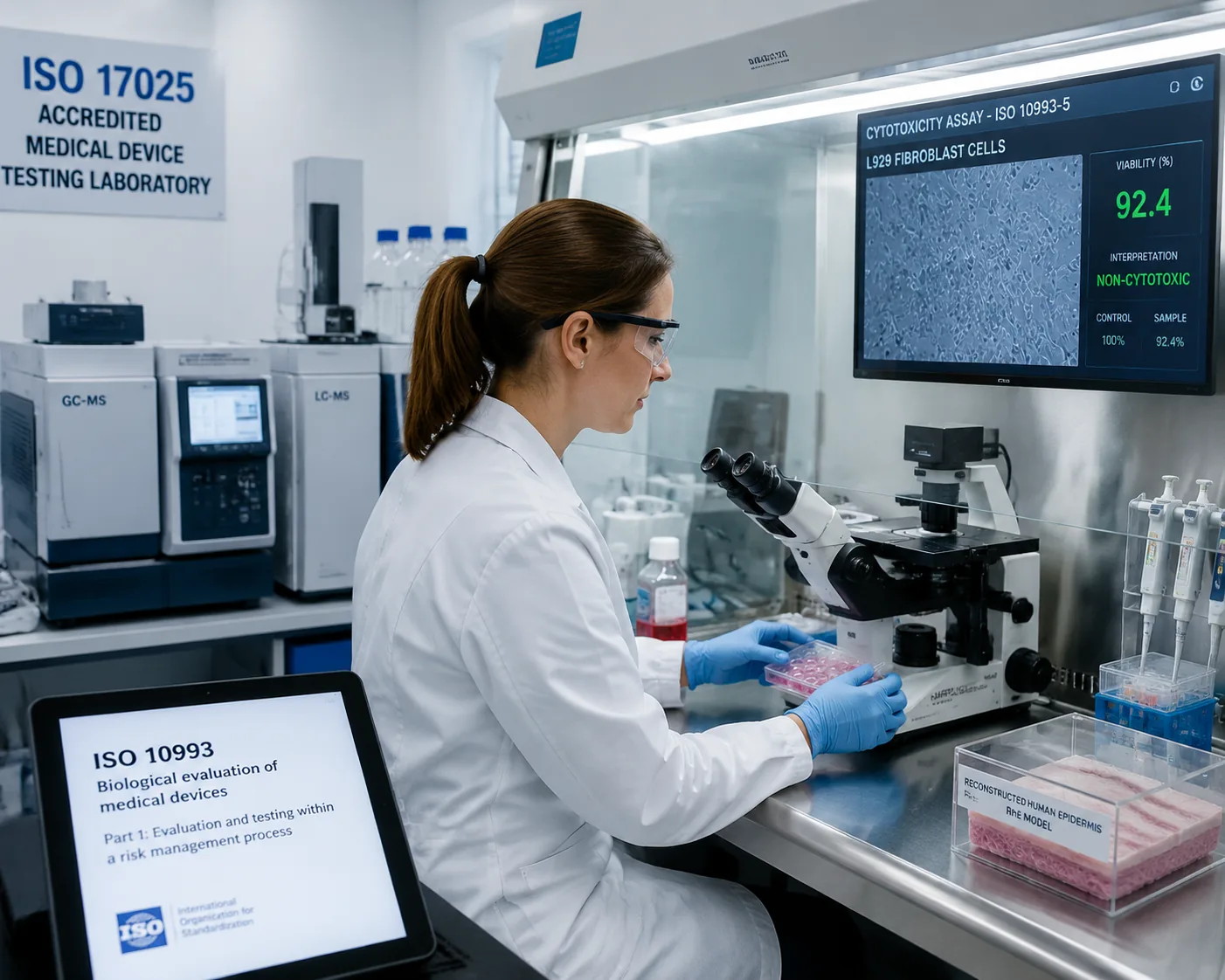
ISO 10993-1:2018 Annex A (and the equivalent table in GB/T 16886.1) defines the test-selection matrix. The device is classified by two axes — nature of body contact and duration of contact — and the matrix returns the list of biological endpoints that must be evaluated.
Nature of body contact (three categories):
| Category | Sub-categories | Typical devices |
|---|---|---|
| Surface-contacting | Skin; mucosal membrane; breached or compromised surface | Electrodes, compression bandages, surgical gloves, wound dressings, urinary catheters, dental impression materials |
| External-communication (indirect contact / tissue communicating / circulating blood) | Blood path (indirect); tissue/bone/dentin communicating; circulating blood | IV infusion sets, dialysers, blood oxygenators, laparoscopes, dental fillings, endoscopes, guidewires |
| Implanted | Tissue/bone; blood | Orthopaedic implants, cardiac stents, intraocular lenses, pacemaker leads, vascular grafts |
Duration of contact (three bands):
| Duration | Definition |
|---|---|
| Limited | ≤ 24 h cumulative exposure |
| Prolonged | 24 h to 30 days cumulative |
| Permanent (long-term) | > 30 days cumulative |
Crossing the two axes returns a 9-cell matrix, and ISO 10993-1 Annex A marks each cell with the endpoints to be considered: ● (required) or ○ (to be considered based on risk). As the contact duration lengthens and as the contact moves deeper into the body (surface → external communication → implant), the number of required endpoints rises. A surface-contact, limited-duration device (e.g. a surgical glove) needs only the Big Three (cytotoxicity, sensitisation, irritation); a permanent-circulating-blood implant (e.g. a cardiac stent) needs the full battery — cytotoxicity, sensitisation, irritation, systemic toxicity, material-mediated pyrogenicity, genotoxicity, implantation effects, hemocompatibility, and (considered) carcinogenicity. The 2025 revision of ISO 10993-1 moved from the single Annex A matrix to a more risk-based selection rationale, but the underlying categorisation logic is unchanged and the matrix remains the working reference in FDA, EU, and NMPA submissions.
The Big Three baseline: cytotoxicity, sensitization, irritation
Three endpoints are required on almost every medical device that has body contact, regardless of category or duration. These are referred to as the "Big Three" and they are the non-negotiable starting battery of any biocompatibility evaluation.
| Endpoint | Standard | Method | Acceptance criterion |
|---|---|---|---|
| Cytotoxicity | ISO 10993-5:2009 | In vitro — extract elution into L929 or Balb/3T3 fibroblast culture; MTT, XTT, or neutral red uptake viability readout after 24 h | Cell viability ≥ 70 % of the control indicates non-cytotoxic |
| Sensitisation | ISO 10993-10:2021 | Guinea pig maximisation test (GPMT); Buehler test; or murine local lymph node assay (LLNA, ISO-recommended, but FDA still prefers GPMT for deep-tissue-contact devices) | No sensitisation response in the test group above the concurrent control |
| Irritation | ISO 10993-23:2021 | In vitro RhE (reconstructed human epidermis, EpiDerm / SkinEthic RHE) — preferred per ISO; 18–24 h extract exposure, MTT viability readout | Cell viability ≥ 50 % of the negative control indicates non-irritating |
The 2021 in vitro RhE irritation method (ISO 10993-23) is a significant advance over the older in vivo rabbit intracutaneous test of ISO 10993-10; a global round-robin validation study (De Jong et al., Toxicology In Vitro 2018) demonstrated that the RhE models predict medical-device extract irritation with sensitivity and specificity matching or exceeding the rabbit test. The US FDA, however, does not recognise the in vitro sections of ISO 10993-23 and still requires the in vivo rabbit intracutaneous test for FDA submissions; devices heading for both EU and US markets therefore often run both methods in parallel until FDA recognition is updated. The same divergence exists for sensitisation — ISO 10993-10:2021 Annex C lists eleven in chemico and in vitro assays (DPRA, KeratinoSens, h-CLAT, etc., per OECD TG 442C/D/E) that the EU increasingly accepts in a weight-of-evidence approach, but FDA still requires GPMT for most device classes.
Sample preparation per ISO 10993-12:2021
Most biocompatibility tests are performed not on the device itself but on extracts of the device — liquid vehicles (polar and non-polar) into which the device's leachable constituents are extracted under standardised conditions, and which are then applied to the biological test system. ISO 10993-12:2021 defines the extraction parameters, and getting them right is the single most common source of cross-laboratory variability.
| Parameter | Standard requirement |
|---|---|
| Surface-area-to-volume ratio | 50 cm²/mL for materials > 0.5 mm thick; 6 cm²/mL for materials < 0.5 mm thick; 1 g per 10 mL for irregular solids; whole device for finished devices with no defined surface area |
| Polar vehicle | 生理盐水 (0.9 % NaCl) or serum-supplemented cell culture medium (MEM + 10 % FBS) |
| Non-polar vehicle | vegetable oil (e.g. sesame, cottonseed) |
| Extraction temperature × time (standard) | 37 ± 1 °C for 72 h (mild, most common) or 50 ± 2 °C for 72 h or 70 ± 2 °C for 24 h or 121 ± 2 °C for 1 h (aggressive) |
| Static vs. dynamic extraction | Static is the default; dynamic (agitation, flow) is used where the device geometry warrants |
The choice of extraction condition (mild 37 °C/72 h vs. aggressive 121 °C/1 h) is risk-based and is documented in the Biological Evaluation Plan: an exaggerated condition is used for an extractables-and-leachables screen (ISO 10993-18), while a simulated-use condition is used for the biocompatibility endpoint tests (cytotoxicity, sensitisation, irritation). Extracts prepared with the wrong surface-area ratio, the wrong vehicle, or the wrong temperature produce test results that are not comparable to historical data and that fail regulatory review.
Chemical characterization (ISO 10993-18) and toxicological risk assessment (ISO 10993-17)
For most modern medical devices the heaviest single piece of the biocompatibility evaluation is not an animal test but a chemical characterization + toxicological risk assessment pair. The premise is that the biological risk of a device is, in most cases, the risk of the chemical constituents that leach out of it; if those constituents can be identified and their release rates measured, their risk can be assessed against toxicological thresholds without recourse to additional animal testing.
ISO 10993-18:2020 defines the chemical characterization. Extractables and leachables are analysed by chromatographic and spectroscopic methods — GC-MS for volatile and semi-volatile organics, LC-MS for non-volatile and polar organics, ICP-MS for inorganics and metals, HS-GC-MS for residual volatiles — and reported as a list of identified compounds with their concentrations. Three extraction conditions are typically run in parallel:
- Simulated-use extraction — at body temperature, in a clinically representative vehicle, for the clinical exposure duration; produces the leachables profile.
- Exaggerated extraction — at elevated temperature or in a strong solvent; produces the extractables profile that bounds the worst-case release.
- Exhaustive extraction — repeated extractions until the released mass converges; used to characterise degradation over the device lifetime.
ISO 10993-17:2023 defines the toxicological risk assessment (TRA) that is performed on the ISO 10993-18 compound list. Each identified constituent is compared against compound-specific toxicity data where available (cancer slope factors, reference doses, NOAELs) and against the Toxicological Screening Limit (TSL) where compound-specific data are absent. The 2023 revision introduced the TSL concept, derived from the 1.5 µg/day Threshold of Toxicological Concern (TTC) borrowed from ICH M7(R2) (Cramer Class III):
| Exposure duration | Toxicological Screening Limit (TSL) |
|---|---|
| Short-term exposure (≤ 30 days cumulative) | 120 µg |
| Long-term exposure (> 30 days cumulative) | 600 µg |
A constituent whose cumulative release falls below the TSL is judged to pose negligible toxicological risk and is removed from further evaluation; a constituent above the TSL requires a compound-specific risk assessment against its own reference dose. This TSL screen dramatically shortens the TRA for devices with dozens of identified extractables, and is one of the most practically useful changes in the 2023 revision.
Additional endpoints: systemic toxicity, genotoxicity, hemocompatibility, implantation
Beyond the Big Three, the ISO 10993-1 Annex A matrix triggers additional endpoints for devices with deeper tissue contact or longer duration.
| Endpoint | Standard | Method summary |
|---|---|---|
| Acute / subacute / subchronic / chronic systemic toxicity | ISO 10993-11:2017 | Device extracts (polar and non-polar) administered to mice or rats by intravenous and intraperitoneal routes; clinical observation, body weight, gross necropsy; duration matched to clinical exposure (acute = 24 h; subacute = 14–28 d; subchronic = 90 d; chronic = 6–12 months) |
| Genotoxicity | ISO 10993-3:2014 | Bacterial reverse mutation (Ames, per OECD TG 471 / GB 15193.4); in vitro mammalian chromosomal aberration or mouse lymphoma assay (MLA); in vivo micronucleus in rodent hematopoietic cells. A positive in any one assay blocks the submission. |
| Hemocompatibility | ISO 10993-4:2017 | For blood-contacting devices: thrombosis, thromboembolism, coagulation (PT, aPTT), platelets (count, activation, aggregation), hematology (hemolysis index), complement activation |
| Local effects after implantation | ISO 10993-6:2016 | Implant in muscle, subcutaneous tissue, or bone in rodent or rabbit; macroscopic and histopathological evaluation at 1, 4, 12, 26, or 52 weeks vs. control material |
| Carcinogenicity (rarely required) | ISO 10993-3 | Chronic rodent bioassay; only triggered for specific concerns, generally not for routine medical devices |
| Reproductive / developmental toxicity | ISO 10993-3 | Only triggered for devices used in pregnant women or devices with known reproductive-active constituents |
| EO sterilisation residuals | ISO 10993-7:2008 | EO ≤ 4 mg, ECH ≤ 9 mg for limited exposure; lower limits for prolonged and permanent contact |
The genotoxicity battery within this group links directly to the Ames test — ISO 10993-3 mandates a bacterial reverse mutation assay conducted per OECD TG 471 (or GB 15193.4 for the Chinese market), with the five-strain Salmonella + E. coli panel, ±S9 metabolic activation, and the three-criterion (≥2× fold increase, dose-related trend, reproducibility) judgement we describe in our dedicated Ames test article.
Breathing-gas-pathway devices: the ISO 18562 overlay
Devices whose gas pathway delivers breathing gas to the patient — ventilators, anaesthesia machines, CPAP/BiPAP devices, respiratory masks, breathing circuits, oxygen conservers, nebulisers, inhalers — are evaluated against an additional biocompatibility framework that ISO 10993 alone does not adequately cover. The ISO 18562:2024 series (four parts) addresses the specific risks of the breathing-gas pathway, where the patient is exposed not by direct tissue contact but by inhaling substances released into the gas stream over hours to years of use.
| Part | Scope | Method |
|---|---|---|
| ISO 18562-1 | General principles — risk management framework, applies to the gas pathway only | — |
| ISO 18562-2 | Particulate matter emissions | Particle count in the gas stream by laser particle counter; size-resolved mass calculation; ≤ 12 µg/m³ (coarse) + ≤ 1.5 µg/m³ (ultrafine) typical limits |
| ISO 18562-3 | Volatile organic compound (VOC and SVOC) emissions | VOC collected on sorbent tubes, desorbed and analysed by TD-GC-MS; cumulative inhaled dose compared to TTC |
| ISO 18562-4 | Leachables in condensate | Condensate collected from the gas pathway under simulated-use conditions; analysed by GC-MS, LC-MS, ICP-MS; cumulative dose compared to compound-specific limits or TTC |
ISO 18562 is additive to ISO 10993 — a ventilator with a blood-contacting sensor is evaluated against ISO 10993 (for the blood contact) and ISO 18562 (for the gas pathway). The 2024 revision tightened the particle emission limits in Part 2 and added the SVOC scope to Part 3, aligning with the 2022 EU MDR implementation deadline for breathing-gas devices.
Regulatory pathways: FDA, EU MDR, NMPA
The biocompatibility evaluation is required by every major regulator, but each regulator applies the standard stack with its own deviations.
| Regulator | Framework | Key requirements |
|---|---|---|
| FDA (US) | Guidance for Industry: Use of International Standard ISO 10993-1 (2023) | FDA-modified Annex A matrix; FDA still requires in vivo rabbit intracutaneous test for irritation (does not recognise ISO 10993-23 in vitro); FDA prefers GPMT for sensitisation of deep-tissue devices (does not fully recognise ISO 10993-10 in vitro); Attachment G allows literature-only justification for some intact-skin devices |
| EU MDR 2017/745 | ISO 10993 series + ISO 18562 series, EU harmonised | Notified bodies expect ISO 10993-23 in vitro RhE for irritation (Europe accepts in vitro); Annex C of ISO 10993-10:2021 in vitro sensitisation methods accepted in weight-of-evidence; COMPLIANCE with REACH SVHC and CMR restrictions additionally required |
| NMPA (China) | GB/T 16886 series (21 parts, IDT ISO 10993) + NMPA Medical Device Biological Evaluation and Review Guidelines (2007) + GB/T 16886.1 matrix | CMA + CNAS accredited laboratory test report; in vitro and in vivo methods both accepted; NMPA-specific documentation in Chinese; for some device classes NMPA adds Chinese national-type examination on top of GB/T 16886 |
The practical consequence of this divergence is that a single device heading for all three markets may need three biocompatibility test sets: an FDA set (including in vivo rabbit irritation, GPMT sensitisation, FDA-modified matrix), an EU set (with in vitro RhE irritation, weight-of-evidence sensitisation), and a NMPA set (under GB/T 16886 with CMA/CNAS reports). A test laboratory that can produce a single consolidated dossier, with parallel in vitro and in vivo data and the regulatory-specific documentation for each market, eliminates the duplication that drives most of the cost and timeline of multi-market biocompatibility.
BEP, BER, and the documentation deliverables
The biocompatibility evaluation is not a set of test reports — it is a structured, written evaluation documented in two deliverables.
Biological Evaluation Plan (BEP). The BEP is the initial risk assessment, written befOre testing begins. It records the device description, the materials, the manufacturing process, the sterilisation method, the body-contact category and duration (per ISO 10993-1 Annex A), the resulting list of biological endpoints to be evaluated, the rationale for any endpoint waived on the basis of existing data, the test methods selected, and the acceptance criteria. ISO 10993-1 clause 4 requires the BEP to be "planned, carried out, and documented by knowledgeable and experienced professionals"; FDA pre-submission meetings typically use the BEP as the discussion document.
Biological Evaluation Report (BER). The BER is the post-test deliverable, written after all the test reports and toxicological risk assessments are complete. Per ISO 10993-1:2018 clause 7, the BER documents: the evaluation strategy and planned content; the criteria for determining material acceptability; the adequacy of material characterisation; the rationale for selection or waiving of tests; the interpretation of existing data and test results; the need for any additional data; and the overall biological safety conclusions for the device. The BER is the document submitted to the regulator (FDA 510(k) package, EU MDR technical documentation, NMPA registration dossier); the underlying test reports are appendices to the BER.
A device manufacturer with a weak BEP ends up running tests that are not needed, missing tests that are needed, or having to re-run tests after a pre-submission discussion reveals gaps; a weak BER is the most common cause of a regulator's request for additional information (FDA "AI letter") or a notified body's non-conformity finding. Both deliverables should be produced by qualified toxicologists or biocompatibility experts, with the test laboratory as a collaborating partner.
FAQ
What is biocompatibility testing and when is it required?
Biocompatibility testing is the evaluation of whether a medical device in its final finished form produces an unacceptable adverse biological response when it contacts the human body. It is required for any device with direct or indirect tissue contact; devices with no tissue contact (e.g. standalone software, external analytical instruments) are exempt.
What is the difference between ISO 10993 and GB/T 16886?
GB/T 16886 is the Chinese national standard that identically translates (IDT) ISO 10993 — the 21 GB/T 16886 parts correspond, one-to-one, to the ISO 10993 parts. A test report against one is, for most endpoints, directly acceptable against the other; NMPA mandates GB/T 16886 in its Medical Device Biological Evaluation and Review Guidelines.
What are the Big Three biocompatibility tests?
Cytotoxicity (ISO 10993-5), sensitisation (ISO 10993-10), and irritation (ISO 10993-23). These three are required on almost every device with body contact regardless of category or duration. Cytotoxicity passes at ≥ 70 % cell viability; the in vitro RhE irritation test passes at ≥ 50 % cell viability of the negative control.
What is the ISO 10993-17 Toxicological Screening Limit?
The 2023 revision of ISO 10993-17 introduced the Toxicological Screening Limit (TSL), derived from the 1.5 µg/day Threshold of Toxicological Concern: 120 µg for ≤ 30-day cumulative exposure and 600 µg for > 30-day cumulative exposure. Constituents released below the TSL are judged to pose negligible toxicological risk and require no compound-specific risk assessment.
Does FDA accept the ISO 10993-23 in vitro irritation test?
Not yet. FDA still requires the in vivo rabbit intracutaneous test for most device classes, while EU notified bodies accept (and increasingly expect) the in vitro RhE test per ISO 10993-23:2021. A device heading for both markets often runs both methods in parallel.
Our biocompatibility testing capabilities
Beijing ZKGX Research (ISO/IEC 17025 accredited, CMA- and CNAS-accredited testing laboratory) provides complete biocompatibility evaluation to ISO 10993, GB/T 16886 (the 21-part NMPA-mandated equivalent), ISO 18562:2024 (breathing-gas pathway), USP <87>/<88> (US Pharmacopeia plastics), and ICH M7(R2) (drug-device combination products) for medical devices destined for the FDA, EU MDR, and NMPA markets.
We deliver the full evaluation chain from a single laboratory:
- Biological Evaluation Plan (BEP) and Biological Evaluation Report (BER) — written by qualified toxicologists, addressing the device description, materials, contact category and duration per ISO 10993-1 Annex A, endpoint matrix, rationale for testing and waiving, acceptance criteria, and the consolidated safety conclusion.
- Big Three baseline — cytotoxicity (ISO 10993-5, 70 % viability criterion); sensitisation (ISO 10993-10:2021, GPMT / LLNA); irritation (ISO 10993-23:2021 in vitro RhE for EU + in vivo rabbit intracutaneous for FDA, run in parallel where the device targets both markets).
- Chemical characterisation (ISO 10993-18:2020) — extractables and leachables by GC-MS, LC-MS, ICP-MS, HS-GC-MS under simulated-use, exaggerated, and exhaustive extraction conditions per ISO 10993-12:2021.
- Toxicological risk assessment (ISO 10993-17:2023) — compound-specific and TSL-based (120 µg ≤ 30 d; 600 µg > 30 d), with the Johner/NAMSA-style structured report format.
- Additional endpoints — systemic toxicity (ISO 10993-11), genotoxicity (ISO 10993-3, including Ames per OECD TG 471 / GB 15193.4), hemocompatibility (ISO 10993-4), implantation with histopathology (ISO 10993-6), EO residuals (ISO 10993-7).
- Breathing-gas-pathway testing (ISO 18562:2024) — particulate emissions (-2), VOC emissions (-3), leachables in condensate (-4), for ventilators, anaesthesia machines, masks, circuits, and nebulisers.
- Sample preparation per ISO 10993-12:2021 — 50 cm²/mL or 6 cm²/mL surface-area ratio, polar (saline / serum-supplemented MEM) and non-polar (vegetable oil) vehicles, 37 °C/72 h to 121 °C/1 h extraction conditions, with full documentation of the choice rationale.
Suitable device categories include: surface-contacting devices (electrodes, dressings, gloves, wound-care); external-communication devices (infusion sets, dialysers, oxygenators, endoscopes, guidewires, dental materials); implanted devices (orthopaedic, cardiovascular, ophthalmic, dental implants); breathing-gas-pathway devices; and drug-device combination products. Each project is delivered with a full data report (BEP, raw data, statistical analysis, test reports, TRA, and consolidated BER) in English and/or Chinese, with CMA/CNAS stamping, ready for direct submission to FDA, EU notified bodies, or NMPA. Contact Beijing ZKGX Research to scope the biocompatibility evaluation applicable to your device and target market.