Titanium alloy testing encompasses a comprehensive range of evaluation methods used to assess the quality, reliability, and performance characteristics of titanium and titanium alloy products. These testing procedures are critical for ensuring product integrity in aerospace, medical, chemical processing, marine, and other demanding applications where titanium's unique properties provide essential advantages.
This comprehensive guide covers all major titanium alloy testing methodologies, from chemical composition verification to advanced non-destructive testing techniques. You'll learn how to evaluate mechanical properties, assess corrosion resistance, characterize microstructure, and ensure compliance with industry standards and specifications.
What you'll learn in this guide:
- Chemical composition analysis methods
- Mechanical property testing procedures
- Non-destructive testing (NDT) techniques
- Microstructural characterization
- Corrosion resistance evaluation
- Surface quality assessment
- Testing standards and specifications
- Quality control procedures
Importance of Titanium Alloy Testing
Testing titanium alloys serves critical functions across multiple high-performance industries.
Key benefits of titanium alloy testing:
Quality assurance: Comprehensive testing verifies that titanium products meet specified chemical, mechanical, and physical requirements for intended applications.
Safety verification: Testing ensures material integrity for critical applications in aerospace, medical implants, and pressure equipment where failure could have catastrophic consequences.
Process control: Regular testing during manufacturing ensures consistent product quality and identifies process deviations early in production.
Certification compliance: Testing provides documentation required for certification to aerospace, medical, and industrial quality management systems.
Material verification: Testing confirms material identity and prevents costly material substitution errors in supply chains.
Performance prediction: Testing enables prediction of service behavior and remaining useful life for titanium components.
Chemical Composition Analysis
Elemental Analysis Methods
Spectrometric Analysis:
Optical Emission Spectroscopy (OES):
- Rapid multi-element analysis
- Applicable to all titanium alloy grades
- Accuracy: typically ±0.01-0.05% for major elements
- Sample preparation: machined or ground surface
- Testing time: 1-3 minutes per sample
X-ray Fluorescence (XRF):
- Non-destructive elemental analysis
- Suitable for sorting and verification
- Limited detection for light elements (Al, V below typical detection limits)
- Portable units available for field use
- Testing time: 30 seconds to 2 minutes
inductively coupled plasma (ICP):
- High-precision trace element analysis
- Detection limits: ppm to ppb levels
- Required for impurity specification compliance
- Sample dissolution in HF-HNO₃ acids
- Testing time: 15-30 minutes per sample
Key Alloying Elements
Alpha stabilizers:
- Aluminum (Al): 3-6% in most alloys, provides strength and oxidation resistance
- Oxygen (O): 0.1-0.4% in commercial grades, interstitial strengthener
- Nitrogen (N): typically <0.05%, interstitial element
- Carbon (C): typically <0.08%, interstitial element
Beta stabilizers:
- Vanadium (V): 3-6% in Ti-6Al-4V, primary beta stabilizer
- Molybdenum (Mo): 2-8% in various alloys, beta stabilizer and strengthener
- Iron (Fe): 0.25-2%, beta stabilizer
- Chromium (Cr): 2-4%, beta stabilizer
Neutral elements:
- Tin (Sn): 2-5%, solid solution strengthener
- Zirconium (Zr): 2-6%, solid solution strengthener
Interstitial Elements Testing
Hydrogen Analysis:
- Critical due to hydrogen embrittlement risk
- Methods: inert gas fusion, vacuum hot extraction
- Typical limits: 0.015% (150 ppm) for most grades
- Lower limits (0.0125%) for aerospace applications
- Testing frequency: per heat or lot
Oxygen and Nitrogen Analysis:
- Inert gas fusion method
- Combustion in graphite crucible at high temperature
- Detection by infrared absorption or thermal conductivity
- Critical for mechanical property prediction
- Typical limits: O<0.20%, N<0.05% for Grade 5
Mechanical Property Testing
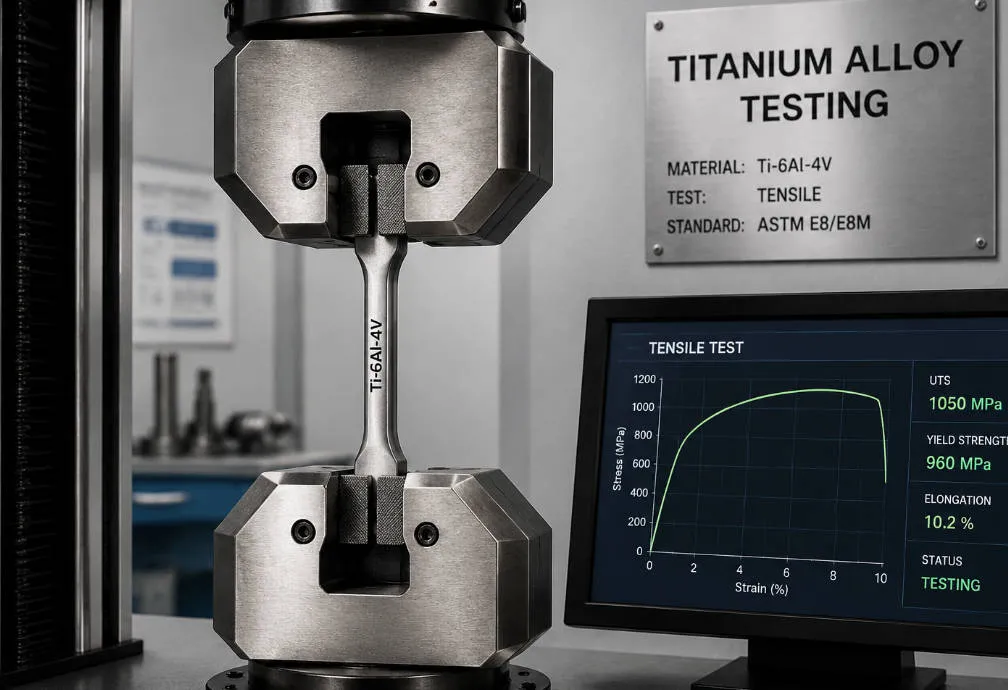
Tensile Testing
Test Method: ASTM E8/E8M, ASTM B557
Specimen Requirements:
- Standard rectangular or round specimens
- Gage length: 4D or 50mm standard
- Surface finish: 63 µin (1.6 µm) Ra or better
- No surface defects or stress concentrators
Test Parameters:
- Strain rate: 0.005-0.007 in/in/min through yield
- Temperature: room temperature (23±5°C)
- Extensometer required for accurate yield strength
- Digital data acquisition recommended
Measured Properties:
- Ultimate tensile strength (UTS)
- Yield strength (0.2% offset)
- Elongation (%)
- Reduction of area (%)
- Young's modulus (initial slope)
Typical Values for Ti-6Al-4V:
- UTS: 900-1100 MPa (130-160 ksi)
- Yield strength: 830-950 MPa (120-138 ksi)
- Elongation: 10-14%
- Reduction of area: 20-30%
Hardness Testing
Rockwell Hardness:
- Scale: HRC for heat-treated alloys
- Typical range: 30-40 HRC for Ti-6Al-4V
- Quick screening test for material verification
- Correlation with tensile strength possible
Vickers Hardness:
- HV scale for research and development
- Microhardness for phase identification
- Load: 500g to 30kg
- Suitable for thin sections and small parts
Brinell Hardness:
- HB scale for plate and bar products
- Ball diameter: 10mm
- Load: 3000 kgf
- Good for castings and thick sections
Impact Testing
Charpy Impact Test:
- ASTM E23, ASTM B771
- V-notch specimens (10x10x55mm)
- Temperature range: -255°C to +25°C
- Critical for cryogenic applications
- Ti-6Al-4V ELI: >20 Joules at -195°C
Fracture Toughness Testing:
- ASTM E399 (KIC)
- CTOD testing (ASTM E1290)
- J-integral testing (ASTM E1820)
- Critical for damage-tolerant design
- Ti-6Al-4V: KIC=55-85 MPa√m
Fatigue Testing
High Cycle Fatigue (HCF):
- ASTM E466
- R ratio: -1 (fully reversed) to 0.1 (tension-tension)
- Frequencies: 50-200 Hz typical
- Endurance limit: 500-700 MPa at 10⁷ cycles for Ti-6Al-4V
- Environment: air, seawater, or service-specific
Low Cycle Fatigue (LCF):
- ASTM E606
- Strain-controlled testing
- Critical for turbine engine components
- Plastic strain range measurement
- Coffin-Manson analysis for life prediction
Fatigue Crack Growth:
- ASTM E647
- da/dN vs. ΔK curves
- Paris law parameters determination
- Threshold ΔK determination
- Critical for damage tolerance analysis
Non-Destructive Testing (NDT)
Ultrasonic Testing (UT)
Applications:
- Detection of internal defects
- Measurement of wall thickness
- Detection of inclusions and porosity
- Bond integrity in claddings
Test Methods:
- Pulse-echo technique
- Immersion or contact methods
- Frequency: 5-15 MHz for fine-grained alloys
- Calibration blocks: Ti alloy reference standards
Acceptance Criteria:
- Typical flaw size: <0.8mm flat-bottom hole
- No indications exceeding reference level
- AMS 2631, ASTM E2375 specifications
Advantages:
- Detects subsurface defects
- High sensitivity for volumetric flaws
- Provides defect depth and size information
- Suitable for thick sections
Radiographic Testing (RT)
Applications:
- Detection of porosity, inclusions
- Verification of weld quality
- Internal configuration verification
- Casting inspection
Techniques:
- X-ray radiography
- Gamma radiography (Ir-192, Co-60)
- Digital radiography and CT scanning
- Film radiography with image quality indicators
Sensitivity:
- Typical: 2% thickness sensitivity
- Image quality indicators per ASTM E1746
- Exposure techniques per ASTM E94
Limitations:
- Cannot detect fine cracks perpendicular to beam
- Radiation safety requirements
- Cost and time compared to UT
Eddy Current Testing (ECT)
Applications:
- Surface and near-surface defect detection
- Conductivity measurement
- Material sorting and verification
- Coating thickness measurement
Techniques:
- Single-frequency or multi-frequency
- Absolute or differential probes
- Encircling coils for tubing
- Surface probes for plates and forgings
Advantages:
- Fast inspection speed
- No couplant required
- Automated scanning possible
- Good for production line inspection
Limitations:
- Limited penetration depth (few mm)
- Sensitive to surface roughness
- Requires reference standards
- Lift-off effects
Dye Penetrant Testing (PT)
Applications:
- Detection of surface-breaking defects
- Cracks, porosity, laps, seams
- Non-magnetic materials (including titanium)
- Weld inspection
Process Steps:
- Preclean surface thoroughly
- Apply penetrant (dwell time: 10-60 minutes)
- Remove excess penetrant
- Apply developer
- Inspect under appropriate lighting
Types:
- Type I: Fluorescent (UV light inspection)
- Type II: Visible (red dye, white developer)
- Sensitivity levels 1-4
Advantages:
- Simple, low-cost method
- Detects very fine surface cracks
- Applicable to complex geometries
- No special equipment needed
Limitations:
- Surface defects only
- Requires thorough cleaning
- Contamination risk in some applications
- Cannot determine defect depth
Magnetic Particle Testing (MT)
Not Applicable to Titanium: Titanium is non-magnetic, so magnetic particle testing cannot be used. Use dye penetrant or eddy current methods instead.
Visual Testing (VT)
Applications:
- Surface condition assessment
- Dimensional verification
- Weld appearance inspection
- Detection of gross defects
Equipment:
- Direct visual: unaided eye
- Magnification: 5-20X for detail examination
- Boroscopes for internal surfaces
- Video systems for documentation
Acceptance Criteria:
- No cracks, laps, or seams
- Surface finish per specification
- No excessive tool marks or scratches
- Color and oxidation within limits
Microstructural Characterization
Metallographic Sample Preparation
Sectioning:
- Abrasive cutting with adequate cooling
- Avoid thermal alteration of microstructure
- Slow feed rates with copious coolant
Mounting:
- Compression mounting in epoxy or acrylic
- Vacuum impregnation for porosity retention
- Conductive mounting for SEM analysis
Grinding and Polishing:
- Sequential grinding: 120-600 grit SiC paper
- Rough polishing: 6-9 µm diamond paste
- Fine polishing: 1-3 µm diamond paste
- Final polish: 0.05 µm colloidal silica
Etching:
- Kroll's reagent: 2% HF, 4% HNO₃, balance H₂O
- Etch time: 5-30 seconds
- Reveals alpha-beta structure
- Alternative: Weck's reagent for phase contrast
Microstructural Features
Alpha Phase:
- HCP crystal structure
- Light etching, equiaxed or elongated
- Present in all titanium alloys
- Provides good ductility and toughness
Beta Phase:
- BCC crystal structure
- Dark etching
- Retained at room temperature in alpha-beta and beta alloys
- Provides strength and heat treatability
Alpha-Beta Structure:
- Two-phase microstructure
- Volume fraction depends on composition and processing
- Processing temperature relative to beta transus determines morphology
- Equiaxed alpha in transformed beta matrix is typical
Widmanstätten Structure:
- Plate-like alpha in prior beta grains
- Formed on cooling from above beta transus
- Common in welds and castings
- Lower ductility but good fracture toughness
Grain Size Measurement
Methods:
- ASTM E112 intercept method
- Planimetric method
- Image analysis software
Significance:
- Affects mechanical properties
- Fine grains: higher strength, better formability
- Coarse grains: lower strength, better creep resistance
- Typical: ASTM 5-8 for wrought products
Phase Analysis
Quantitative Metallography:
- Volume fraction of alpha and beta phases
- Image analysis on multiple fields
- Statistical analysis for reliability
- Correlation with mechanical properties
X-ray Diffraction (XRD):
- Phase identification and quantification
- Texture analysis
- Residual stress measurement
- Lattice parameter determination
corrosion testing
General Corrosion Testing
Immersion Testing:
- ASTM G31 weight loss method
- Duration: 24 hours to 90+ days
- Temperature control: ambient to boiling
- Solution chemistry control
- Weight loss measurement and corrosion rate calculation
Electrochemical Testing:
- ASTM G59 potentiodynamic polarization
- ASTM G61 cyclic polarization
- Corrosion rate from Tafel extrapolation
- Pitting potential determination
- Repassivation potential measurement
Localized Corrosion Testing
Crevice Corrosion Testing:
- ASTM G78 multiple crevice assembly
- Duration: 30-90 days in chloride solutions
- Temperature: ambient to boiling
- Assessment: visual examination, weight loss
- Critical crevice temperature determination
Pitting Corrosion Testing:
- ASTM G48 ferric chloride test
- Critical pitting temperature (CPT) determination
- Pitting potential from electrochemical tests
- Statistical analysis of pit depth and density
Stress Corrosion Cracking (SCC) Testing
Constant Load Testing:
- ASTM G49
- Sustained load below yield strength
- Environment: chloride solutions, seawater
- Time to failure measurement
- Threshold stress determination
Slow Strain Rate Testing:
- ASTM G129
- Strain rate: 10⁻⁵ to 10⁻⁷ s⁻¹
- Comparison of ductility in air vs. environment
- SCC susceptibility index calculation
fracture mechanics Approach:
- Pre-cracked specimens (CT, DCB)
- KISCC threshold determination
- Crack growth rate measurement
- Environment: hot chloride brines, sour service
High-Temperature Oxidation Testing
Thermogravimetric Analysis (TGA):
- Continuous weight measurement
- Temperature: 400-800°C
- Duration: 100-1000 hours
- Oxidation rate determination
Alpha Case Formation:
- Oxygen diffusion at elevated temperature
- Hard, brittle surface layer
- Depth measurement by microhardness profile
- Typical limit: <0.025mm for aerospace components
Testing Standards and Specifications
ASTM Standards
Material Specifications:
- B265: Titanium and titanium alloy strip, sheet, and plate
- B348: Titanium and titanium alloy bars and billets
- B381: Titanium and titanium alloy forgings
- B861: Titanium and titanium alloy seamless pipe
- B862: Titanium and titanium alloy welded pipe
- B367: Titanium and titanium alloy castings
Test Methods:
- E8/E8M: Tension testing of metallic materials
- E23: Notched bar impact testing
- E399: Plane-strain fracture toughness
- E647: Fatigue crack growth measurement
- E8/E8M: Tensile testing
- G31: Laboratory immersion corrosion testing
AMS Specifications
Aerospace Material Specifications:
- AMS 4911: Ti-6Al-4V sheet, strip, and plate
- AMS 4928: Ti-6Al-4V bar, forging, and rings
- AMS 4967: Ti-6Al-4V ELI forgings
- AMS 2631: Ultrasonic inspection
- AMS 2249: Chemical check analysis
International Standards
ISO Standards:
- ISO 5832-3: Titanium 6-Al 4-V for surgical implants
- ISO 24034: Aerospace - Titanium alloys
- ISO 6892-1: Metallic materials - Tensile testing
European Standards:
- EN 2951: Titanium and titanium alloys - Test methods
- EN 2952: Titanium and titanium alloys - Technical delivery conditions
Quality Control Procedures
Incoming Material Testing
Visual Inspection:
- Surface condition and finish
- Dimensions and tolerances
- Marking and identification
- Damage during shipping
Chemical Verification:
- Mill test certificate review
- Spot check analysis (OES or XRF)
- Interstitial element verification
- Impurity element check
Mechanical Testing:
- Tensile testing per specification
- Hardness testing
- Charpy impact (if required)
- Verification against MTC values
In-Process Testing
Heat Treatment Verification:
- Temperature monitoring and recording
- Time at temperature compliance
- Quench rate measurement (if applicable)
- Furnace qualification records
Forming Operations:
- Dimensional checks
- Surface inspection
- Crack detection (PT or ET)
- Microstructure sampling
Welding Operations:
- Welder qualification
- Procedure qualification records
- Visual inspection
- NDT per applicable specification
Final Product Testing
Dimensional Verification:
- Critical dimensions measurement
- GD&T compliance
- Surface finish measurement
- Weight verification
Mechanical Property Verification:
- Tensile test from production lot
- Hardness survey
- Functional testing (if applicable)
- Conformance to drawing requirements
NDT Inspection:
- UT for internal defects
- PT or ET for surface defects
- RT for castings and welds
- Documentation and traceability
Common Testing Challenges
Hydrogen Pickup During Testing
Sources:
- Acid pickling operations
- Chemical milling
- Aqueous cleaning processes
- Service in hydrogen-containing environments
Detection:
- Inert gas fusion analysis
- Slow strain rate testing
- Fracture surface examination
Prevention:
- Control acid chemistry (HNO₃:HF ratio)
- Limit exposure times
- Post-processing vacuum degassing
- Bake-out at 600-700°C if required
Alpha Case Detection
Formation:
- High-temperature exposure (>600°C) in air
- Oxygen diffusion into surface
- Hard, brittle layer forms
Detection Methods:
- Microhardness traverse
- Metallographic examination
- Color change (yellow to blue)
- Weight gain measurement
Removal:
- Mechanical machining
- Chemical milling (HF-based)
- Electrochemical machining
- Verify complete removal before service
Weld Testing Challenges
Issues:
- Porosity detection
- Lack of fusion
- Contamination (oxygen pickup)
- Hardness variations
Testing Approach:
- Visual inspection
- Dye penetrant testing
- Radiography for volumetric defects
- Tensile testing of weld samples
- Microhardness survey
- Bend testing
Frequently Asked Questions
How often should titanium alloy products be tested?
Testing frequency depends on specification requirements and quality system controls. For mill products, testing per heat and per lot is typical. For critical aerospace applications, 100% NDT inspection may be required. Follow applicable specifications and customer requirements.
What is the most common NDT method for titanium?
Ultrasonic testing is the most common NDT method for titanium products due to its ability to detect internal defects and its applicability to various product forms. For surface defects, dye penetrant testing is most widely used since magnetic particle testing cannot be applied to non-magnetic titanium.
Why is hydrogen analysis critical for titanium?
Hydrogen embrittlement is a serious concern for titanium alloys. Hydrogen can cause delayed cracking, reduced ductility, and premature failure. Most specifications limit hydrogen content to 150 ppm or less. Hydrogen can be absorbed during processing (pickling, chemical milling) or service, making monitoring essential.
How is alpha case removed from titanium surfaces?
Alpha case (oxygen-enriched surface layer) is removed by mechanical machining, chemical milling in HF-based solutions, or electrochemical machining. Removal must be verified by metallographic examination or microhardness testing. The depth of removal depends on the severity of exposure but typically ranges from 0.025mm to 0.5mm.
What testing is required for medical implants?
Medical implants require extensive testing including chemical composition analysis, mechanical property testing (tensile, fatigue), microstructural characterization, corrosion testing (ISO 10993 biocompatibility), and surface analysis. Specifications include ASTM F136 (Ti-6Al-4V ELI) and ISO 5832-3.
Can titanium be tested using magnetic methods?
No. Titanium is non-magnetic (paramagnetic) and cannot be tested using magnetic particle inspection or magnetic-based methods. Use eddy current testing or dye penetrant testing for surface defect detection in titanium alloys.
Conclusion
Titanium alloy testing provides the essential data foundation for quality assurance, safety verification, and performance prediction of titanium products across critical industries. Comprehensive testing programs that include chemical analysis, mechanical testing, non-destructive examination, and corrosion evaluation ensure that titanium components will perform reliably in demanding service conditions.
Understanding testing methods, properly interpreting results, and applying this knowledge to quality control decisions enables manufacturers and users to realize the full potential of titanium's unique combination of high strength, low density, exceptional corrosion resistance, and biocompatibility.
Key takeaways:
- Chemical composition analysis verifies alloy identity and impurity control
- Mechanical testing confirms strength, ductility, and fracture properties
- NDT methods ensure defect-free products without material destruction
- Microstructural characterization predicts mechanical behavior
- Corrosion testing validates suitability for service environments
- Testing standards ensure consistency and acceptance across industries
- Quality control procedures maintain product integrity throughout manufacturing
The investment in proper testing methodology and equipment pays dividends through improved quality, reduced failures, enhanced safety, and customer confidence in titanium products for the most demanding applications.
Note: This article provides general guidance on titanium alloy testing methods. Always consult applicable specifications (ASTM, AMS, ISO), manufacturer data sheets, and customer requirements for detailed testing procedures and acceptance criteria. Reference sources include RMI Titanium Company's Titanium Alloy Guide and other authoritative technical publications.