What Does "Bisphenol A (BPA) Testing" Mean in a Laboratory?
Bisphenol A (BPA, CAS 80-05-7) is a high-volume industrial monomer used to make polycarbonate plastics and epoxy resins — the materials behind rigid water bottles, infant feeding bottles, and the internal lacquer lining of food and beverage cans. Residual unreacted BPA can migrate from these materials into food, beverages and drinking water, and because BPA is a known endocrine disruptor (classified SVHC under REACH for human-health and environmental endocrine-disrupting properties), its presence is regulated across food contact materials (FCMs), toys, cosmetics, thermal paper and drinking water. "BPA testing" in a laboratory is therefore not one assay but four distinct services, each answering a different question on a different matrix: specific migration testing (how much BPA transfers from an FCM into food under real use), residual content / "BPA-NI" verification (is a "BPA-free" product actually free of BPA, down to ppb/ppt?), biomonitoring (what is the human exposure, measured in urine?), and environmental water testing (is the BPA level at the tap below the limit?). The methods look related (most end in LC-MS/MS or HPLC-FLD), but the sample preparation, the detection limit and the acceptance criterion differ by an order of magnitude or more — and confusing the services produces an invalid report.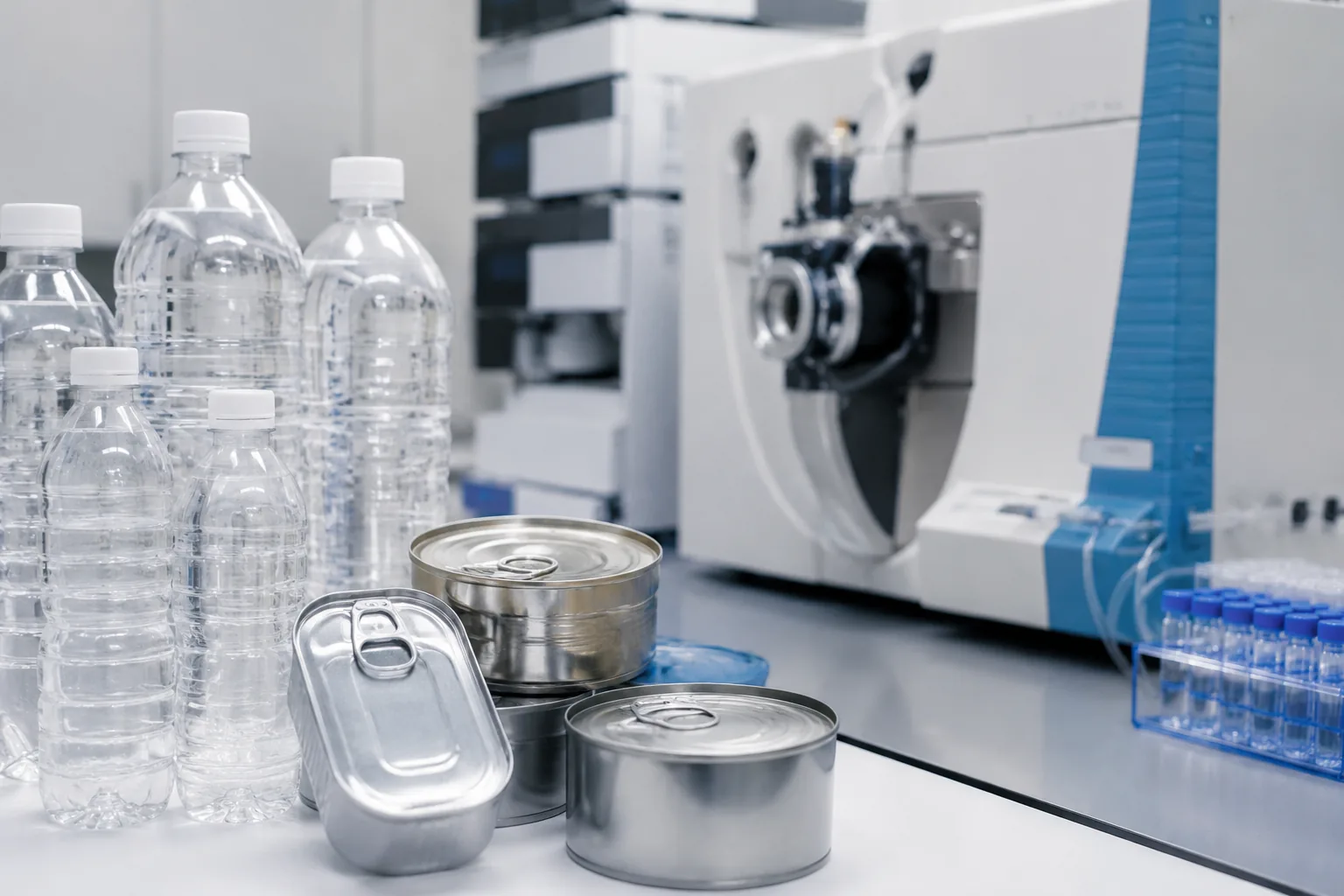
Why the BPA Regulatory Landscape Changed — and Why It Matters
The single most important shift in BPA testing over the last decade is the regulatory tightening driven by EFSA's 2023 re-evaluation and the EU ban. In April 2023, EFSA lowered the tolerable daily intake (TDI) from the temporary 4 µg/kg bw/day (2015) to 0.2 ng/kg bw/day — a 20,000-fold reduction — based on immune-system effects in mice. EFSA concluded that dietary exposure in all age groups exceeds the new TDI by hundreds to thousands of times. Following that, Commission Regulation (EU) 2024/3190 (in force January 2025) bans BPA in food contact materials, with narrow exemptions (polysulfone filtration membranes; heavy-duty epoxy varnishes) that still require no detectable migration, and the compliance method must reach a 1 µg/kg detection limit. The previous 0.05 mg/kg specific migration limit (SML) under Regulation (EU) 10/2011 still applies to transitional products on the market until 2026/2028. In China, GB 4806 sets a general BPA SML of 0.6 mg/kg, with infant FCMs requiring BPA "not detected", and the method standards are GB 31604.1 (migration test general) and GB 31604.54-2023 (BPF and BPS migration by LC-MS/MS). The practical consequence: a test report must cite the current regulation and reach the current detection limit — citing the old 0.05 mg/kg SML or an LOD of 10 ppb is now out of date for the EU market.
Why "BPA-Free" Is No Longer Enough — Regrettable Substitution
The second shift is that "BPA-free" no longer guarantees regulatory or commercial safety, because of regrettable substitution. As BPA was restricted, manufacturers switched to structural analogues — principally bisphenol S (BPS) and bisphenol F (BPF) — that carry the same endocrine-disrupting concerns. ECHA's 2022 group assessment recommended restricting > 30 bisphenols, and BPS was added to the REACH Candidate List as an SVHC in 2022. Under HBM4EU biomonitoring, BPS was detected in 67 % and BPF in 62 % of European adult urine. A modern BPA test program therefore cannot stop at BPA alone — a bisphenol panel (BPA + BPS + BPF, often extended to BPAF, BPB, BPZ and BADGE) is now the defensible scope, and the "BPA-NI" (BPA-Non-Intent) threshold demands detection at ppb/ppt to prove no BPA was intentionally used. A "BPA-Free" label is legally precarious if the product contains high BPS.
What Are the Analytical Methods — and When to Use Which?
Selecting the right instrumentation is critical for legal defensibility, because not all laboratories can reach the ultra-low detection limits now required:
| Method | Primary use case | Sensitivity (LOD) |
|---|---|---|
| LC-MS/MS | Gold standard for food/beverage migration, complex matrices, multi-analyte bisphenol panels | Ultra-trace (< 0.1 ppb) — required for EU 2024/3190 (1 µg/kg) and "BPA-NI" |
| GC-MS | Thermal paper, raw resin analysis; requires silylation derivatisation | High (1–10 ppb) |
| HPLC-FLD | Routine QC for materials with known higher concentrations (UV 230 nm / FL Ex 225 Em 310) | Moderate (> 10 ppb) |
| ELISA | Rapid screening of large liquid batches | Screening only — not defensible alone |
The LC-MS/MS is the gold standard because BPA at the new regulatory levels is in the low-ppt range, complex food matrices suppress the signal, and a single run can resolve BPA + BPS + BPF + BADGE simultaneously. HPLC-FLD (the Sigma drinking-water method: Ascentis Express C18, water:acetonitrile 60:40, FL Ex 225/Em 310, SPE concentration) remains valid for higher-level QC but cannot reach the EU 2024/3190 limit.
How Is Specific Migration Testing Performed?
Migration testing is mandatory for FCMs because proving a container is made from BPA-free resin is legally insufficient if BPA leaches from a secondary source (coating, adhesive, recycled fibre). The procedure:
- Food simulants — water, 3 % acetic acid, 10/20/50 % ethanol, or vegetable oil, selected per GB 31604.1 / EU 10/2011 to mimic the actual food type.
- Contact conditions — time and temperature chosen to simulate shelf life and consumer use (e.g. 10 days at 40 °C for long-term storage; microwave conditions; hot-fill).
- Analysis — the simulant is extracted (SPE), concentrated, and quantified by LC-MS/MS (or HPLC-FLD for higher levels).
- Result — specific migration in mg/kg food (or µg/kg), compared against the SML (0.6 mg/kg in China GB 4806; transitional 0.05 mg/kg in EU; "no detectable migration" at 1 µg/kg under EU 2024/3190).
Recycled paper and board is a special case — the German BfR recommends BPA + BPS testing (BPS migration limit 0.05 mg/kg; BPA "as low as reasonably achievable", 0.01 mg/kg under discussion) because recycled fibre carries contamination risk.
How Are Biomonitoring and Environmental Testing Performed?
- Biomonitoring (urine) — total BPA (free + conjugated metabolites) by LC-MS/MS after enzymatic deconjugation; reported in µg/L. HBM4EU detected BPA in 92 % of European adult urine, and with EFSA's new TDI translated to an HBM-GV of 11.5 ng/L, 71–100 % of national populations exceed it. The detection limit of current methods sits above the HBM-GV, so reported exceedances are minimum numbers.
- Drinking water — per EU Drinking Water Directive (EU) 2020/2184, BPA at the tap must be ≤ 2.5 µg/L; SPE + HPLC-FLD or LC-MS/MS on the water sample. The 12 January 2026 compliance date applies.
- Thermal paper — solvent extraction + GC-MS/LC-MS; the REACH limit is 0.02 % by weight (in force since 2020).
- Toys — migration limit 0.04 mg/L per the Toy Safety Directive, measured per EN 71-10/71-11.
What Belongs on the Report?
A compliant BPA test report states the service, the matrix, the method (and its LOD), the regulation referenced, and the result against the applicable limit — migration mg/kg vs SML (FCM); residual ppm/ppb vs BPA-NI (content); urinary µg/L vs HBM-GV (biomonitoring); water µg/L vs 2.5 µg/L (drinking water). The cardinal error is citing the old 0.05 mg/kg SML or an LOD that cannot reach the EU 2024/3190 1 µg/kg threshold.
For related services, see our Cosmetics testing and Health Food Testing for China SAMR.
FAQ
What is the current EU limit for BPA in food contact materials?
Commission Regulation (EU) 2024/3190 (in force January 2025) bans BPA in FCMs, with narrow exemptions that still require no detectable migration, and the compliance method must reach a 1 µg/kg detection limit. The previous 0.05 mg/kg SML (EU 10/2011) applies only to transitional products until 2026/2028. A report citing the old SML is out of date.
Why is "BPA-Free" no longer sufficient?
Because of regrettable substitution — manufacturers replaced BPA with BPS and BPF, which carry the same endocrine-disrupting concerns. ECHA recommends restricting > 30 bisphenols, and a "BPA-Free" product containing high BPS is legally precarious. A modern test program uses a bisphenol panel (BPA + BPS + BPF + BADGE), not BPA alone.
What method is required for BPA in food contact materials?
LC-MS/MS is the gold standard — it reaches the ultra-trace (< 0.1 ppb) detection needed for the EU 2024/3190 1 µg/kg limit and "BPA-NI" verification, and resolves BPA + BPS + BPF in one run. HPLC-FLD is valid for routine QC at higher levels but cannot reach the EU limit; GC-MS requires derivatisation and is used for thermal paper and raw resin.
What is the BPA limit in drinking water?
Under the EU Drinking Water Directive (EU) 2020/2184, BPA at the tap must be ≤ 2.5 µg/L, with the compliance date 12 January 2026. China's GB 4806 sets the FCM SML at 0.6 mg/kg (food), with infant FCMs requiring BPA "not detected".
How is BPA biomonitoring interpreted?
Urinary total BPA (free + metabolites, by LC-MS/MS after enzymatic deconjugation) is compared against the HBM-GV of 11.5 ng/L derived from EFSA's 2023 TDI of 0.2 ng/kg bw/day. HBM4EU found 92 % of European adults exceed it — but current method LODs sit above the HBM-GV, so reported exceedances are minimum numbers.
Our Testing Capabilities
As an ISO/IEC 17025-accredited third-party laboratory, Beijing ZKGX Research provides bisphenol testing across the four service families:
- Food contact material migration — specific migration to GB 31604.1 / GB 4806 (SML 0.6 mg/kg) and EU 10/2011 / EU 2024/3190 (1 µg/kg detection), by LC-MS/MS with food simulants (water, 3 % acetic acid, ethanol, vegetable oil) and full contact-condition simulation.
- Bisphenol panel + BPA-NI verification — BPA + BPS + BPF + BPAF + BADGE residual content and migration to GB 31604.54-2023, reaching ppb/ppt detection for "BPA-free" / BPA-NI claims and recycled-paper-and-board BPA+BPS (BfR XXXVI).
- Biomonitoring — total urinary BPA (and BPS/BPF) by LC-MS/MS after enzymatic deconjugation, against the HBM4EU HBM-GV.
- Environmental / drinking water — BPA in drinking water to EU 2020/2184 (2.5 µg/L) and environmental waters, by SPE + HPLC-FLD / LC-MS/MS.
- Consumer products — thermal paper (0.02 % REACH limit, GC-MS/LC-MS), toys (0.04 mg/L, EN 71-10/11), cosmetics (prohibited-substance trace).
Sample types include food and beverage packaging, can lacquers, polycarbonate products, infant feeding bottles, recycled paper and board, thermal paper, toys, cosmetics, drinking and environmental water, and clinical urine. If you have a specific matrix, regulatory target (EU 2024/3190 / EU 10/2011 / GB 4806 / GB 31604 / REACH / FDA / Prop 65), or acceptance criterion (SML / BPA-NI / HBM-GV), contact the laboratory to confirm the correct standard, method, LOD and reporting format befOre testing.