Table of Contents
- What standards govern cardiac occluder testing?
- How is structural integrity and fatigue durability tested?
- How is nitinol corrosion resistance evaluated?
- What biocompatibility testing is required?
- How is the delivery system tested?
- How is endothelialization assessed?
- How does the Chinese framework regulate cardiac occluders?
- FAQ
- Our cardiac occluder testing service
What standards govern cardiac occluder testing?
Cardiac occluder testing is governed by ISO 22679:2021, Cardiovascular implants — Transcatheter cardiac occluders and delivery systems, the product-specific international standard for transcatheter cardiac occluder devices — the self-expanding nitinol mesh devices used to close atrial septal defects (ASD), ventricular septal defects (VSD), patent ductus arteriosus (PDA), patent foramen ovale (PFO) and the left atrial appendage (LAA). ISO 22679 is the Level 3 standard under the Level 1 general framework of ISO 14630, and it is supplemented by the FDA premarket approval (PMA) requirements, the ASTM nitinol-corrosion standards, and the ISO 10993 biocompatibility framework.
The principal reference standards our laboratory works to are:
- ISO 22679:2021, Cardiovascular implants — Transcatheter cardiac occluders (ISO 22679:2021) — the international product standard for transcatheter cardiac occluders. ISO 22679 specifies the important in vitro tests including functional and durability characteristics, and it describes the requirements and the recommendations for the performance tests, the preclinical in vivo evaluation, and the clinical evaluation. The standard does not prescribe specific test methods for the functional / durability testing, but it provides the requirements and the recommendations that the test programme must meet.
- ISO 14630:2024, Non-active surgical implants — General requirements (ISO 14630:2024) — the Level 1 general framework for all non-active surgical implants, covering the intended performance, the design attributes, the materials, the design evaluation, the manufacture, the sterilisation, and the packaging. ISO 14630 provides the three-level structure (the general requirements → the particular requirements for implant families → the specific requirements for implant types) that ISO 22679 sits within.
- FDA PMA requirements and SSED — the FDA Premarket Approval for a cardiac occluder (e.g. the AMPLATZER Septal Occluder, PMA P000039) requires the full preclinical bench-testing programme, the corrosion testing, the biocompatibility testing, the animal testing, and the pivotal clinical study. The Summary of Safety and Effectiveness Data (SSED) for the approved devices documents the test programme and the acceptance criteria that the FDA expects.
- ASTM F746, Standard Test Method for Pitting or Crevice Corrosion of Metallic Surgical Implant Materials — the pitting / crevice corrosion test for the nitinol wire mesh, referenced in the Amplatzer SSED.
- ASTM F2129, Standard Test Method for Conducting Cyclic Potentiodynamic Polarization Measurements to Determine the Corrosion Susceptibility of Small Implant Devices — the FDA-recommended corrosion test for all nitinol-containing devices, per the FDA's Technical Considerations for Non-Clinical Assessment of Medical Devices Containing Nitinol (finalised May 2023, FDA Nitinol Guidance).
- ISO 10993 series, Biological evaluation of medical devices — the biocompatibility framework for the nitinol mesh and the polyester fabric, covering cytotoxicity (Part 5), sensitisation (Part 10), haemocompatibility (Part 4), systemic toxicity (Part 11), genotoxicity (Part 3), and implantation (Part 6).
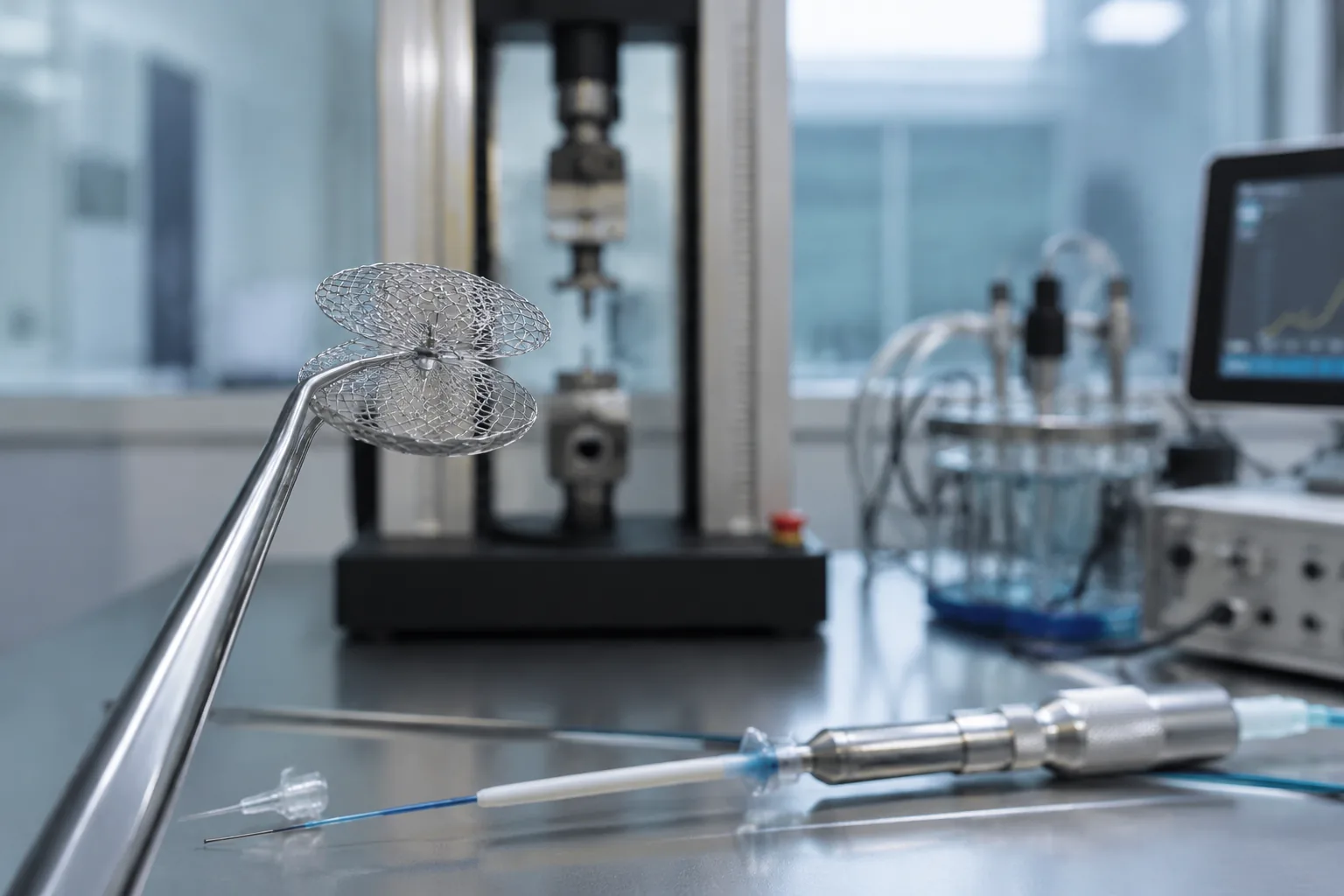
A point worth stating plainly: the cardiac occluder is a Class III (the highest-risk) implantable device in every major market — the FDA PMA, the EU MDR, the Chinese NMPA — and the testing regime is the most demanding of any cardiovascular device category. The occluder is a permanent implant, manufactured predominantly from the nitinol (nickel-titanium alloy) wire mesh filled with the polyester fabric, deployed by the transcatheter delivery system through the venous or the arterial access, and expected to remain in the patient's heart for the rest of their life. Every aspect of the device — the nitinol mesh strength, the corrosion resistance, the polyester fabric biocompatibility, the delivery-system reliability, the fatigue durability under the cyclic cardiac loading — must be tested to the most stringent standard, and the conformity project is correspondingly extensive.
How is structural integrity and fatigue durability tested?
The structural integrity and the fatigue durability are the properties that determine whether the nitinol mesh occluder maintains its double-disc shape and its clamping force across the septal defect, over the decades of the cyclic cardiac loading. The cardiac occluder is subjected to approximately 400 million to 1 billion cardiac cycles over a 10-to-25-year service life, and the fatigue test must demonstrate the structural survival under this loading.
The structural-integrity and fatigue test programme, drawn from the FDA SSED for the Amplatzer Septal Occluder (P000039):
The wire tensile test verifies the strength of the individual nitinol wires that constitute the mesh. Each wire diameter (0.004", 0.005", 0.006", 0.007", 0.008") is tested to failure, and the tensile force is recorded. The published SSED data: 0.004" wire mean 30.3 ± 2.6 lbs; 0.005" wire 36.8 ± 3.3 lbs; 0.006" wire 37.6 ± 3.8 lbs; 0.007" wire 49.8 ± 6.2 lbs.
The pull test verifies the strength of the critical joints — the laser weld of the marker bands to the wire braid, the laser weld of the screw attachment to the marker bands, and the delivery cable screw-to-device-end-screw connection. The acceptance criteria: 0.004–0.006" diameter wire > 12 lbs; 0.007" wire > 24 lbs; 0.008" wire > 32.2 lbs. The SSED reports that all samples exceeded 55 lbs — well above the specification.
The device integrity test verifies that the occluder maintains its structural integrity when individual wires or components are cut — simulating the in-vivo wire-fracture scenario. The acceptance criterion: the structural integrity must remain intact when single and multiple wires are cut, as well as when the left atrial disc post is cut. The SSED confirms that the structural integrity remained intact in all tested samples. A critical property of the nitinol mesh — if a wire fractures in the clinical setting, it would not protrude due to the shape-memory property of the nitinol.
The life-cycle fatigue test is the most demanding single test — the occluder must maintain its structural integrity after 400 million cycles (corresponding to approximately 10 years of cardiac cycles at 72 bpm). The SSED reports testing 300 samples (30 each of the smallest and largest device in each wire diameter), with the structural integrity verified after the 400-million-cycle loading. The published research on the occluder fatigue indicates that the cycle count can extend to 1 billion cycles for the longer-service-life claims.
How is nitinol corrosion resistance evaluated?
The nitinol (nickel-titanium alloy) corrosion resistance is the property that determines whether the occluder mesh corrodes in the blood-contacting environment — the corrosion that could release the nickel ions, weaken the mesh, and provoke the adverse tissue response. The corrosion resistance is evaluated by the bench testing and the animal-explant testing.
The bench corrosion test (ASTM F746, per the Amplatzer SSED) tests the pitting and the crevice corrosion of the nitinol sample in the defined electrolyte. The SSED reports: "The Nitinol sample did not display the general pitting found on the 316SS sample. In addition, there was no indication of crevice corrosion on the nickel-titanium sample as was seen on the 316 SS samples."
The polarisation test (ASTM F2129) measures the corrosion potential and the breakdown potential by the cyclic potentiodynamic polarisation scan. The SSED for the Amplatzer reports: eight devices tested in the deoxygenated sodium chloride electrolyte, the open-circuit potential established for 60 minutes, the polarisation scan at 0.6 V/h, the corrosion onset at approximately 0.08 V from the open circuit potential. The FDA's 2023 Nitinol Guidance recommends ASTM F2129 for all nitinol-containing devices in the premarket submission, and the corrosion-test data is a core element of the PMA application.
The animal-explant corrosion test examines the occluder explanted from the animal after the defined implantation period (the Amplatzer SSED: 18 months and 14 months). The gross inspection, the light microscopy, and the SEM examination of the explanted device reveal no wire breakage, a smooth surface identical to the control wire, and no evidence of corrosion — confirming the bench-test prediction in the in-vivo environment.
What biocompatibility testing is required?
The cardiac occluder is a permanent blood-contacting implant (the nitinol mesh and the polyester fabric in direct contact with the blood and the cardiac tissue), and the ISO 10993 biocompatibility evaluation is required for the full set of endpoints. The Amplatzer SSED documents the biocompatibility testing under the FDA General Program Memorandum G95-1 (the FDA-modified matrix of ISO 10993):
| Test | Polyester Fabric | Delivery System |
|---|---|---|
| Cytotoxicity | Pass | Pass |
| Sensitisation | Non-sensitiser | Non-sensitiser |
| Haemolysis | Non-haemolytic | Non-haemolytic |
| Intracutaneous injection (irritation) | Pass | Pass |
| Systemic toxicity | Pass (subchronic) | Pass (systemic) |
| Acute systemic injection | Pass | Not required |
| Ames mutagenicity | No mutagenic activity | Not required |
| Implantation | Moderate reaction* | Not required |
| Chronic toxicity | Pass | Not required |
*A "moderate reaction" is exactly what is expected when tissue ingrowth is the desired result — the occluder is designed to be incorporated into the cardiac tissue through the fibrotic-tissue and the endothelial-cell coverage.
The nitinol mesh biocompatibility is supported by the extensive published literature on the nitinol alloy as an implant material, demonstrating the biocompatibility for the permanent implantation. The nickel-ion release from the nitinol is a documented concern (the nitinol contains 54.5–57.0 wt% nickel), and the FDA's 2023 Nitinol Guidance specifically addresses the nickel-leaching assessment — the quantification of the nickel released from the device into the simulated body fluid over the defined time, and the toxicological assessment of the released nickel.
How is the delivery system tested?
The delivery system — the sheath, the dilator, the loading device, the delivery cable, and the plastic vise — is the critical accessory that deploys the occluder to the target site, and its reliability directly affects the procedural success and the patient safety. The delivery system is tested under the defined test methods documented in the SSED:
The kink resistance of the delivery sheath (6F to 12F) and the delivery cable is measured as the angle at which the component kinks. The SSED data: 6F sheath 131° ± 4.8°; 7F sheath 118.8° ± 2.5°; up to 12F sheath 129° ± 4.2°. The delivery cable kink resistance: 128.5° ± 7.8°. The acceptance criterion: the sheath / cable must not kink during the normal clinical use.
The pull tests of the delivery sheath hub-to-tubing bond (6F–12F) verify the bond strength, with the acceptance criterion > 3 lbs. The SSED data: 6F 8 ± 1.3 lbs to 12F 17.3 ± 1.0 lbs. The delivery cable cable-to-cable-screw weld joint must withstand > 12 lbs; the SSED reports 46.1 ± 5.5 lbs.
The MRI compatibility is tested by placing the occluder in the water phantom and examining it in the 1.5 Tesla MRI. The SSED reports minimal artefacts only in the device vicinity, and the device is MRI-safe up to 1.5 Tesla.
How is endothelialization assessed?
The endothelialization — the coverage of the occluder surface by the fibrotic tissue and the neoendothelium — is the biological process that integrates the device into the cardiac tissue, isolating the nitinol mesh from the blood contact and completing the defect closure. The endothelialization is critical for the long-term safety: the incomplete endothelialization exposes the nitinol mesh and the polyester fabric to the blood, risking the thrombus formation and the infective endocarditis.
The endothelialization is assessed by two complementary methods:
The animal study (the preclinical in-vivo evaluation) implants the occluder in the animal model (commonly the Yucatan minipig with the surgically created ASD), and the animals are euthanised at the defined intervals (1 week, 1 month, 3 months). The Amplatzer SSED reports: "At 3 months all animals studied exhibited complete endothelialisation by neoendothelium. This tissue in-growth demonstrated that the device was firmly fixed into position and was covered by a glistening non-thrombogenic layer of cells." The animal study is the preclinical evidence of the endothelialization that supports the clinical study.
The clinical CTA assessment is the non-invasive method that evaluates the device endothelialization in the human patients, based on the contrast uptake within the occluder on the cardiac computed tomography angiography. The published clinical research (Liu et al., PLoS ONE 2025) demonstrates: the contrast uptake within the occluder correlates with the incomplete endothelialization (confirmed pathologically), with 76 % of the tested devices showing the contrast uptake (incomplete endothelialization). The late device endothelialization was a common histopathological feature, with 71.43 % of the patients with implantation > 6 months showing the incomplete coverage on the left disc. The CTA assessment is the in-vivo method that informs the antiplatelet / anticoagulation therapy duration, which is the clinical management decision that the endothelialization status drives.
How does the Chinese framework regulate cardiac occluders?
The Chinese framework for the cardiac occluder testing uses the industry standard and the NMPA registration guidelines:
-
YY/T 1553-2017, 心血管植入物 心脏封堵器 (Cardiovascular implants — Cardiac occluders) (CMDE PDF) — the Chinese industry standard for cardiac occluders, aligned with ISO 22679:2021, covering the structural design requirements, the material performance (the nitinol wire), the finished-product evaluation, the manufacture / sterilisation / packaging requirements, and the post-market surveillance. YY/T 1553-2017 applies to all cardiac occluder types (the ASD, the VSD, the PDA, the PFO, the LAA occluders), and it explicitly notes that the biodegradable occluder systems (the emerging-technology devices) must also be evaluated per the standard's basic requirements.
-
NMPA registration — the cardiac occluder is a Class III high-risk implantable device in the Chinese classification, and the NMPA registration requires the full preclinical testing (the structural, the corrosion, the biocompatibility, the animal study), the clinical investigation, and the quality-management-system documentation.
Three regulatory points for the Chinese-market project:
The biodegradable occluder. China approved the world's first fully biodegradable occluder system in 2022 (developed by the Sichuan University team), and the biodegradable occluder is a distinct regulatory category requiring the additional biodegradation testing (the degradation-rate, the degradation-product biocompatibility, the long-term imaging follow-up). The YY/T 1553-2017 notes that the biodegradable occluders must meet the standard's basic requirements, but the biodegradation-specific testing is additional.
The left atrial appendage (LAA) occluder. The LAA occluder is a distinct product category (different from the ASD / VSD / PDA occluders in design and in the deployment technique), and the NMPA has approved multiple LAA occluder products. The LAA occluder testing includes the additional anchorage-force testing (the LAA anatomy requires the secure mechanical anchoring that the ASD occluder does not).
The provincial alliance volume-based procurement. The cardiac occluder products (including the LAA occluders) are subject to the provincial-alliance集中带量采购 in China, which is the price-and-volume procurement mechanism that affects the market access alongside the NMPA registration. The testing project should be scoped to support both the regulatory registration and the procurement qualification.
FAQ
Which standard should my cardiac occluder be tested to?
ISO 22679:2021 (international product standard) for the functional and durability testing. ISO 14630:2024 (general framework). ASTM F746 / F2129 for the nitinol corrosion. ISO 10993 for the biocompatibility. FDA PMA requirements (for the U.S. market). YY/T 1553-2017 (for the Chinese market). We confirm the occluder type, the target market, and the regulatory pathway before quoting.
How many fatigue cycles are required?
The standard target is 400 million cycles (approximately 10 years at 72 bpm), per the FDA SSED for the Amplatzer Septal Occluder. Some projects test to 1 billion cycles for the longer-service-life claims. The test runs on the defined number of samples (the Amplatzer tested 300 samples, 30 each of the smallest and largest device in each wire diameter), and the structural integrity must remain intact after the cycle loading.
What corrosion tests are required for the nitinol occluder?
ASTM F746 (pitting / crevice corrosion) and ASTM F2129 (cyclic potentiodynamic polarisation), per the FDA's 2023 Nitinol Guidance. The bench corrosion test verifies the nitinol's resistance, and the animal-explant test confirms it in the in-vivo environment. The nickel-ion release from the nitinol is the additional assessment the FDA Guidance specifically addresses.
How is the endothelialization assessed?
The animal study (the preclinical in-vivo evaluation in the minipig or the sheep model, with the explant at 1 week / 1 month / 3 months) provides the preclinical evidence. The clinical CTA assessment (the contrast-uptake evaluation on the cardiac CTA) provides the in-vivo human evidence. The endothelialization status drives the antiplatelet / anticoagulation therapy duration — the clinical management decision.
Can you test the biodegradable occluder?
Yes. The biodegradable occluder requires the additional biodegradation testing (the degradation rate, the degradation-product biocompatibility, the imaging follow-up), alongside the standard structural, corrosion, biocompatibility, and delivery-system tests. The YY/T 1553-2017 notes that the biodegradable occluders must meet the standard's basic requirements, and the biodegradation-specific testing is additional.
Our cardiac occluder testing service
Our laboratory provides cardiac occluder testing across the full standard stack — ISO 22679:2021 (functional and durability), ISO 14630:2024 (general framework), ASTM F746 / F2129 (nitinol corrosion), ISO 10993 (biocompatibility), the FDA PMA preclinical requirements, and YY/T 1553-2017 (Chinese market). Each project begins with a scoping step that confirms the occluder type (ASD, VSD, PDA, PFO, LAA, biodegradable), the material (nitinol mesh with polyester fabric), the delivery-system design, the target market, and the regulatory pathway.
We test the wire tensile strength; the laser-weld and screw-attachment pull-test strength; the device structural integrity (single and multiple wire cut); the 400-million-cycle fatigue durability; the ASTM F746 / F2129 corrosion resistance; the ISO 10993 biocompatibility (cytotoxicity, sensitisation, haemolysis, irritation, systemic toxicity, genotoxicity, implantation); the delivery-system kink resistance and pull-test strength; the MRI compatibility; the nickel-ion release assessment; and the endothelialization assessment in the animal model. Reports are issued with the standard, the method, the measured values, the acceptance criteria, and the conformity conclusion explicitly stated, with the force-displacement curves, the polarisation curves, the fatigue-test logs, and the histology images included, in a format suitable for the FDA PMA submission, the EU MDR technical documentation, the NMPA registration dossier, or the internal quality audit.
To start a project, send us the occluder type, the nitinol wire diameter, the device size range, the delivery-system design, the target market, the regulatory pathway, and whether the occluder is a standard nitinol or a biodegradable device. We will return a project scope, sample requirement, schedule and quotation, and begin testing on your confirmation.