Circuit breaker testing is the set of type tests and routine tests that verify a low-voltage circuit breaker will clear the fault currents it is rated for, carry its rated current without overheating, and trip within its time-current band — and that it survives the mechanical and short-circuit duty of doing so repeatedly. The governing standard for industrial breakers is IEC 60947-2 (Low-voltage switchgear and controlgear — Part 2: Circuit-breakers, IEC webstore), adopted in China as GB/T 14048.2; for household MCBs it is IEC 60898-1 (IEC webstore). The test programme is not a single "does it trip" check — it is a sequenced verification of short-circuit breaking capacity (Icu / Ics), short-time withstand (Icw), making capacity (Icm), overload release operation, temperature rise, dielectric withstand, and endurance, each tied to the breaker's utilization category (A or B) and its rated values.
What Is the Difference Between Icu, Ics, Icw and Icm?
These four ratings are the heart of circuit breaker testing, and the SERP routinely conflates them. They are not four ways of saying "how much current it can break" — they describe four different duties, each with its own test:
- Icu — ultimate short-circuit breaking capacity. The maximum prospective fault current the breaker must interrupt once, on a defined test circuit at a defined power factor and recovery voltage. The test duty is O – t – CO (Open, delay, Close-Open). After breaking Icu the breaker must still be able to trip, but continued service is not guaranteed — it has done its job of clearing the fault and may be damaged. Icu is the headline number on a datasheet.
- Ics — service short-circuit breaking capacity. A current (commonly 25 %, 50 %, 75 % or 100 % of Icu) at which the breaker must interrupt repeatedly and remain fully serviceable afterward. The test duty is the more severe O – t – CO – t – CO, followed by verification of dielectric withstand and overload-release operation. A breaker that clears Ics must still carry its rated current and trip correctly — Ics is the rating that decides whether the breaker can be left in service after a fault, or must be replaced.
- Icw — rated short-time withstand current. The current the breaker must carry without opening for a defined short time (commonly 0.05 s, 0.1 s, 0.2 s, 0.5 s, 1 s) — used for selective coordination, so a downstream breaker clears the fault and the upstream breaker holds. Icw applies only to utilization category B breakers (see below); category A breakers have no Icw requirement.
- Icm — rated making capacity. The peak current the breaker can close onto under short-circuit conditions (the asymmetrical peak, not the RMS). Icm is tied to Icu by a factor n set by the test-circuit power factor: e.g. at Icu = 100 kA with cos φ = 0.2, n = 2.2 and Icm = 220 kA peak. The making-capacity test verifies the contacts can close against the electromagnetic force of the fault without welding or bouncing.
The fact the SERP obscures: a breaker datasheet that quotes only "100 kA" is unverifiable. 100 kA Icu means "breaks it once," 100 kA Ics means "breaks it and keeps working," and 100 kA Icw means "carries it for 1 second without opening" — three completely different capabilities (background on circuit breaker ratings). A complete specification cites all four numbers plus the utilization category.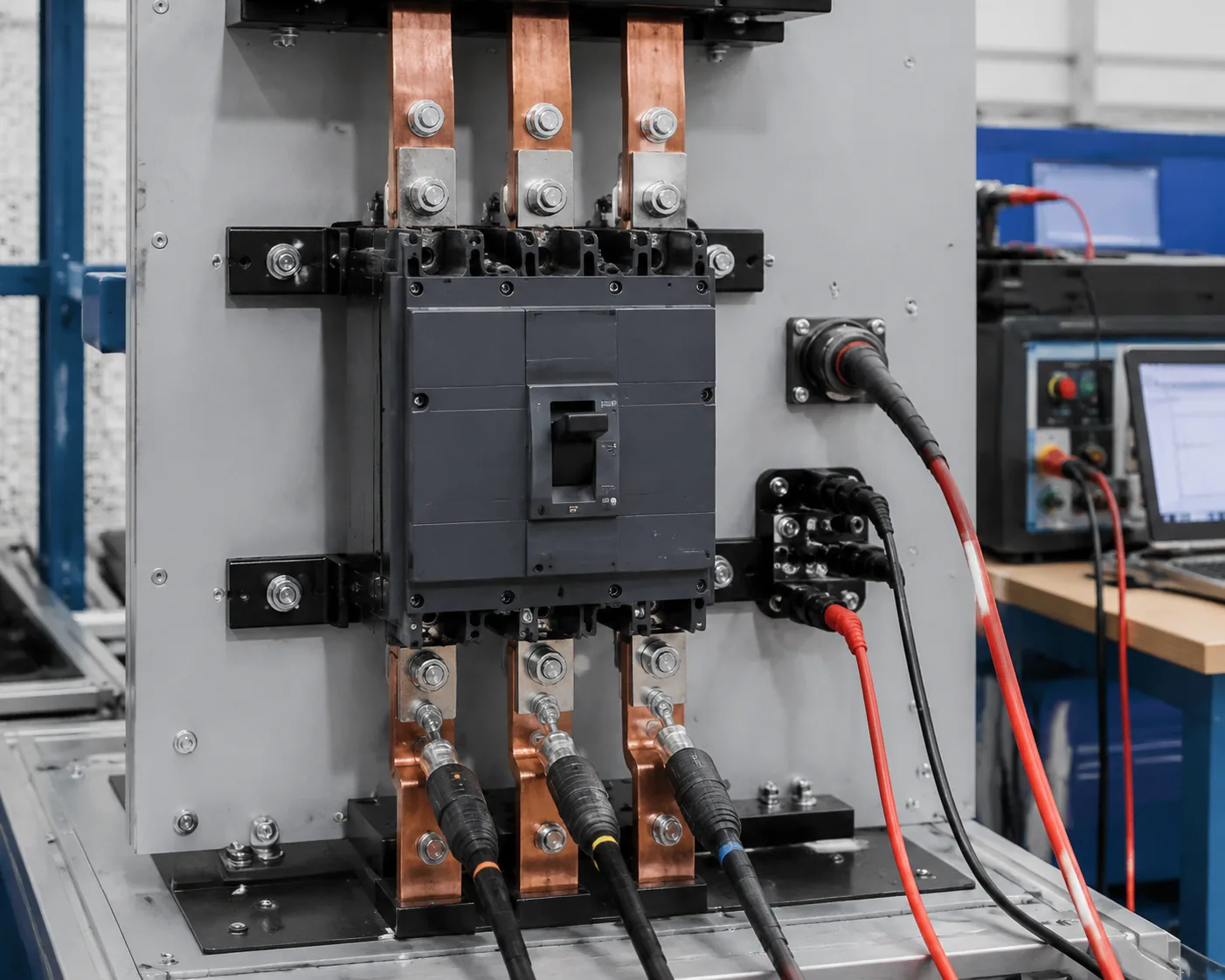
What Is Utilization Category A vs B — and Why Does It Change the Test?
IEC 60947-2 splits breakers into two utilization categories that decide whether the short-time-withstand (Icw) test applies:
- Category A — breakers not intended for short-time withstand. They have no deliberate time delay on the short-circuit trip; they are designed to clear the fault as fast as possible. No Icw test. Typical: most moulded-case circuit breakers (MCCBs) in final distribution, and all MCBs.
- Category B — breakers intended for short-time withstand, so they can hold for a defined time to let a downstream breaker clear the fault first (selective coordination). They must pass the Icw test at the declared short-time value. Typical: air circuit breakers (ACBs) and selectivity-class MCCBs in main distribution.
The practical consequence: a category-B breaker is tested to a programme that category-A is not, because its job is different — it must not open during the downstream breaker's clearing time. A specifier who picks a category-A breaker expecting selectivity will get nuisance tripping of the main every time a downstream fault occurs, because the main was never tested to hold.
What Test Sequences Does IEC 60947-2 Mandate?
The standard groups tests into test sequences (programmes), each run on a sample breaker. The three headline sequences:
- Test sequence I — overload and performance. Verifies the breaker carries rated current without exceeding temperature-rise limits, operates mechanically and electrically for the declared endurance, and that the overload release trips within its time-current band (the conventional non-tripping and tripping currents, the inverse-time and definite-time zones). This is the test that confirms the breaker protects, not just survives.
- Test sequence II — rated service short-circuit capacity (Ics). The breaker is subjected to the O – t – CO – t – CO duty at Ics, then re-verified for dielectric withstand and overload-release operation. Passing sequence II is what makes the breaker reusable after a fault.
- Test sequence III — rated ultimate short-circuit capacity (Icu). The O – t – CO duty at Icu. After this the breaker must still trip but need not be reusable. For category-B breakers there is also test sequence III with Icw — the short-time-withstand duty, often run as a separate sequence verifying the breaker holds for the declared time at the declared current.
Across all sequences the acceptance criteria are uniform: the breaker must interrupt the current with no sustained arcing, no flashover to ground, no shedding of parts; the recovery voltage must be held after interruption; and the post-test dielectric and overload-release verifications must pass. A breaker that clears the fault but whose contacts weld shut, or that fails the post-test dielectric check, fails the sequence.
IEC 60947-2 vs IEC 60898-1 — Which Standard Applies?
This is the most common point of confusion in the SERP, because both standards cover "circuit breakers" but apply to different products and operators:
| Aspect | IEC 60898-1 | IEC 60947-2 (GB/T 14048.2) |
|---|---|---|
| Application | Household & similar | Industrial & similar |
| Operator | Unskilled persons | Trained / authorized |
| Typical device | MCB (miniature) | MCCB, ACB (also MCB) |
| Current rating | up to ~125 A | up to 1600 A+ |
| Short-circuit rating | Icn (single value) | Icu / Ics (two values) |
| Tripping curves | B, C, D | Varied, configurable |
| Reference standard | GB/T 10963.1 | GB/T 14048.2 |
A household MCB certified to IEC 60898-1 carries a single short-circuit capacity number (Icn) and is tested to a simpler programme; an industrial MCCB certified to IEC 60947-2 carries both Icu and Ics and is tested to the full sequence programme above. The two are not interchangeable — a 6 kA Icn MCB is not equivalent to a 6 kA Icu MCCB, because the test conditions (power factor, recovery voltage, post-test verification) differ. A specification that does not name the standard is unverifiable. Circuit breaker testing therefore sits alongside our surge / impulse immunity testing and electrostatic discharge immunity testing work — a breaker's electronic trip unit must tolerate the same surges and ESD events that the downstream equipment faces — and the coordination results feed the protection studies used in electric motor testing and the cable systems covered by Fire-resistant cable tray testing.
How Are Overload and Short-Circuit Releases Tested?
The release (trip unit) is what makes a breaker protective rather than just a switch. IEC 60947-2 verifies it both before and after the short-circuit sequences:
- Thermal (bimetal) overload release — tested at the conventional non-tripping current (must not trip within the conventional time) and the conventional tripping current (must trip within the conventional time), confirming the inverse-time curve.
- Magnetic (instantaneous) short-circuit release — tested at the lower and upper limits of its tripping band to confirm it does not trip below the band and does trip above it.
- Electronic overcurrent release — for breakers with electronic trip units, Annex F of IEC 60947-2 adds EMC verification (F4, F5): behavior under voltage dips, surges, conducted disturbances, and radiated fields. This is the test sequence that decides whether a microprocessor-based trip unit will mis-trip or fail to trip in a noisy industrial electrical environment.
A common field failure — nuisance tripping of an electronic-release breaker near a variable-frequency drive — is traceable to Annex F compliance: a release that passed EMC verification tolerates the drive's conducted emissions; one that did not, trips spuriously.
Frequently Asked Questions
What standard governs circuit breaker type testing?
IEC 60947-2 (Low-voltage switchgear and controlgear — Circuit-breakers), adopted in China as GB/T 14048.2, governs industrial breakers (MCCB, ACB). Household MCBs are governed by IEC 60898-1 (GB/T 10963.1). The two standards are not interchangeable — they have different test programmes, different rating definitions (Icn vs Icu/Ics), and different operators in mind.
What is the difference between Icu and Ics?
Icu is the ultimate short-circuit breaking capacity — the breaker must interrupt it once (O–t–CO) and need not be reusable afterward. Ics is the service short-circuit capacity — a percentage of Icu at which the breaker must interrupt repeatedly (O–t–CO–t–CO) and remain fully serviceable, passing post-test dielectric and overload-release checks. Ics decides whether the breaker can stay in service after a fault.
What is Icw and which breakers need it?
Icw is the rated short-time withstand current — the current the breaker must carry without opening for a defined time (e.g. 1 s). It applies only to utilization category B breakers, which are designed for selective coordination (holding while a downstream breaker clears). Category A breakers have no Icw requirement.
What is the test duty O – t – CO?
O is an open (breaking) operation, CO is a close-onto-fault then open operation, and t is the time interval between them. Icu is tested at O–t–CO; Ics at the more severe O–t–CO–t–CO. The breaker must interrupt at each operation with no flashover, no contact weld, and recovery voltage held.
What is Annex F of IEC 60947-2?
Annex F adds EMC verification for breakers with electronic overcurrent releases — behavior under voltage dips, surges, conducted and radiated disturbances (test items F4, F5). It is what decides whether a microprocessor trip unit will mis-trip or fail to trip in a noisy industrial environment.
Why must the overload release be verified after the short-circuit test?
Because a breaker that survives a short-circuit but whose trip curve has shifted no longer protects. Test sequence II (Ics) re-verifies the overload release after the short-circuit duty — if the bimetal or electronic release no longer trips within its time-current band, the breaker fails, even though it interrupted the fault.
Our Testing Capabilities
Beijing ZKGX Research (ISO/IEC 17025 testing laboratory) provides circuit breaker type and routine testing across the low-voltage range:
- Short-circuit breaking capacity to IEC 60947-2 / GB/T 14048.2 — Icu (O–t–CO) and Ics (O–t–CO–t–CO) at prospective currents up to the rated value, with power-factor, recovery-voltage, and post-test verification.
- Short-time withstand (Icw) for category-B breakers — time-current duty at the declared short-time value, with selective-coordination verification.
- Making capacity (Icm) — peak-current close-onto-fault test at the factor-n multiple of Icu.
- Overload and short-circuit release verification — conventional non-tripping / tripping currents, instantaneous band limits, inverse-time curve points, before and after short-circuit duty.
- Temperature rise at rated current in the defined test arrangement; dielectric withstand verification after each sequence.
- Operating performance / endurance — mechanical and electrical endurance to the declared cycle counts.
- Annex F EMC for electronic trip units — immunity to voltage dips, surges, conducted and radiated disturbances.
- Household MCB testing to IEC 60898-1 / GB/T 10963.1 (Icn, B/C/D tripping curves).
If you have a circuit breaker to type-test, an Icu/Ics/Icw rating to qualify, or a trip-unit time-current curve to verify against IEC 60947-2 or IEC 60898-1, contact our testing team to scope the applicable test sequence, the utilization category, and the acceptance criteria.