What Does "CMRR Testing" Mean in a Laboratory?
The Common-Mode Rejection Ratio (CMRR) is the headline metric of any differential circuit — the ratio of differential-mode gain to common-mode gain (CMRR = |A_d| / |A_c|, in dB = 20·log₁₀(A_d/A_c)) — and it tells you how completely a differential input stage rejects a signal that appears identically and in-phase on both inputs (mains hum, switching noise, common-mode pickup on a cable). "CMRR testing" in a laboratory is therefore the measurement of this ratio under controlled conditions, on three distinct device classes that share the metric but use different methods and standards: the operational-amplifier / instrumentation-amplifier IC (semiconductor parametric test, IEC 60748 / SJ/T op-amp methods), the medical ECG/EEG equipment (patient-safety standard IEC 60601-2-25 / YY 0782, where CMRR is the regulatory requirement that the device display a clean waveform under 50/60 Hz mains interference and ±300 mV DC electrode offset), and the differential probe / RF front-end (instrument calibration, where CMRR is verified at multiple frequencies against a datasheet curve). The competitor material is rich but fragmented across these three worlds; the laboratory service unifies them.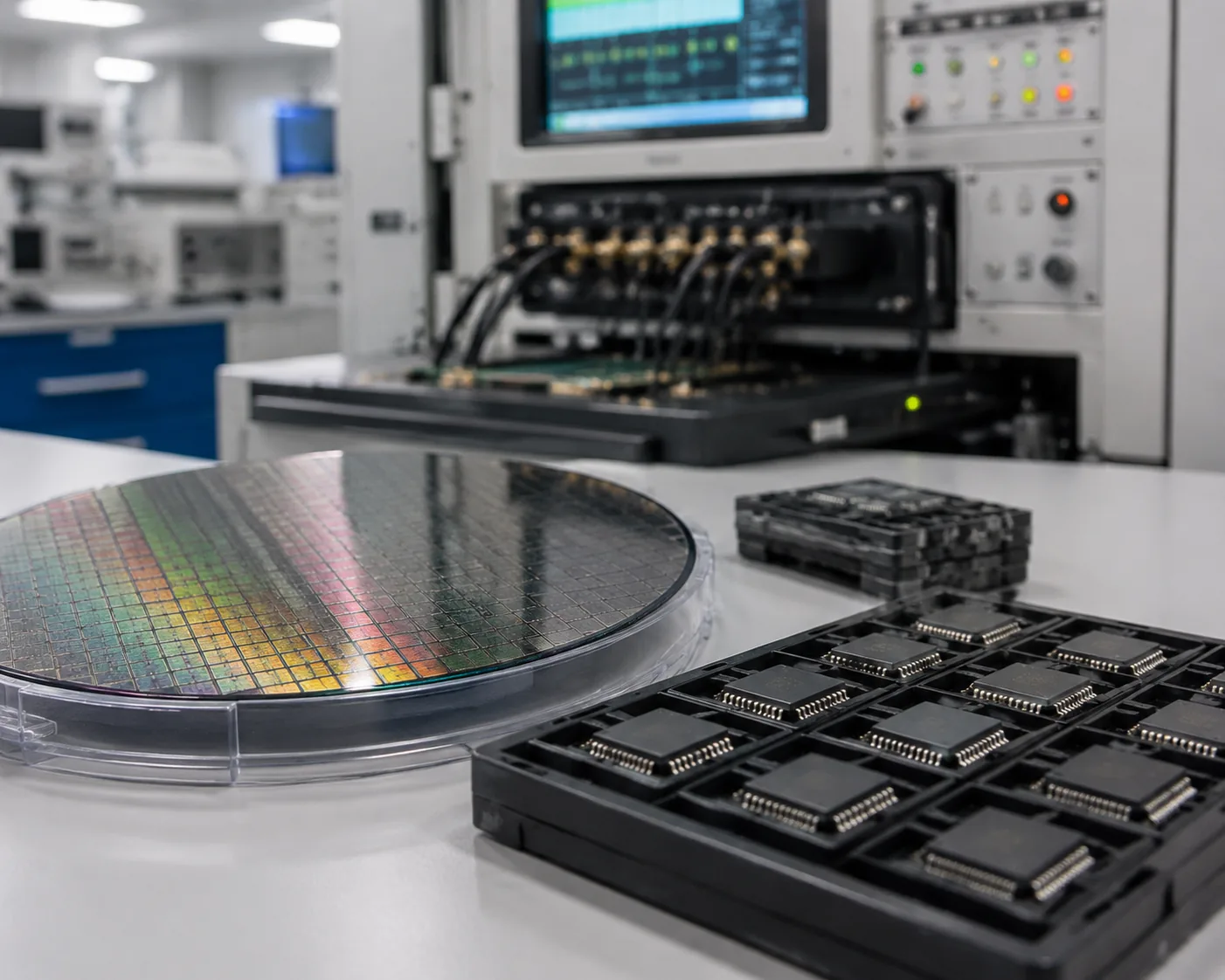
Why CMRR Is Never a Single Number — the Definition vs the Measurement Trap
CMRR is defined as A_d / A_c, but the measured value depends sharply on which of several test configurations is used, and they do not agree. Zhou & Liu's 2005 IEEE analysis of five measurement setups showed systematic discrepancies:
| Setup | What it does | Limitation |
|---|---|---|
| I — Direct by definition | Measure A_d and A_c separately, divide | Measuring very high A_d is hard; two-measurement technique is impractical |
| II — Matched sources | Two equal in-phase sources at both unity-gain inputs | Sources must be exactly equal and in-phase — hard in practice |
| III — Power-supply perturbation | Perturb both supply rails as the common-mode stimulus | Gives lower CMRR and narrower bandwidth than the definition — a unity term in the denominator dominates when A_c < 1 |
| IV — Matched-resistor difference amp | Four matched resistors, inputs tied, measure ΔV_out | Resistor mismatch limits the measurable CMRR — 0.1 % mismatch caps CMRR at 66 dB, 100 dB needs 0.001 % matching; finite output impedance adds a feedforward path that narrows bandwidth |
| V — Matched-resistor + buffer (improved) | Insert a unity-gain buffer to null the output impedance | Closest to the definition over wide bandwidth; still needs resistor-mismatch extrapolation |
The practical consequence, captured in ADI's MT-042 tutorial: a simple four-resistor test circuit measures the resistor matching as much as the op-amp's CMRR — a 0.1 % resistor mismatch caps the measured CMRR at 66 dB no matter how good the op-amp, and 100 dB needs 1 ppm (0.0001 %) matching. This is why production CMRR test uses the servo-loop / power-supply-perturbation method that does not require precision resistors, accepting the bandwidth limitation; full characterization uses the buffer method (Setup V) for the wideband curve.
How Is the Op-Amp / Instrumentation-Amp CMRR Tested?
For a semiconductor IC, CMRR is one item in the parametric-test suite, with two established methods (Hua Feng / 华峰测控 test-method guide):
- Common-mode input method (共模输入法) — apply a defined common-mode voltage step ΔV_CM to both inputs (with the device in a defined closed-loop configuration), measure the resulting ΔV_OUT, and compute CMRR = ΔV_CM / ΔV_OS where ΔV_OS is the equivalent input offset change. This is the setup used in production ATE.
- Variable-supply method (变电源法) — keep the input common-mode fixed and instead shift the supply rails symmetrically by ΔV_S; the effect on the output is equivalent to a common-mode perturbation, and CMRR is computed from ΔV_OUT vs ΔV_S. This avoids the need for precision resistors and is the basis of ADI's MT-042 Figure 4 production fixture.
- DC CMRR and the CMRR-vs-frequency curve — datasheets specify CMRR at DC (e.g. OP177 ≈ 140 dB) and provide a CMR-vs-frequency curve, because CMRR rolls off as parasitic capacitances unbalance the two input paths at frequency. The headline number alone is insufficient; the curve is the characterisation.
Standards: IEC 60748 (semiconductor IC test, including op-amp parameters) and its Chinese adoption, with op-amp test methods in the SJ/T series. CMRR is reported with the test configuration, the closed-loop gain, the supply voltage and the frequency.
How Is the Medical ECG / EEG CMRR Test Performed?
For an ECG/EEG machine, CMRR is a patient-safety regulatory requirement — the device must display a clean waveform under 50/60 Hz mains interference and ±300 mV DC electrode-to-electrode offset, because the 0.5–3 mV ECG signal is dwarfed by these common-mode disturbances. The framework is IEC 60601-2-25 / -27 (YY 0782/1079/1139 in China) for ECG, IEC 60601-2-47 (YY 0885) for mobile ECG, and IEC 60601-2-26 (GB 9706.226) for EEG. The WhaleTeq CMRR 3.0+ test sequence is representative:
- Set the signal source Vs — 20 Vrms mains frequency for IEC 60601-2-25/27; 8 Vp-p (2.828 Vrms) for IEC 60601-2-47.
- Adjust common-mode voltage Vc — disconnect all leads, adjust the tester's variable capacitor Ct so Vc = 0.5 Vs (this sets Cx + Ct = 100 pF, modelling body capacitance to ground; total 200 pF).
- Balance test — connect all leads with the same electrode-skin impedance (51 kΩ ∥ 47 nF); measure all-lead output amplitude.
- Imbalance test — open/close one electrode's switch at a time (the rest opposite); the imbalance converts a sliver of common-mode into differential; measure all-lead amplitude.
- Superimpose ±300 mV DC offset — on the electrode under test; measure all-lead amplitude.
- Pass criterion — IEC 60601-2-25/27: ≤ 10 mm p-p (1 mV p-p) on any lead, equivalent to CMRR ≥ ~89 dB (20·log₁₀(1 mV/10 Vrms·2√2)). IEC 60601-2-47: ≤ 4 mV p-p; IEC 60601-2-26 (EEG): ≤ 0.1 mV p-p.
Critical test-environment rule: the test must run in a mains-noise-free setup — a metal bench/sheet ≥ 60 × 100 cm under the DUT, its ground isolated from other system grounds, the 50/60 Hz notch filter of the DUT turned off — otherwise ambient mains pickup swamps the measurement. The DC-offset and imbalance steps catch the CMRR degradation that an ECG experiences in real electrode contact.
How Is a Differential Probe / RF Front-End CMRR Tested?
For a differential oscilloscope probe or an RF balanced front-end, CMRR is verified by applying the same signal to both inputs and measuring the leakage at the output:
- Test fixture — a BNC tee with the centre pin split to both probe inputs (and a ground jumper to the probe ground), so the signal generator drives both inputs equally; a second scope channel monitors the input, the probe output goes to a third channel.
- At frequency — e.g. 10 MHz, 2 Vp-p sine, 50 Ω inputs, scope averaging 1024 for resolution; measure V_out (common-mode leakage) and compute CMRR = A_d/A_c ≈ V_in/V_out_leakage. A probe claiming ≥ 40 dB at 10 MHz measured 151.8:1 = 43.6 dB (pass); at 60 Hz with 20 Vp-p it measured 6799:1 = 76.6 dB (pass, ≥ 70 dB spec).
- Frequency dependence — CMRR drops with frequency, so the test is repeated across the band (60 Hz, 10 MHz, …). The datasheet CMRR-vs-frequency curve is the acceptance reference.
For RF front-ends (active loop antenna, balanced preamp), the same principle applies but the external balance (source impedance, cable symmetry, balun balance, common-mode choke) dominates — a perfect-amplifier CMRR is defeated by coax outer-conductor common-mode current converting interference to differential before the amplifier sees it.
What Belongs on the Report?
A compliant CMRR test report states the device class (op-amp IC / ECG-EEG equipment / differential probe), the standard (IEC 60748 / SJ/T for op-amp; IEC 60601-2-25 / YY 0782 for ECG; IEC 60601-2-26 / GB 9706.226 for EEG; datasheet curve for probe), the method (servo-loop / variable-supply / four-resistor / medical CMRR tester / differential-probe fixture), the frequency (DC and/or the frequency curve), and the result against the acceptance limit (op-amp datasheet dB; ECG ≤ 1 mV p-p ≈ 89 dB; probe datasheet curve). The cardinal error is reporting a single-frequency CMRR as if it were the device's CMRR — the frequency curve is the characterisation.
For the related semiconductor-IC parametric test, see integrated circuit testing; for the ECG/EEG medical-equipment context, biocompatibility testing to ISO 10993.
FAQ
What is the difference between CMR and CMRR?
CMR (common-mode rejection) is the behaviour — the circuit's ability to reject common-mode input. CMRR (common-mode rejection ratio) is the numeric metric that quantifies it — the ratio A_d/A_c, usually expressed in dB (CMR(dB) = 20·log₁₀(CMRR)). The terms are used loosely in the industry, but CMR = concept, CMRR = number.
Why do different CMRR measurement setups give different results?
Because each setup perturbs a different point (inputs, supply rails, resistor network) and each has a non-ideality that departs from the A_d/A_c definition — the variable-supply method gives lower CMRR and narrower bandwidth (a unity term in the denominator dominates when A_c < 1), and the four-resistor method measures resistor matching as much as the op-amp (0.1 % mismatch caps CMRR at 66 dB). The buffer-improved Setup V is closest to the definition over wide bandwidth.
What is the medical ECG CMRR pass criterion?
Under IEC 60601-2-25 / -27 (YY 0782/1079/1139), with a 20 Vrms common-mode source, the output on any lead must not exceed 10 mm p-p (1 mV p-p), equivalent to CMRR ≥ ~89 dB. The test is run with the 50/60 Hz notch filter off, with ±300 mV DC electrode offset superimposed, and with both balance and imbalance lead configurations. EEG (IEC 60601-2-26) requires ≤ 0.1 mV p-p.
Why is CMRR frequency-dependent, and why does that matter?
Because at higher frequencies tiny parasitic capacitances and inductances unbalance the two input paths, converting common-mode into differential and reducing the effective rejection — a 140 dB DC CMRR may fall to 60 dB at 1 MHz. The datasheet CMRR-vs-frequency curve is the characterisation, and the test must verify the curve, not just the headline DC number. In RF, layout and cable symmetry dominate.
Can a passive-resistor imbalance defeat an otherwise excellent CMRR?
Yes — this is the most common real-world CMRR failure. A 0.1 % resistor mismatch in a difference-amplifier configuration caps the measurable CMRR at 66 dB regardless of the op-amp; 100 dB needs 0.001 % matching. External imbalance (unequal source impedance, asymmetric cable, imperfect balun, coax common-mode current) converts common-mode to differential before the amplifier, and the amplifier's CMRR cannot remove it once it has become differential.
Our Testing Capabilities
As an ISO/IEC 17025-accredited third-party laboratory, Beijing ZKGX Research provides CMRR testing across the three device classes:
- Op-amp / instrumentation-amp IC — CMRR by common-mode-input method and variable-supply method (Hua Feng test-method guide), DC CMRR and CMRR-vs-frequency curve, to IEC 60748 / SJ/T op-amp parametric-test methods, against the datasheet.
- Medical ECG / EEG — CMRR to IEC 60601-2-25 / -27 / -47 / -26 (YY 0782/1079/1139/0885, GB 9706.226), with the CMRR-tester balance + imbalance + ±300 mV DC-offset sequence, mains-noise-free metal-bench environment, notch filter off, against the ≤ 1 mV p-p / 89 dB (ECG) and ≤ 0.1 mV p-p (EEG) pass criteria.
- Differential probe / RF front-end — CMRR vs frequency by the common-mode-input fixture, against the datasheet curve (e.g. ≥ 40 dB @ 10 MHz, ≥ 70 dB @ 60 Hz), with the external-balance / balun / common-mode-choke caveat documented.
Sample types include op-amp and instrumentation-amp ICs, ECG/EEG/ patient-monitor equipment, differential oscilloscope probes, and RF balanced front-ends. If you have a specific device class, standard (IEC 60748 / IEC 60601-2-25 / YY 0782 / GB 9706.226 / SJ-T), frequency range (DC / mains / MHz), or acceptance limit (datasheet dB / medical p-p / probe curve), contact the laboratory to confirm the correct method, fixture and reporting format befOre testing.