Table of Contents
- What is polysaccharide testing?
- The standard stack: SN/T 4260, GB 16740, pharmacopeial monographs
- Total polysaccharide content: the phenol-sulfuric acid method
- Molecular weight and distribution: HPGPC-MALS
- Monosaccharide composition: PMP derivatisation HPLC
- Structural characterisation: IR, NMR, methylation analysis
- Specific polysaccharide identification: β-glucan, uronic acid, characteristic glycosidic linkages
- The major polysaccharide categories and their characteristic tests
- Polysaccharide testing for health food registration
- FAQ
- Our polysaccharide testing capabilities
What is polysaccharide testing?
Polysaccharide testing is the measurement and validation of the total content, molecular weight, monosaccharide composition, structural features, and bioactive identity of plant, fungal, and marine polysaccharides — the high-molecular-weight carbohydrate polymers (glucans, mannans, galactans, fructans, glycosaminoglycans, and their heteropolysaccharide combinations) that are the active ingredients of mushrooms (lentinan from Lentinula edodes, schizophyllan from Schizophyllum commune, Ganoderma lucidum polysaccharide), herbs (Astragalus polysaccharide, Lycium barbarum polysaccharide, Panax ginseng polysaccharide), foods (starch, cellulose, pectin, inulin, alginate, carrageenan, chitosan), and pharmaceuticals (heparin, hyaluronic acid, chondroitin sulfate). The output of a polysaccharide test is a dossier covering the total polysaccharide content (by the phenol-sulfuric acid colorimetric method, reported as glucose equivalent), the molecular weight and distribution (by high-performance gel permeation chromatography with multi-angle light scattering, HPGPC-MALS), the monosaccharide composition (by PMP-derivatisation HPLC or ion chromatography with pulsed amperometric detection), and the structural characterisation (by FT-IR for the glycosidic linkage fingerprint, by NMR for the anomeric configuration, and by methylation analysis for the linkage pattern).
Polysaccharides are the most structurally diverse class of biomacromolecules. A polysaccharide is defined by its monosaccharide building blocks (glucose, galactose, mannose, arabinose, xylose, rhamnose, fucose, glucuronic acid, galacturonic acid, N-acetylglucosamine, etc.), its glycosidic linkage pattern (α-1,4; β-1,3; β-1,6; α-1,6; etc.), its anomeric configuration (α or β), its branching pattern (linear, branched, comb-shaped), its molecular weight (from ~10 kDa to ~10 MDa), and its conformation (random coil, single helix, triple helix). This structural diversity is the basis of the biological activity: the β-1,3/1,6-branched glucan (lentinan, schizophyllan, Grifolan) activates the innate immune system through the dectin-1 receptor; the β-1,4-linked glucosamine (chitosan) binds cholesterol; the α-1,4/1,6-branched glucan (glycogen, amylopectin) is the energy reserve. A polysaccharide test must therefore identify not only how much polysaccharide is present but also which polysaccharide it is — the structural fingerprint that determines the bioactivity.
The standards governing polysaccharide testing span the Chinese SN/T 4260-2015 Determination of Crude Polysaccharides in Plant-Origin Foods for Export — Phenol-Sulfuric Acid Method, the GB 16740-2014 National food safety Standard for Health Food (the framework for the polysaccharide content declaration on a health food), the pharmacopeial monographs for specific polysaccharides (USP Lentinan, EP Chondroitin Sulfate, Chinese Pharmacopoeia lentinan / polyporus polysaccharide / Ganoderma polysaccharide monographs), and the FAO JECFA food-additive monographs for the polysaccharide gums (INS 400–418). A polysaccharide-containing health food placed on the Chinese market must satisfy the GB 16740 framework with the total polysaccharide content declared; a lentinan injection placed on the pharmaceutical market must satisfy the Chinese Pharmacopoeia lentinan monograph with the molecular weight, the monosaccharide composition, and the β-1,3/1,6 glucan identity.
The standard stack: SN/T 4260, GB 16740, pharmacopeial monographs
A complete polysaccharide testing project draws on a stack of Chinese national standards, pharmacopeial monographs, and analytical-method references.
| Family | Standard | Scope |
|---|---|---|
| SN/T 4260-2015 | Determination of Crude Polysaccharides in Plant-Origin Foods for Export — Phenol-Sulfuric Acid Method | The Chinese national standard for total polysaccharide content by the phenol-sulfuric acid colorimetric method |
| GB 16740-2014 | National Food Safety Standard for Health Food | The Chinese framework for the polysaccharide content declaration on health food; the SAMR filing requires the total polysaccharide content per this standard |
| GB/T 29605-2013 | Sensory analysis — General guidance | Related quality testing framework |
| Chinese Pharmacopoeia | Lentinan (香菇多糖), Polyporus polysaccharide (猪苓多糖), Ganoderma polysaccharide (灵芝多糖), Cordyceps polysaccharide (虫草多糖) monographs | The pharmacopeial standards for specific bioactive polysaccharides; molecular weight, monosaccharide composition, β-glucan identity, bioactivity |
| USP Lentinan | (USP draft / monograph reference) | The US pharmacopeial reference for lentinan |
| EP Chondroitin Sulfate / Heparin / Hyaluronic Acid | European Pharmacopoeia monographs | The European pharmacopeial monographs for glycosaminoglycans |
| FAO JECFA | Food-additive monographs for polysaccharide gums (INS 400 alginate, 406 agar, 407 carrageenan, 409 arabic gum, 410 locust bean gum, 412 guar gum, 413 tragacanth, 414 xanthan, 415 gellan, 416 karaya, 418 gellan, 440 pectin) | International specifications for the food-grade polysaccharide gums |
| AOAC Official Methods | (Specific methods for polysaccharide-containing foods) | The international analytical reference |
| TC387 national standards (Biochemical testing) | Molecular weight and distribution of polysaccharides by HPGPC-MALS (under TC387) | The Chinese national standard for molecular weight determination by gel permeation chromatography with multi-angle light scattering |
| ISO 13320 | Particle size analysis — Laser diffraction methods | (Related, for the polysaccharide particle size) |
The single most consequential fact for a Chinese manufacturer is that the total polysaccharide content declared on a health food filing must be determined by a validated method (typically the phenol-sulfuric acid method per SN/T 4260 or an equivalent), and the pharmacopeial polysaccharides (lentinan, Ganoderma polysaccharide) must satisfy their specific monographs with the molecular weight, monosaccharide composition, and structural identity.
Total polysaccharide content: the phenol-sulfuric acid method
The phenol-sulfuric acid method (the Dubois method, 1956) is the reference method for the total polysaccharide content — the single most-reported polysaccharide number in the health food, supplement, and traditional medicine industry.
Principle — The polysaccharide is hydrolysed by concentrated sulfuric acid to its constituent monosaccharides, which dehydrate to furfural derivatives (5-hydroxymethylfurfural from hexoses, furfural from pentoses). The furfural derivatives condense with phenol to form an orange-yellow chromophore, measured at 490 nm (hexose-dominant polysaccharides) or 480 nm (pentose-dominant).
Procedure (SN/T 4260-2015 / Chinese Pharmacopoeia):
- Sample preparation — Extract the sample with hot water (80-100 °C, 2-4 h, water-to-sample ratio 20:1 to 40:1); precipitate the polysaccharide from the aqueous extract with 4 volumes of 95 % ethanol (the polysaccharide precipitates, the mono- and oligosaccharides stay in solution); centrifuge; dissolve the precipitate in water.
- Calibration — Prepare a glucose standard curve (0, 10, 20, 40, 60, 80, 100 µg/mL) in water.
- Colour reaction — Add 1.0 mL of 5 % phenol solution to 1.0 mL of the sample or standard solution; rapidly add 5.0 mL of concentrated sulfuric acid (the order is critical — the acid must be added to the phenol-sugar solution, not the reverse, to ensure the rapid dehydration); let stand 10 min; shake; incubate 20 min at 40 °C in a water bath.
- Measurement — Measure the absorbance at 490 nm against the reagent blank.
- Calculation — Calculate the total polysaccharide content as mg glucose-equivalent per g dry weight of sample.
Limitations — The phenol-sulfuric acid method measures the total sugar (the polysaccharide + any mono/oligosaccharide that co-precipitated) and reports it as glucose equivalent — it does not distinguish between glucose, galactose, mannose, arabinose, or any other monosaccharide (different monosaccharides give different colour intensities, but the method is standardised on glucose). The ethanol precipitation step removes most of the mono/oligosaccharides; a second precipitation (deproteinisation with Sevag reagent, TCA, or protease) may be required for the protein-rich samples.
Molecular weight and distribution: HPGPC-MALS
The molecular weight (Mw) and molecular weight distribution (polydispersity index, PDI = Mw/Mn) are the most important structural parameters of a bioactive polysaccharide — they determine the viscosity, the biological activity, and the pharmacokinetics. The β-1,3-glucan triple helix (lentinan, schizophyllan) requires a Mw > 100 kDa for the antitumour activity; the same glucan degraded to < 50 kDa loses the triple helix and the activity.
Method — high-performance gel permeation chromatography with multi-angle light scattering (HPGPC-MALS):
- Column — aqueous SEC column (e.g. Shodex OHpak SB-806M HQ, TSKgel G4000PWxl, Agilent PL aquagel-OH MIXED)
- Mobile phase — 0.1 M NaNO₃ or 0.05 M Na₂SO₄ in water (to suppress polyelectrolyte effects)
- Flow rate — 0.8-1.0 mL/min
- Detector 1 — Multi-angle light scattering (MALS, e.g. Wyatt DAWN HELEOS, Malvern/Viscotek) — gives the absolute Mw without column calibration
- Detector 2 — Refractive index (RI) — gives the concentration and the Mn
- Calibration — Dextran standards (10-2000 kDa) for the conventional column-calibration method; or no calibration needed (the "absolute" method with the MALS)
Reported parameters:
- Mw (weight-average molecular weight)
- Mn (number-average molecular weight)
- PDI = Mw/Mn (polydispersity index; 1.0 for a monodisperse sample, > 2 for a broad distribution)
- Rg (radius of gyration, from the MALS angular dependence)
The HPGPC-MALS is the absolute method — it does not rely on the column calibration with dextran standards (which gives a relative Mw because dextran and the test polysaccharide have different conformations and therefore different elution volumes at the same Mw). The absolute Mw from the MALS is the value reported on the polysaccharide data sheet and the pharmacopeial monograph.
Monosaccharide composition: PMP derivatisation HPLC
The monosaccharide composition identifies which monosaccharides are present in the polysaccharide and in what molar ratio — the first step of the structural characterisation. The ratio of glucose, galactose, mannose, arabinose, xylose, rhamnose, glucuronic acid, and galacturonic acid distinguishes a glucan (glucose only) from a heteropolysaccharide (multiple sugars), and within the heteropolysaccharides, identifies the botanical or fungal source.
Method — PMP (1-phenyl-3-methyl-5-pyrazolone) derivatisation HPLC:
- Acid hydrolysis — Hydrolyse ~5 mg of the polysaccharide with 2 M trifluoroacetic acid (TFA) at 110 °C for 4 h in a sealed vial; the TFA cleaves all glycosidic bonds, releasing the constituent monosaccharides; evaporate the TFA under nitrogen.
- PMP derivatisation — Dissolve the hydrolysate in water; add 0.5 M PMP in methanol and 0.3 M NaOH; incubate at 70 °C for 30 min; the PMP reacts with the reducing end of each monosaccharide, forming a UV-absorbing derivative.
- HPLC — C18 reversed-phase column (e.g. Agilent Zorbax SB-C18); mobile phase: 0.1 M phosphate buffer pH 6.7 + acetonitrile (83:17 isocratic); detection at 250 nm; the PMP-monosaccharide derivatives are separated by the C18 column in a defined order (typically: mannose, rhamnose, glucuronic acid, galacturonic acid, glucose, galactose, arabinose, xylose).
- Quantification — External standard (each monosaccharide as the PMP derivative); report the molar ratio.
Alternative methods:
- Ion chromatography (IC) with pulsed amperometric detection (PAD) — no derivatisation needed; the monosaccharides are separated on a high-pH anion-exchange column (e.g. Dionex CarboPac PA20) and detected by the gold-electrode PAD. Higher sensitivity, no derivatisation, but requires the IC instrument.
- gas chromatography (GC / GC-MS) — the monosaccharides are derivatised to volatile alditol acetates or trimethylsilyl (TMS) ethers; the GC separates and the MS identifies; the method can determine the absolute configuration (D or L) with chiral derivatisation.
Structural characterisation: IR, NMR, methylation analysis
The structural characterisation of a polysaccharide identifies the glycosidic linkage pattern (α-1,4; β-1,3; β-1,6; etc.) and the anomeric configuration — the structural features that determine the biological activity.
| Method | What it identifies |
|---|---|
| FT-IR (Fourier-transform infrared) | The glycosidic-linkage fingerprint: α vs β (the anomeric C-O stretch at ~840 cm⁻¹ for α, ~890 cm⁻¹ for β); the pyranose vs furanose ring; the uronic acid carbonyl at ~1740 cm⁻¹; the sulfate ester at ~1240 cm⁻¹ |
| 1D and 2D NMR (¹H, ¹³C, COSY, HSQC, HMBC, NOESY) | The anomeric configuration (the ¹H anomeric chemical shift: α at 4.8-5.2 ppm, β at 4.4-4.6 ppm); the glycosidic linkage pattern (the ¹³C chemical shifts identify the linkage positions); the monosaccharide sequence in a repeating unit |
| Methylation analysis (the Hakomori or Ciucanu method) | The linkage pattern — the polysaccharide is fully methylated (all free OH groups), hydrolysed, reduced, and acetylated; the resulting partially methylated alditol acetates (PMAA) are identified by GC-MS; each PMAA identifies a specific linkage position (1,4-linked glucose gives a 1,4,5-tri-O-acetyl-2,3,6-tri-O-methyl glucitol; 1,3-linked glucose gives a 1,3,5-tri-O-acetyl-2,4,6-tri-O-methyl glucitol; etc.) |
| Periodate oxidation + Smith degradation | The linkage pattern (1,3-linked sugars are periodate-resistant; 1,4 and 1,6 are periodate-sensitive) — a complementary method to the methylation analysis |
| X-ray diffraction | The triple-helix conformation (the β-1,3-glucan triple helix gives a characteristic 0.45-0.50 nm d-spacing); the amorphous / crystalline ratio |
| Congo Red test | The triple-helix presence — Congo Red binds the β-1,3-glucan triple helix and produces a characteristic red shift in the absorption maximum; the test is positive for lentinan, schizophyllan, and Grifolan |
The combination of FT-IR (anomeric configuration), NMR (detailed structure), methylation analysis (linkage pattern), and Congo Red (triple helix) fully characterises a bioactive polysaccharide and distinguishes it from other polysaccharides of the same monosaccharide composition.
Specific polysaccharide identification: β-glucan, uronic acid, characteristic glycosidic linkages
For the identification of a specific bioactive polysaccharide (e.g. lentinan, Ganoderma polysaccharide, Astragalus polysaccharide), the monosaccharide composition alone is insufficient — many polysaccharides have similar compositions. The identification requires the structural fingerprint.
| Specific identification | Method | Acceptance |
|---|---|---|
| β-Glucan (the β-1,3/1,6-branched glucan of mushrooms and fungi) | The Mushroom and Yeast β-Glucan assay kit (Megazyme) — an enzymatic method using a specific β-1,3-glucanase; or the Congo Red triple-helix test; or the ¹³C NMR anomeric region | Identity as β-1,3/1,6 glucan; the Mw per the pharmacopeia |
| Uronic acid (the galacturonic acid of pectin, the glucuronic acid of gum, the hyaluronic acid) | The m-hydroxydiphenyl colorimetric method (the uronic acid is hydrolysed, the galacturonic acid is the standard); or the carbazole method | The uronic acid content per the pectin / gum specification |
| α-Glucan (starch / glycogen) | The amyloglucosidase / α-amylase enzymatic method (Megazyme) — distinguishes the α-glucan from the β-glucan | The starch / glycogen content |
| Sulfated polysaccharides (heparin, chondroitin sulfate, fucoidan, carrageenan) | The DMMB (1,9-dimethylmethylene blue) colorimetric method for the sulfate content; the ¹H NMR for the specific sulfation pattern | The sulfate content and the sulfation pattern per the pharmacopeia |
The β-glucan enzymatic assay (the Megazyme kit) is the most widely-used identification test for the mushroom and fungal polysaccharides — it quantifies the β-1,3/1,6 glucan content and distinguishes it from the α-glucan (starch) contamination that is the most common adulteration of mushroom polysaccharide products.
The major polysaccharide categories and their characteristic tests
| Category | Representative polysaccharide | Source | Characteristic test |
|---|---|---|---|
| β-1,3/1,6-glucans (mushroom / fungal) | Lentinan, schizophyllan, Grifolan, Ganoderma polysaccharide | Lentinula edodes, Schizophyllum commune, Grifola frondosa, Ganoderma lucidum | β-glucanase enzymatic assay; Congo Red triple helix; ¹³C NMR |
| Heteropolysaccharides (herb / plant) | Astragalus polysaccharide (glucose + arabinose + galactose), Lycium barbarum polysaccharide (arabinose + galactose + glucose + rhamnose), ginseng polysaccharide | Astragalus, Lycium, Panax | PMP-HPLC monosaccharide composition; the source-specific fingerprint |
| Pectic polysaccharides (fruit / plant cell wall) | Pectin (galacturonic acid + rhamnose + arabinose + galactose) | Citrus peel, apple pomace | Uronic acid content; the galacturonic acid / methoxyl ratio (the DE); see our pectin testing article |
| Fructans (storage polysaccharide) | Inulin (β-2,1-linked fructose), levan (β-2,6-linked fructose) | Chicory, Jerusalem artichoke, agave | Fructose content after acid hydrolysis; the DP (degree of polymerisation) |
| Glycosaminoglycans (animal) | Heparin, chondroitin sulfate, hyaluronic acid, dermatan sulfate, keratan sulfate | Animal tissue (porcine intestine, bovine cartilage, rooster comb) | DMMB sulfate assay; the specific disaccharide composition by SAX-HPLC |
| Marine polysaccharides | Alginate (mannuronate + guluronate), carrageenan (sulfated galactan), fucoidan (sulfated fucan), chitosan (deacetylated chitin) | Brown seaweed, red seaweed, brown seaweed, crustacean shell | The specific monosaccharide / uronic acid / sulfate fingerprint |
| Microbial polysaccharides (food gums) | Xanthan, gellan, dextran, pullulan, curdlan | Xanthomonas, Sphingomonas, Leuconostoc, Aureobasidium, Alcaligenes | The FAO JECFA monograph specification (see the specific INS 415 / 418 / 1201 / 1204 / 407 monographs) |
A polysaccharide test report must identify the category and the source-specific fingerprint — a "mushroom polysaccharide" that fails the β-glucanase enzymatic assay is not a β-1,3-glucan and may be an α-glucan (starch) adulteration.
Polysaccharide testing for health food registration
For a Chinese health food (保健食品) containing a polysaccharide as the active ingredient (e.g. a Ganoderma polysaccharide tablet with the "helps maintain immune function" claim), the SAMR filing requires:
- The total polysaccharide content declared on the product label, determined by the phenol-sulfuric acid method (SN/T 4260-2015 or equivalent) per GB 16740-2014
- The 80-120 % tolerance on the declared content (per the SAMR health food filing convention)
- The source identification — the polysaccharide must be traceable to the declared botanical / fungal source (the monosaccharide fingerprint)
- The bioactivity — for the "helps maintain immune function" claim, the SAMR function-evaluation test battery is required (see our health food testing article)
- The stability — the polysaccharide content over the shelf life (typically 24 months per the SAMR stability guideline)
A "Ganoderma polysaccharide" health food whose total polysaccharide content is declared as 10 % per tablet must test at 8-12 % by the phenol-sulfuric acid method; a content outside this range fails the filing. The β-glucanase enzymatic assay verifies that the polysaccharide is the β-1,3/1,6-glucan of Ganoderma lucidum and not an α-glucan (starch) adulteration.
FAQ
What is the phenol-sulfuric acid method and what does it measure?
The phenol-sulfuric acid method (the Dubois 1956 method, adopted by SN/T 4260-2015) measures the total polysaccharide content by hydrolysing the polysaccharide to monosaccharides with concentrated sulfuric acid, dehydrating to furfural derivatives, condensing with phenol to an orange-yellow chromophore, and measuring at 490 nm. The result is reported as glucose equivalent. The method does not distinguish between glucose, galactose, mannose, or any other monosaccharide.
What is HPGPC-MALS and why is it used for polysaccharide molecular weight?
HPGPC-MALS is high-performance gel permeation chromatography with multi-angle light scattering — the absolute method for the molecular weight of a polysaccharide. The MALS detector measures the absolute Mw without the column-calibration artefacts of the older dextran-standard method (which gives a relative Mw because dextran and the test polysaccharide have different conformations). The HPGPC-MALS reports the Mw, Mn, PDI, and the radius of gyration.
What is PMP derivatisation HPLC for monosaccharide composition?
PMP (1-phenyl-3-methyl-5-pyrazolone) derivatisation HPLC is the method for determining the monosaccharide composition of a polysaccharide. The polysaccharide is acid-hydrolysed (TFA at 110 °C for 4 h) to release the monosaccharides; the monosaccharides are derivatised with PMP to UV-absorbing derivatives; the derivatives are separated on a C18 reversed-phase HPLC and quantified against external standards. The molar ratio of glucose, galactose, mannose, arabinose, xylose, rhamnose, glucuronic acid, and galacturonic acid identifies the polysaccharide source.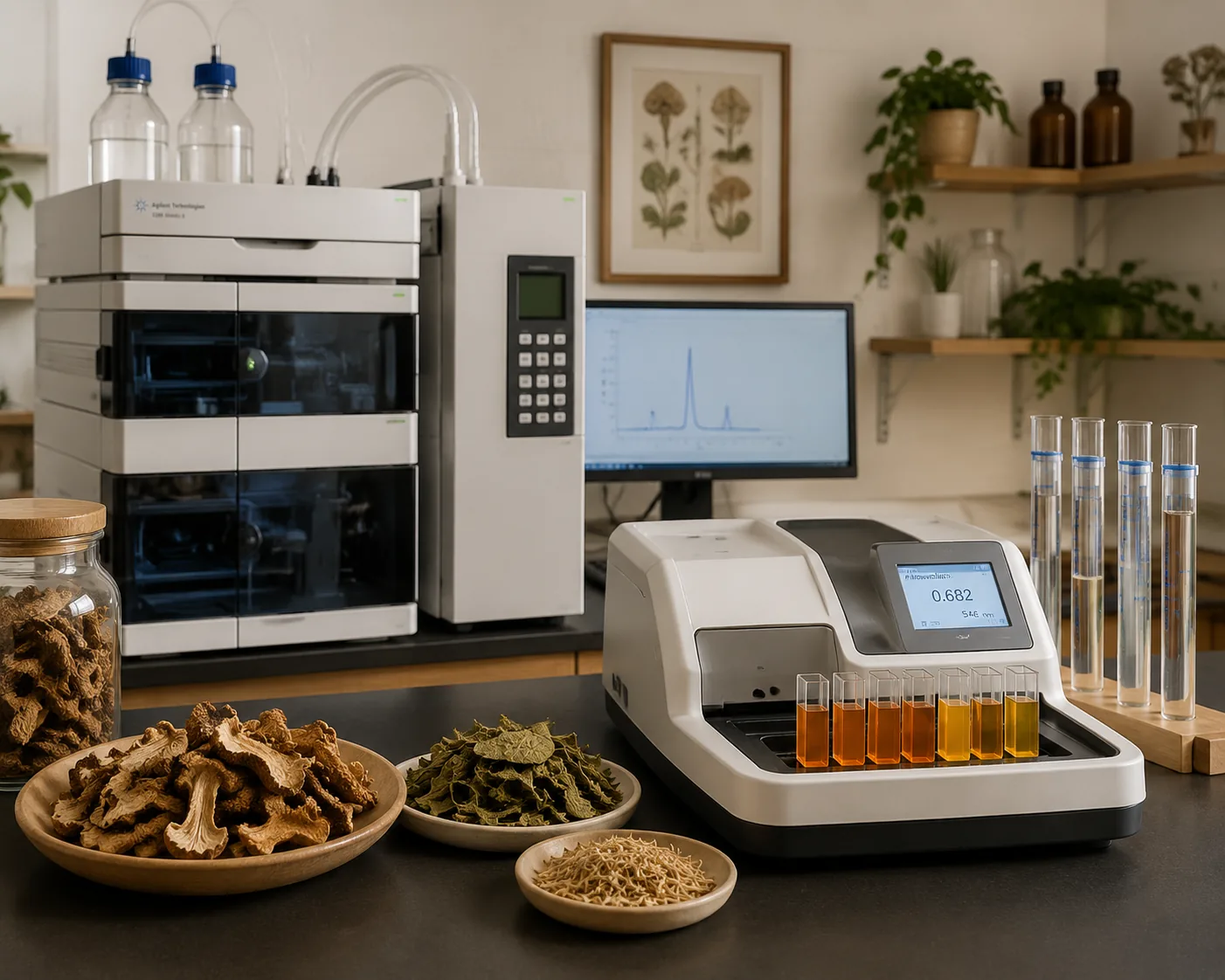
How is a mushroom β-glucan distinguished from starch adulteration?
The β-1,3/1,6-glucan of mushrooms and fungi is identified by the β-glucanase enzymatic assay (the Megazyme kit) — a specific β-1,3-glucanase hydrolyses the β-glucan but not the α-glucan (starch); the released glucose is measured. The starch (α-glucan) is measured separately by the amyloglucosidase / α-amylase enzymatic method. A "mushroom polysaccharide" that has high total sugar (phenol-sulfuric) but low β-glucan (β-glucanase) is likely starch-adulterated.
What polysaccharide tests are required for a Chinese health food filing?
The SAMR filing requires the total polysaccharide content declared on the label (by the phenol-sulfuric acid method per SN/T 4260-2015 / GB 16740-2014, within 80-120 % tolerance), the source identification (the monosaccharide fingerprint that traces the polysaccharide to the declared botanical / fungal source), the bioactivity (the SAMR function-evaluation test battery for the claim), and the stability (the polysaccharide content over the 24-month shelf life).
Our polysaccharide testing capabilities
Beijing ZKGX Research (ISO/IEC 17025 accredited, CMA- and CNAS-accredited testing laboratory) provides complete polysaccharide testing across the SN/T, GB, pharmacopeial, and FAO JECFA standard stack:
- Total polysaccharide content — the phenol-sulfuric acid method per SN/T 4260-2015; the glucose-equivalent calibration; the ethanol-precipitation sample preparation; the deproteinisation (Sevag / TCA / protease) for the protein-rich samples; reported as mg/g dry weight.
- Molecular weight and distribution (HPGPC-MALS) — the absolute Mw, Mn, PDI, and radius of gyration by HPGPC with multi-angle light scattering (Wyatt DAWN HELEOS) and refractive index; aqueous SEC column (Shodex OHpak / TSKgel PWxl / Agilent PL aquagel).
- Monosaccharide composition (PMP-HPLC) — TFA acid hydrolysis; PMP derivatisation; C18 reversed-phase HPLC at 250 nm; the molar ratio of glucose, galactose, mannose, arabinose, xylose, rhamnose, glucuronic acid, galacturonic acid. Alternative: ion chromatography with pulsed amperometric detection (Dionex IC-PAD).
- Structural characterisation — FT-IR (α vs β anomeric configuration; uronic acid; sulfate ester); 1D/2D NMR (¹H, ¹³C, COSY, HSQC, HMBC); methylation analysis (Hakomori / Ciucanu; GC-MS of PMAA); Congo Red triple-helix test.
- β-Glucan identification — the Megazyme β-glucanase enzymatic assay (mushroom and yeast β-1,3/1,6-glucan); the α-glucan (starch) assay by the amyloglucosidase / α-amylase method; the starch-adulteration detection.
- Uronic acid — the m-hydroxydiphenyl colorimetric method (galacturonic acid standard); for the pectin / gum / glycosaminoglycan polysaccharides.
- Sulfated polysaccharides — the DMMB colorimetric method for the sulfate content; the ¹H NMR for the sulfation pattern; for heparin, chondroitin sulfate, fucoidan, carrageenan.
- Pharmacopeial monograph conformance — Chinese Pharmacopoeia lentinan / polyporus polysaccharide / Ganoderma polysaccharide / Cordyceps polysaccharide; USP lentinan; EP chondroitin sulfate / heparin / hyaluronic acid.
- Health food filing support — total polysaccharide content per GB 16740-2014 / SN/T 4260-2015 within the 80-120 % tolerance; source identification; stability; SAMR function-evaluation partnership.
Suitable sample matrices include: mushroom and fungal polysaccharides (lentinan, schizophyllan, Ganoderma lucidum, Grifola frondosa, Cordyceps); herb and plant polysaccharides (Astragalus, Lycium barbarum, ginseng, Dendrobium, Spirulina); marine polysaccharides (alginate, carrageenan, fucoidan, chitosan, sea cucumber); glycosaminoglycans (heparin, chondroitin sulfate, hyaluronic acid, dermatan sulfate); microbial polysaccharides (xanthan, gellan, dextran, pullulan, curdlan); health food products; pharmaceutical injectables; dietary supplements. Each project is delivered with a full data report (test protocol, instrument calibration, raw UV-Vis / HPLC / MALS / NMR / GC-MS data, statistical analysis, identification-test evidence, classification conclusion per the applicable standard) in English and/or Chinese, with CMA/CNAS stamping. Contact Beijing ZKGX Research to scope the polysaccharide test applicable to your product and target market.