Wheat testing ensures quality control throughout the grain supply chain, from breeding programs to commercial milling and end-use product manufacturing. These tests evaluate physical properties, chemical composition, rheological characteristics, and end-product quality to meet both domestic and international market requirements.
This comprehensive guide covers all major wheat testing methods, from basic physical measurements to advanced rheological analyses. You'll learn how testing procedures assess milling quality, flour performance, and end-use suitability for diverse wheat-based products including bread, pasta, noodles, and flatbreads.
What you'll learn in this guide:
- Physical testing methods for grain quality
- Chemical analysis procedures and parameters
- Rheological testing for dough properties
- End-product evaluation methods
- Testing standards and regulations
- Quality criteria for different wheat classes
- Laboratory equipment and procedures
- Interpreting test results
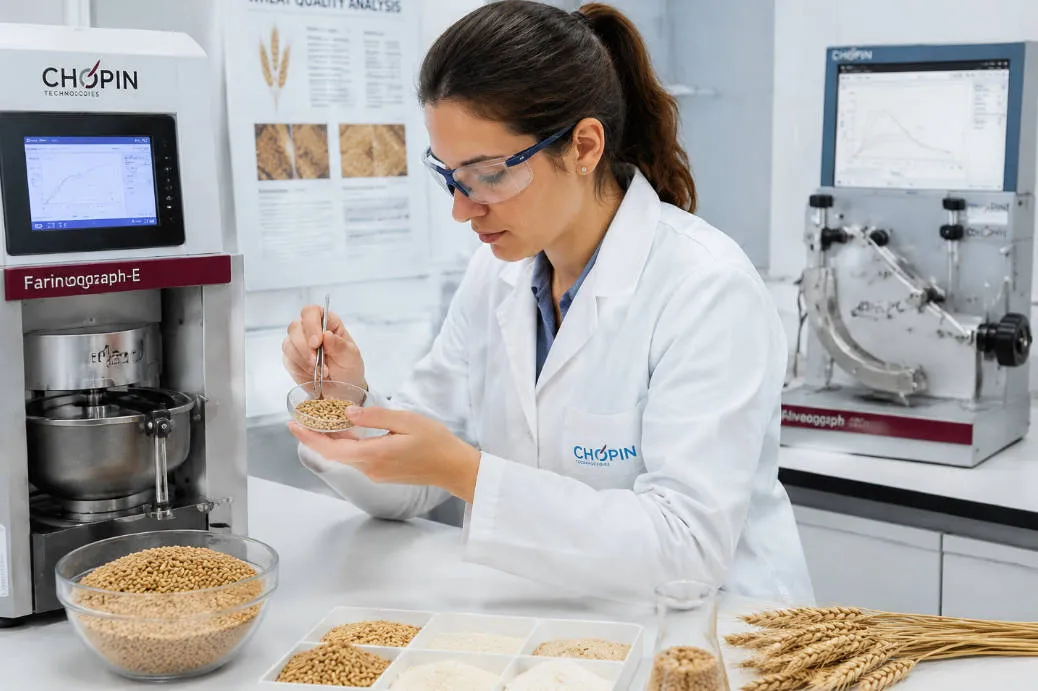
Importance of Wheat Testing
Wheat quality testing serves critical functions across the entire value chain, from variety development to commercial trade and food processing.
Key benefits of wheat testing:
Quality assurance: Testing verifies that wheat meets specified quality standards for intended end uses, ensuring consistent product performance.
Trade requirements: International wheat trade requires standardized testing to fulfill contract specifications and meet importing country regulations.
Variety development: Breeding programs use quality testing to select new varieties with improved end-use characteristics.
Milling optimization: Test data guides millers in wheat blending and milling processes to achieve target flour specifications.
food safety compliance: Testing ensures wheat products meet regulatory limits for contaminants, mycotoxins, and heavy metals.
Process control: Regular testing enables processors to maintain consistent product quality and identify issues before they affect production.
Physical Testing Methods
Grain Appearance Score
Grain appearance evaluates visual characteristics that influence market acceptance and price.
Evaluation Criteria:
- Size: Bold, uniform kernels preferred
- Shape: Attractive, well-filled grains
- Color: Amber golden color with natural luster
- Texture: Smooth, vitreous appearance
Scoring System:
Maximum score of 10 points for excellent quality. Grains with superior appearance command premium prices in domestic and export markets.
Thousand Grain Weight (TGW)
TGW measures kernel mass and indicates grain size and density.
Method:
- Count 1000 kernels using electronic counter
- Weigh kernels to nearest 0.1 gram
- Report as grams per 1000 kernels
Significance:
- Positively correlated with agronomic yield
- Strongly related to flour yield
- Influences milling quality
- Important for seed quality assessment
Typical Ranges:
- Bread wheat: 22-45 grams
- Durum wheat: 35-55 grams
Higher TGW indicates better filled grains with higher milling potential.
Test Weight
Test weight measures bulk density and indicates grain plumpness and milling potential.
Method:
- Use standardized 0.5 liter container
- Fill using Cox funnel for consistent pouring
- Level contents with striker
- Weigh grain and convert to kg/hL
Significance:
- Primary grading factor in wheat trade
- Rough index for flour yield prediction
- Affected by kernel size, shape, and density
- Influenced by moisture content and physical damage
Typical Values:
Indian wheats: 75-80 kg/hL
Higher test weight correlates with better milling quality and flour yield.
Grain Hardness
Grain hardness determines wheat classification and end-use suitability.
Testing Method: Single Kernel Characterization System (SKCS)
Procedure:
- Prepare sample by removing broken kernels and foreign material
- Analyze 50 individual kernels
- Record hardness index, weight, size, and moisture
Hardness Classification:
| Hardness Index | Classification | End-Use |
|----------------|----------------|---------|
| < 45 | Soft | Biscuits, cakes, pastries |
| 45-75 | Medium Hard | All-purpose flour |
| > 75 | Hard | Bread, noodles |
Importance:
- Determines milling requirements
- Affects starch damage during milling
- Influences flour particle size
- Critical for end-product quality
Flour Recovery (Milling Yield)
Flour recovery measures the percentage of flour obtained from wheat during milling.
Method:
- Clean wheat sample and determine moisture content
- Temper wheat to 14% moisture overnight
- Mill using laboratory mill (Brabender Quadrumat or Bühler)
- Weigh flour, bran, and shorts fractions
- Calculate extraction percentage
Equipment:
- Brabender Quadrumat Senior
- Bühler Laboratory Mill
- Chopin Laboratory Mill CD1
Extraction Rates:
- White flour: ≤75% extraction
- Straight-run flour: 75-80%
- Whole meal flour: ~100%
Significance:
Higher extraction rates increase protein content, fiber, and minerals but may reduce flour brightness and quality.
Damaged and Infected Kernels
Types of Damage:
- Sprout damage
- Insect damage
- Weather damage
- Disease infection
- Heat damage
Impact:
- Reduces grading value
- Lowers flour quality
- Affects product shelf life
- May cause off-flavors
Yellow Berry
Yellow berry refers to non-vitreous kernels, particularly important in durum wheat.
Characteristics:
- Starchy, opaque appearance
- Lower protein content
- Reduced semolina quality
- Decreased yellow pigment
Causes:
- Nitrogen fertility issues
- Environmental stress
- Genetic predisposition
Impact on Pasta Quality:
- Increased stickiness during cooking
- Reduced color quality
- Lower protein content
Speck Count
Speck count measures bran fragments and impurities in semolina.
Method:
- Spread semolina sample on flat surface
- Flatten surface and place grid
- Count visible specks within defined area
- Report specks per unit area
Significance:
- Affects semolina appearance
- Causes dark flecks in pasta
- Reduces consumer acceptability
- Important quality specification
Chemical Testing Methods
Moisture Content
Moisture content affects wheat storage, milling, and test result calculations.
Methods:
- Air-oven method (AACC 44-15.02)
- Near-infrared (NIR) spectroscopy
- UGMA moisture meters
Standard Basis:
- Wheat analysis: 13.5% moisture
- Flour analysis: 14.0% moisture
Importance:
- Critical for safe storage
- Affects milling efficiency
- Used for test result conversion
- Influences pricing and trade
Protein Content
Protein content is the most important quality parameter for bread-making quality.
Method: Combustion nitrogen analysis (CNA)
Procedure:
- Grind wheat on UDY cyclone mill (1.0 mm screen)
- Analyze 250 mg sample
- Calculate protein = nitrogen × 5.7
- Report on constant moisture basis
Equipment:
- LECO Truspec N analyzer
- Elementar rapid N cube
Significance:
- Determines bread-making potential
- Influences dough strength
- Affects water absorption
- Critical for end-use classification
Typical Ranges:
- Soft wheat: 8-11%
- Hard wheat: 11-14%
- Strong bread wheat: >13%
Ash Content
Ash content indicates mineral content and bran contamination in flour.
Method (AACC 08-01.01):
- Incinerate sample in muffle furnace
- Hard wheats: 590°C overnight
- Soft wheats: 550°C overnight
- Weigh ash residue
Significance:
- Indicates milling efficiency
- Measures bran contamination
- Affects flour color
- Important for flour specifications
Typical Values:
- Patent flour: 0.40-0.45%
- Straight-run flour: 0.50-0.55%
- Whole wheat: 1.5-2.0%
Gluten Content
Gluten proteins (gliadin and glutenin) determine dough properties.
Methods:
- Wet gluten content (AACC 38-12.02)
- Dry gluten content
- Gluten index
Gluten Index:
Measures gluten strength by centrifuging wet gluten through specialized sieve.
Significance:
- Indicates dough quality
- Predicts baking performance
- Important for flour specifications
- Varies with protein composition
Falling Number
Falling number measures α-amylase activity and sprout damage.
Method (AACC 56-81.04):
- Grind 300g wheat sample
- Mix 7g ground wheat with water
- Heat and stir to gelatinize starch
- Measure time for plunger to fall
Results:
Reported in seconds. Higher values indicate lower enzyme activity.
Interpretation:
-
300 seconds: Sound wheat, minimal sprout damage
- 250-300 seconds: Acceptable for most purposes
- <250 seconds: Significant sprout damage
- <200 seconds: Severe sprout damage, unsuitable for bread
Importance:
- Critical for bread-making quality
- Affects dough handling
- Influences bread texture
- Important grading factor
Sedimentation Value
Sedimentation test evaluates gluten quality and protein strength.
Method:
- Mix flour with lactic acid solution
- Allow sediment to settle
- Measure sediment volume
Significance:
- Indicates gluten strength
- Predicts bread-making quality
- Useful for variety screening
- Correlates with loaf volume
Higher sedimentation values indicate stronger gluten and better bread-making quality.
Yellow Pigment Content
Yellow pigment determines color quality, especially important for durum wheat.
Method:
- Extract pigments with solvent
- Measure absorption spectrophotometrically
- Calculate concentration as β-carotene equivalent
Importance for Durum Wheat:
- Determines semolina color
- Affects pasta appearance
- Influences consumer preference
- Quality specification for trade
Heavy Metals and Micronutrients
Heavy metal testing:
- Cadmium (Cd)
- Lead (Pb)
- Arsenic (As)
- Mercury (Hg)
Method: ICP-MS (Inductively Coupled Plasma Mass Spectrometry)
Micronutrient Analysis:
- Iron (Fe)
- Zinc (Zn)
- Copper (Cu)
- Manganese (Mn)
Significance:
- Food safety compliance
- Nutritional quality assessment
- Biofortification programs
- Regulatory requirements
Rheological Testing Methods
Farinograph
The farinograph measures dough mixing properties and water absorption.
Method (AACC 54-21.02):
- Use constant flour weight procedure (50g bowl)
- Add water to reach 500 BU consistency
- Record mixing curve
Parameters Measured:
- Water absorption: Percentage of water needed for standard consistency
- Dough development time: Time to reach peak consistency
- Stability: Duration of dough stability at 500 BU
- Mixing tolerance index: Drop in consistency 5 minutes after peak
Significance:
- Predicts dough mixing requirements
- Indicates flour strength
- Guides processing adjustments
- Important specification parameter
Alveograph
The alveograph measures dough extensibility and resistance to extension.
Method (AACC 54-30.02):
- Prepare dough at standard hydration
- Blow air bubble in dough sheet
- Record pressure curve during inflation
Parameters:
- P (maximum height): Dough resistance/tenacity
- L (curve length): Dough extensibility
- W (curve area): Dough strength/energy
- P/L ratio: Balance between strength and extensibility
Applications:
- Predicts bread-making quality
- Evaluates gluten strength
- Guides variety selection
- Used in flour specifications
Extensograph
The extensograph measures dough resistance to extension over time.
Method (AACC 54-10.01):
- Mix dough with salt and water
- Shape into cylinder
- Stretch dough piece at controlled rate
- Record resistance and extension
Parameters:
- Maximum resistance (Rmax): Maximum force during extension
- Extensibility (E): Distance dough stretches
- Energy (area): Work required for extension
Significance:
- Evaluates dough handling properties
- Predicts bread quality
- Assesses gluten quality
- Important for flour blending
Mixograph
The mixograph provides rapid assessment of dough mixing properties.
Advantages:
- Small sample size (10-35g)
- Rapid test (5-8 minutes)
- Good for early-generation screening
- Predicts bread-making quality
Parameters:
- Peak time
- Peak height
- Mixing tolerance
- Bandwidth
End-Product Testing Methods
Bread Baking Test
Bread baking tests evaluate flour performance in actual product.
Methods:
Canadian Short Process (CSP):
- 200g flour basis
- Uses ascorbic acid as oxidant
- 2% salt, reduced formulation
- No fermentation time
Lean No Time (LNT) Method:
- 150g flour basis
- No oxidant
- 1% salt and shortening
- More discriminating than CSP
Sponge and Dough Method:
- 4.5 hour fermentation
- 70% sponge system
- Traditional commercial process
Parameters Evaluated:
- Loaf volume: Primary quality indicator (reported per 100g flour)
- Loaf top ratio: (Height - Pan height) / Width
- Crumb structure: Visual assessment
- Crust color: External appearance
- Texture: Softness and resilience
Cookie Baking Test
Cookie tests evaluate soft wheat flour quality.
Methods:
- Sugar-snap cookie (AACC 10-50.05)
- Wire-cut cookie (AACC 10-53.01)
Parameters:
- Cookie diameter
- Spread factor
- Surface characteristics
- Texture
Pasta Quality Testing
Pasta testing evaluates durum wheat semolina quality.
Procedures:
Spaghetti Processing:
- Mix semolina and water to uniform crumbs
- Extrude through 1.8mm Teflon-coated die
- Dry at 85°C
Quality Tests:
- Color: L, a, b* values using colorimeter
- Firmness: Texture analyzer, cutting force
- Cooking quality: Cooking loss, water absorption
- Diameter: Caliper measurement of dry and cooked pasta
Chapati Quality
Chapati testing evaluates flour quality for flatbread.
Procedure:
- Mix flour, water, and salt
- Rest dough
- Sheet into thin rounds
- Bake on hot plate
Parameters:
- Puffing characteristics
- Texture (softness, pliability)
- Color
- Eating quality
Testing Standards and Regulations
International Standards
AACC International: Approved Methods of Analysis
- Standard methods for wheat and flour testing
- Widely used in North America
ICC (International Association for Cereal Science and Technology):
- European standard methods
- International harmonization
ISO Standards:
- International Organization for Standardization
- Globally recognized test methods
National Standards
United States:
- USDA Federal Grain Inspection Service (FGIS)
- Grade standards and testing procedures
Canada:
- Canadian Grain Commission
- Official Grain Grading Guide
India:
- Bureau of Indian Standards (BIS)
- FSSAI regulations
Vietnam:
- TCVN standards
- QCVN technical regulations
Food Safety Requirements
Mycotoxin Limits:
- Aflatoxin B1
- Total aflatoxins
- Ochratoxin A
- Deoxynivalenol (DON)
Heavy Metal Limits:
- Lead, cadmium, arsenic, mercury
- National and international maximum limits
Microbiological Criteria:
- Total aerobic count
- Coliforms and E. coli
- Pathogens (Salmonella, etc.)
- Yeast and mold counts
Quality Criteria for Different Wheat Classes
Hard Red Spring Wheat
Primary Uses: Bread, rolls, high-quality baked goods
Key Quality Parameters:
- Protein content: 13-15%
- High gluten strength
- Good water absorption
- Sound grain (high falling number)
Hard Red Winter Wheat
Primary Uses: Bread, noodles, all-purpose flour
Key Quality Parameters:
- Protein content: 11-13%
- Medium to strong gluten
- Good milling quality
- Versatile baking quality
Soft Red Winter Wheat
Primary Uses: Cakes, cookies, pastries, crackers
Key Quality Parameters:
- Protein content: 8-11%
- Soft kernel texture
- Low water absorption
- Weak gluten
Durum Wheat
Primary Uses: Pasta, couscous, semolina products
Key Quality Parameters:
- Protein content: 12-14%
- Hard, vitreous kernels
- High yellow pigment
- Strong gluten
- Low speck count
Soft White Wheat
Primary Uses: Cakes, pastries, noodles, flatbreads
Key Quality Parameters:
- Low protein (8-11%)
- Soft texture
- White color
- Low ash content
testing equipment and Laboratory Setup
Essential Equipment
Physical Testing:
- Electronic kernel counter
- Test weight apparatus
- SKCS hardness tester
- Laboratory mills (Brabender, Bühler, Chopin)
Chemical Testing:
- Moisture meters (NIR, oven)
- Protein analyzers (combustion method)
- Spectrophotometer
- ICP-MS for metals
Rheological Testing:
- Farinograph
- Alveograph
- Extensograph
- Mixograph
Product Testing:
- Dough mixer
- Baking oven
- Texture analyzer
- Colorimeter
Laboratory Requirements
Environmental Control:
- Temperature: 21±1°C
- Relative humidity: 60±5%
- Controlled for consistent results
Sample Handling:
- Proper sample identification
- Appropriate storage conditions
- Representative sampling procedures
Quality Assurance:
- Certified reference materials
- Inter-laboratory comparisons
- Method validation
- Equipment calibration
Interpreting Test Results
Understanding Variability
Sources of Variation:
- Genetic differences (variety)
- Environmental conditions (location, year)
- Crop management practices
- Storage and handling
Statistical Measures:
- Mean values for quality traits
- Standard deviation
- Coefficient of variation
- Least significant difference (LSD)
Quality vs. Price Relationships
Premium Quality Factors:
- High protein content (for bread wheat)
- Strong gluten strength
- Sound grain (no sprout damage)
- Good milling quality
- Appropriate kernel hardness
Price Discounts:
- Low protein content
- Sprout damage (low falling number)
- High foreign material
- Poor test weight
- Damage and defects
Decision-Making Applications
Variety Selection:
- Match quality profile to target market
- Consider environment × genotype interaction
- Balance yield and quality
Wheat Buying:
- Specify quality requirements
- Test representative samples
- Verify contract specifications
Flour Milling:
- Blend wheats to achieve specifications
- Optimize extraction rate
- Monitor quality consistently
Food Processing:
- Select flour appropriate for product
- Adjust formulation based on test results
- Maintain process control
Frequently Asked Questions
What are the most important wheat quality tests?
The most critical tests depend on intended end use. For bread-making, protein content, gluten strength, and falling number are most important. For pasta, protein content, yellow pigment, and kernel vitreousness are key. For cookies and cakes, kernel softness and low protein are critical.
How often should wheat testing be performed?
Testing frequency depends on the application. Breeding programs test throughout variety development. Commercial operations test each incoming lot. Mills test continuously for process control. Regulatory testing follows specified schedules for food safety.
What is the difference between protein content and protein quality?
Protein content measures the amount of protein in wheat or flour. Protein quality refers to the composition and functionality of gluten proteins. Two samples with identical protein content may have very different bread-making quality due to differences in protein composition.
Why is falling number important?
Falling number measures α-amylase enzyme activity, which increases when wheat sprouts. High enzyme activity degrades starch during baking, causing sticky dough, poor bread texture, and reduced volume. Sprout-damaged wheat is severely discounted in trade.
How do environmental conditions affect wheat quality?
Environment strongly influences protein content and quality. Drought and heat stress typically increase protein content but may reduce quality. Rainfall before harvest can cause sprout damage. Soil fertility affects protein and mineral content. Variety selection must consider local growing conditions.
What specifications should wheat buyers specify?
Key specifications include protein content, moisture, test weight, foreign material, damaged kernels, and falling number. Additional specifications may include variety, origin, pesticide residues, mycotoxin limits, and specific quality parameters relevant to intended use.
Conclusion
Wheat testing provides the essential data foundation for quality-based decision-making throughout the grain value chain. Understanding testing methods, interpreting results accurately, and applying this knowledge to practical decisions enables breeders, traders, millers, and processors to optimize quality and value.
Comprehensive testing programs that include physical, chemical, and rheological analyses, combined with end-product testing, provide the most complete assessment of wheat quality. Standardized methods and proper laboratory procedures ensure reliable, comparable results that support quality improvement and market development.
Key takeaways:
- Physical tests evaluate grain characteristics and milling quality
- Chemical analyses measure composition and food safety
- Rheological tests predict dough and product performance
- End-product testing confirms suitability for intended use
- Testing standards ensure consistency across laboratories
- Quality specifications must match end-use requirements
- Environmental factors significantly influence quality traits
- Regular testing enables process control and quality improvement
The investment in proper wheat testing pays dividends through improved quality, reduced waste, better process control, and enhanced market competitiveness. Testing programs serve as essential tools for successful wheat production, trade, and processing operations.
Note: This article provides general guidance on wheat testing methods and quality evaluation. Always consult current testing standards, regulatory requirements, and specific industry specifications for detailed procedures and acceptance criteria.