What Is a Wire Tensioner, and What Does Testing It Mean?
A wire tensioner (紧线器 / come-along / puller-tensioner) is the hand- or lever-operated load-holding device used to pull conductor, guy wire or cable up to sag tension during overhead-line, guyed-mast and fencing construction, then hold that load while the termination is made. It is a load-bearing safety tool, not an accessory — if its jaw slips or its body fractures under strain, the stored energy in the tensioned wire releases violently and injures the operator. Wire tensioner testing is therefore the mechanical qualification and periodic verification of that load-bearing performance, governed in China by the power-industry construction-tool framework: DL/T 875-2016 (架空输电线路施工机具基本技术要求 — basic requirements for transmission-line construction tools), DL/T 2131-2020 (架空输电线路施工卡线器 — conductor-holding/clamping tools), DL/T 1741 (double-hook tensioners, static load test), GB/T 12167-2006 (live-working aluminium-alloy conductor clamps), and the in-service preventive-test regime of DL/T 1476. It is distinct from the tensile testing of the wire itself (which is the wire-rope or conductor breaking-force test) — here the tool that tensions the wire is the subject.
Why a Wire Tensioner Is a Safety-Critical Construction Tool
Two physics facts make tensioner testing mandatory rather than optional. First, the tool carries the full running tension of the conductor during stringing — typically tens of kN for a medium-span overhead conductor, applied by a hand-operated lever that multiplies the operator's force many times. Second, a high-tensile steel wire or ACSR conductor under that load stores elastic energy; if the jaw grip slips, the wire whips back as a projectile. Published field experience is blunt about this: half a kilogram of wire released with ~200 kgf behind it is a serious injury hazard, which is why the dominant failure mode that the standards guard against is jaw slip under load, not body rupture. A tensioner that "pulls and holds" on the bench is not proof it will hold in service — the test must reproduce the worst-case load, jaw wear and conductor surface condition.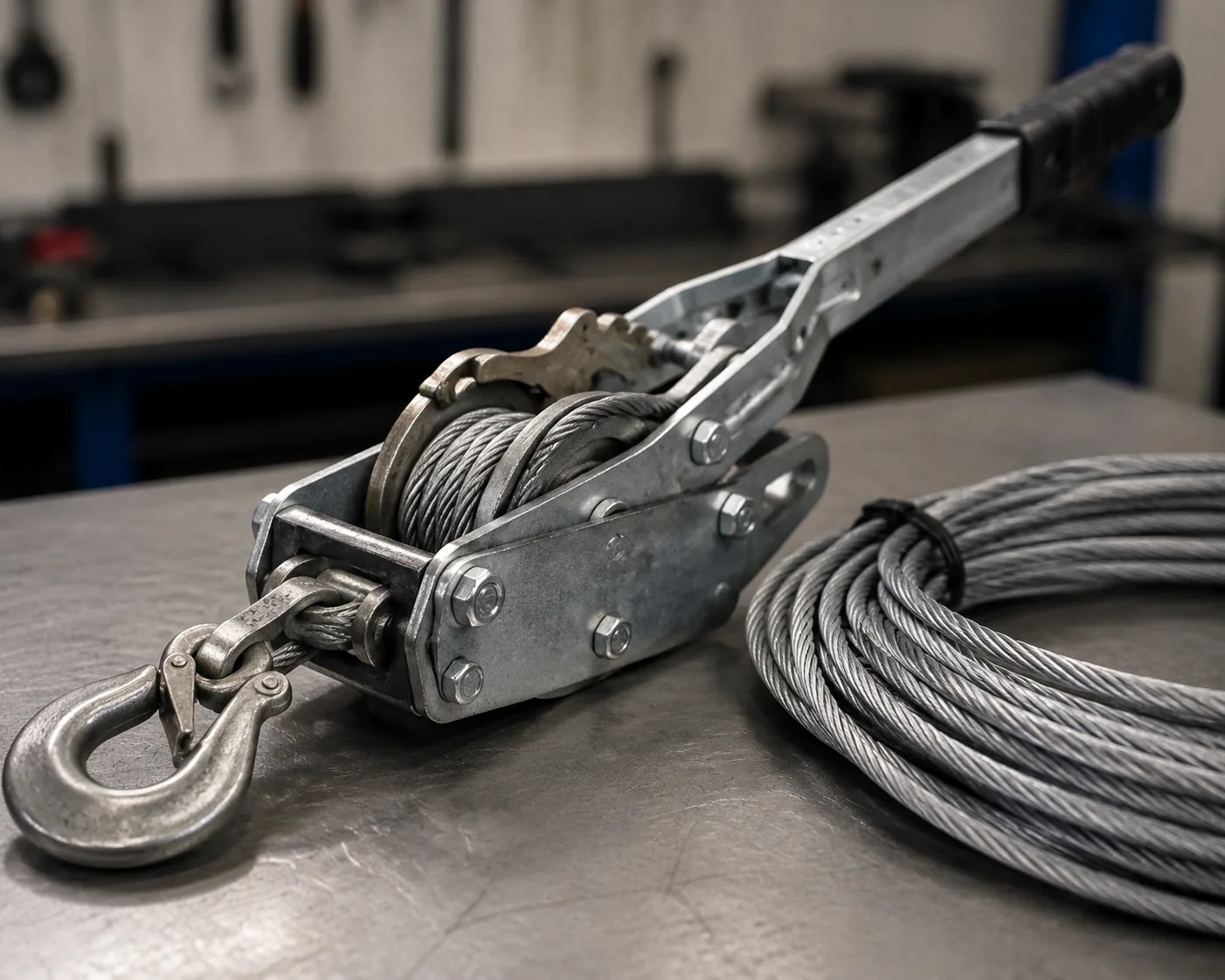
What Are the Core Mechanical Tests?
The test program for a wire tensioner or holding clamp follows the construction-tool framework of DL/T 875-2016, specialised by product standard (DL/T 2131 for clamps, DL/T 1741 for double-hook tensioners). The mechanical tests are:
- Rated load test (额定荷载试验) — apply the declared rated working load (common commercial ratings 10 kN / 20 kN / 30 kN, i.e. "1 t / 2 t / 3 t" tools), hold, and verify the tool functions correctly with no permanent deformation and no jaw slip. This is the working-load proof test.
- Overload / proof load test (过载试验) — apply a multiple of the rated load (commonly 1.25× to 1.5× rated for dynamic/proof performance per the construction-tool requirement), hold, and verify no slip, no fracture, no permanent deformation that impairs function. The overload proves the safety margin above rated.
- Breaking force test (破断力试验) — load to destruction and record the ultimate breaking force. Pass criterion is the safety factor: breaking force ≥ 3 × rated load, the long-standing construction-tool requirement for load-bearing lifting/tensioning gear. A tool that breaks at less than three times its rated load has insufficient reserve.
- Jaw grip / slip test (钳口握力 / 滑移试验) — the test that catches a worn or mismatched jaw. A conductor sample of the declared size is clamped in the tool under a specified grip load, tension is applied, and the load is held for a defined period (the DL/T 1099 clamp-grip test method holds the grip load for 60 s, pass criterion = no slip). This is the test most sensitive to jaw geometry, surface hardness and conductor compatibility.
- Operating-function test — verify the ratchet/lever/chain-walking mechanism cycles freely, the release releases under control, and any load-holding brake holds positively at rated load.
Why the Slip Test Is the One That Catches Bad Tools
Most of the tensioners in field use fail not by breaking but by slipping, and the mechanism is well documented. Modern high-tensile (HT) fencing wire and ACSR conductor are harder than the cast-metal jaws of older grip designs; with use, the jaw forms a groove at the grip point, the groove widens, and one day the wire slips through it. The standards counter this in three ways that a test report should verify:
- Jaw material hardness — the jaw must be harder than the wire it grips; a worn jaw with a formed groove fails the grip test. Newer designs use high-tensile steel jaws specifically to resist grooving.
- Grip-vs-conductor compatibility — a jaw rated for ACSR may slip on a harder steel guy wire; the test must use the conductor the tool is declared to grip.
- Spring-loaded / positive-hold jaw — designs that release the moment the operator stops pulling are inherently less safe than those that lock on; the load-hold test verifies the jaw stays engaged without continuous operator force.
This is also why a generic "1 tonne" or "2 tonne" rating on a catalog page is not enough — the rating only holds for the conductor size and type the jaw was tested against.
How Do the Different Tensioner Types Compare on Test?
| Type | Working principle | Dominant test concern |
|---|---|---|
| Lever-hoist (ratchet) come-along | Ratchet lever winds cable onto a drum; fine 3 mm increments; operator stands off-line | Overload safety, brake slip at rated |
| Chain-walker (chain grab) | Hook engages chain links, cranked back-and-forth; fast on long strains | Coarse 40 mm increments → overtension/break risk on short strains; finger-trap hazard |
| Double-hook tensioner (双钩紧线器) | Two opposed hooked rods, screw-adjusted span (DL/T 1741) | Static load test, hook deformation, screw engagement |
| Conductor clamp / 卡线器 | Jaw grips conductor during tensioning/holding (DL/T 2131, GB/T 12167) | Jaw slip test against declared conductor |
| Torque-tensioner (bolt torsion, Ilizarov-type medical) | Bolt torsion stretches wire by feel | Target tension accuracy (90–130 kg range) |
Each type has a different dominant failure mode — ratchet brakes slip, chain-walkers overtension, double-hooks bend hooks, clamps slip jaws — so the test plan must be selected by tool type, not run as one generic script.
What Is the In-Service Preventive-Test Regime?
A tensioner is treated as a periodically re-testable safety tool under the power-sector preventive-test code (DL/T 1476 for electrical-safety tools; the construction-tool framework for the mechanical side). The in-service regime:
- Register every tool — by type, rated load, serial, issue date and last-test date.
- Pre-use visual check — jaw wear/grooving, hook deformation, bent levers, frayed cable, cracked body, missing labels. Any visible damage removes the tool from service regardless of test date.
- Periodic proof-load retest — at the interval the construction-tool code sets (commonly annual for actively-used tensioners), re-run the rated-load and overload proof tests on the intact tool, with jaw-slip verification against a sample conductor.
- Retire on age/wear — jaws with formed grooves are retired or re-faced, not "tested through"; the groove is itself the failure, and the slip test only confirms what is already visible.
- Document the conductor pairing — the test record should name the conductor type/size the tool was grip-tested against, because a pass on one conductor is not a pass on all.
For the underlying load-bearing-element testing that the tensioner's cable or chain relies on, see our Steel wire rope testing; for the fastener side, Fastener testing; and for the wider construction-tool cluster, Scaffolding testing.
FAQ
What is the difference between testing a wire tensioner and testing the wire itself?
Testing the wire (wire-rope or conductor breaking-force test, e.g. ASTM A931 / GB/T 8358) measures the wire's tensile strength. Testing the tensioner measures the tool that pulls the wire — its rated-load proof, overload margin, breaking-force safety factor, and most importantly its jaw grip/slip behaviour. A tool can pass on a perfect wire and still slip on a worn jaw.
What does a "1 tonne" / "2 tonne" tensioner rating mean?
It is the rated working load the tool is designed to pull and hold — 10 kN for "1 t", 20 kN for "2 t", 30 kN for "3 t". It is not the breaking load: the construction-tool framework requires the breaking force to be at least 3× the rated load (safety factor). And the rating only holds for the conductor size and type the jaw was tested against — a "2 t" clamp that passed on ACSR may slip on a steel guy wire.
Why is the slip (grip) test the most important one?
Because most field failures are slips, not breaks. A worn or mismatched jaw forms a groove, the wire slips through it, and the stored energy whips the wire back as a projectile. The 60-second hold-at-grip-load test (DL/T 1099 method) is the one that catches this before service.
How often should a tensioner be retested?
It is a periodically re-testable safety tool: commonly annual proof-load retest for actively used tools, with pre-use visual checks every shift and immediate removal on any visible jaw grooving, hook deformation or cable damage. The construction-tool and power-sector preventive-test codes set the exact interval by tool class and service duty.
Can I use a tensioner on any wire of the right size?
Not safely. The jaw geometry and hardness are matched to a declared conductor type (e.g. ACSR vs steel guy wire vs HT fencing wire). A jaw that grips ACSR cleanly may slip on harder HT steel because the jaw is softer than the wire and grooves immediately. The test report should always name the conductor the tool was grip-tested against.
Our Testing Capabilities
As an ISO/IEC 17025-accredited third-party laboratory, Beijing ZKGX Research provides wire tensioner and conductor-clamp testing aligned to the DL/T construction-tool and conductor-clamp framework:
- Rated-load and overload proof tests to DL/T 875-2016, at the declared rated load (10 / 20 / 30 kN classes) and overload multiple (1.25× / 1.5×), verifying no slip, no fracture, no impairing permanent deformation.
- Breaking-force test with safety-factor verification (breaking force ≥ 3× rated load), per the construction-tool requirement.
- Jaw grip / slip test to the DL/T 1099 method (hold the grip load for 60 s, pass = no slip), against the declared conductor type and size.
- Type-specific tests — double-hook tensioner static-load and hook-deformation test (DL/T 1741), conductor-clamp product test (DL/T 2131), live-working aluminium-alloy clamp (GB/T 12167).
- In-service periodic retest with documentation of conductor pairing, jaw condition and proof-load result.
Sample types include lever-hoist come-alongs, chain-walker tensioners, double-hook tensioners, conductor clamps (卡线器) and live-working aluminium-alloy clamps. If you have a specific tool type, rated load, target conductor, or compliance standard, contact the laboratory to confirm the exact test set and reporting format.