Meta Description: Learn about rebar testing methods including tensile testing, bond strength testing, bend tests, and surface geometry inspection. Discover international standards, quality assurance requirements, and testing procedures for steel reinforcing bars. (200 characters)
Rebar testing ensures the quality, safety, and performance of steel reinforcing bars used in concrete construction. These tests verify that reinforcing steel meets mechanical property requirements, bond characteristics, and chemical composition specifications essential for structural integrity.
This comprehensive guide covers all critical rebar testing methods, from tensile and bend tests to surface geometry inspection and chemical analysis. You'll learn how testing procedures ensure compliance with international standards like ISO 15630-1, ASTM E488, and BS 4449, supporting safe and durable concrete structures.
What you'll learn in this guide:
- Mechanical testing methods and their significance
- Bond strength testing procedures and requirements
- Surface geometry and rib inspection techniques
- Chemical composition analysis and specifications
- Galvanized rebar testing procedures
- International testing standards and compliance
- Quality assurance and certification requirements
- testing equipment and best practices
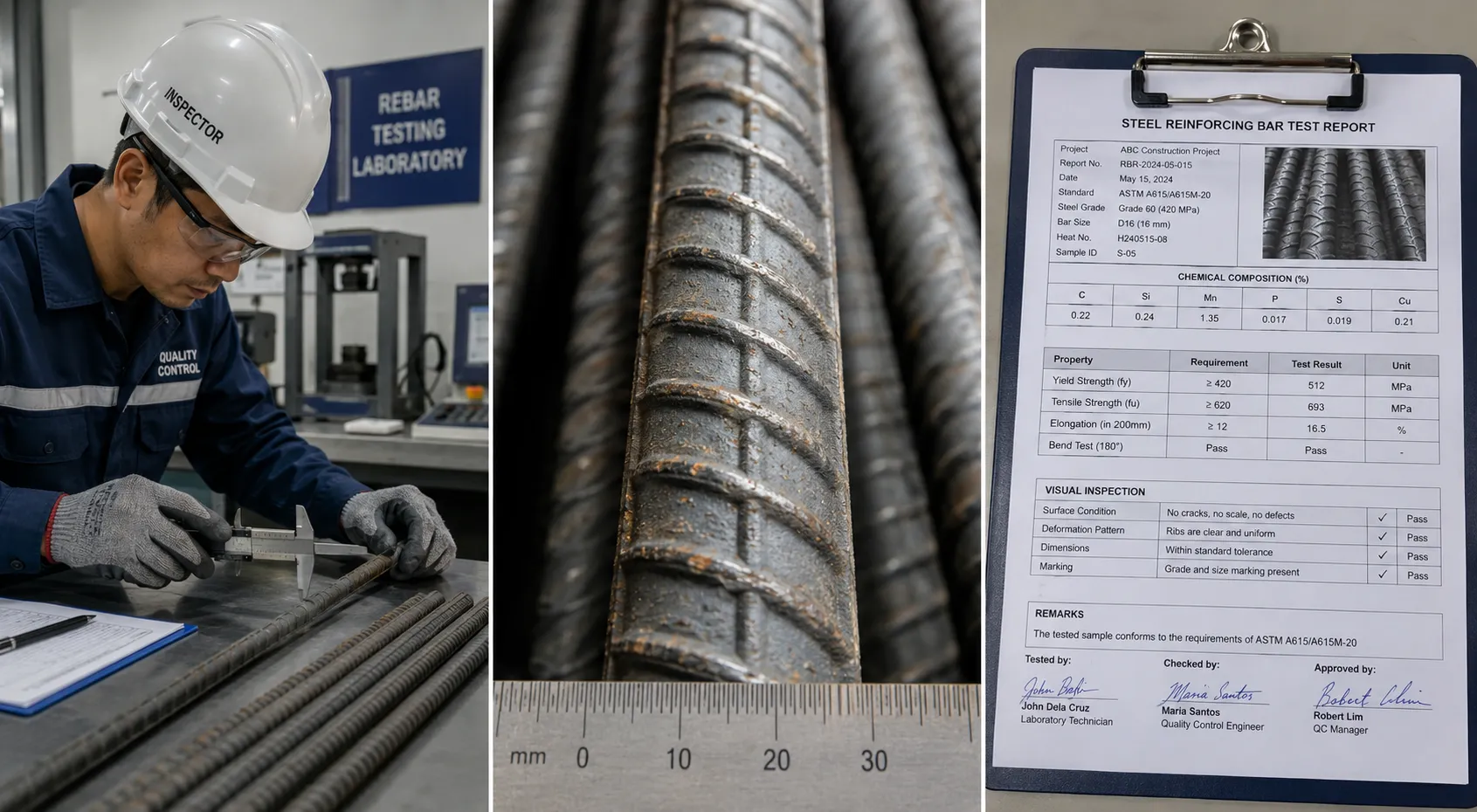
Importance of Rebar Testing
Steel reinforcing bars provide critical structural strength to concrete elements. The quality of reinforcement directly impacts the safety, durability, and load-bearing capacity of concrete structures. Testing serves multiple essential purposes:
Safety verification: Testing confirms that reinforcing bars meet specified strength requirements, preventing structural failures that could result in injury or property damage.
Quality assurance: Systematic testing identifies non-conforming materials before they are incorporated into structures, maintaining construction quality standards.
Compliance documentation: Test results provide documented evidence that materials meet project specifications and regulatory requirements.
Performance prediction: Testing data helps engineers predict how reinforcement will perform under various loading conditions throughout the structure's service life.
Cost prevention: Identifying defective materials early prevents costly remediation work after concrete placement.
Mechanical Testing Methods
Tensile Testing
Tensile testing is the most fundamental mechanical test for reinforcing steel, measuring strength and ductility properties essential for structural performance.
Test Procedure:
- Select test specimen of appropriate length from the rebar batch
- Mount specimen in universal testing machine jaws
- Apply increasing axial load until failure
- Record yield strength, tensile strength, and elongation
Key Measurements:
Yield strength (Re): Stress at which the steel begins to deform plastically. For grade 500 bars, yield strength must reach at least 500 MPa. Upper yield strength (ReH) applies for grade 500 bars, measured as maximum stress prior to first force decrease.
Tensile strength (Rm): Maximum stress the material can withstand. Calculated using nominal cross-sectional area.
Tensile/yield strength ratio (Rm/Re): Indicates ductility and strain hardening capacity. For grade 500B, minimum ratio is 1.08; for grade 500C, range is 1.15 to 1.35.
Total elongation at maximum force (Agt): Measures ductility. Grade 500B requires minimum 5.0% elongation; grade 500C requires minimum 7.5%.
Testing Standards:
- ISO 15630-1: Test methods for reinforcement steel
- ASTM E488: Tensile testing of metallic materials
- BS 4449: Steel reinforcing bar specifications
Acceptable Results (ISO 15630-1):
| Steel Grade | Yield Strength (MPa) | Tensile Strength (MPa) | Agt (%) |
|---|---|---|---|
| FeB450C | 450 | 540 | 7.5 |
| FeB450A | 450 | 540 | 3.0 |
| FeB500 | 500 | 550 | 5.0 |
| FeB500C | 500 | 550 | 7.0 |
Equipment Requirements:
Universal testing machines with capacity up to 2,000 kN, video extensometers for non-contact strain measurement, and data acquisition software for accurate result recording.
Bend and Rebend Tests
Bend tests evaluate ductility and the ability of reinforcing bars to withstand bending during construction without cracking or fracture.
Test Procedure:
- Support specimen on two points or in bending fixture
- Apply force at center point to achieve specified bend angle
- For rebend test, bend specimen to specified angle, then reverse bend
- Inspect specimen for cracks or fractures
Test Parameters:
- Bend angle: Typically 90° or 180°
- Rebend angle: Usually 20° reversal from bent position
- Mandrel diameter: Depends on bar diameter and steel grade
Acceptance Criteria:
After testing, specimens must show no signs of fracture or visible cracks. The test verifies that the steel has adequate ductility for construction bending operations.
Testing Requirements:
- One test specimen per test unit and nominal diameter
- Test specimens must be straight befOre testing
- Bending must be performed smoothly without impact loading
Fatigue Testing
Fatigue testing assesses resistance to cyclic loading, critical for structures subjected to repeated vibrations and stress cycles during service life.
Test Method:
Specimens undergo millions of load cycles (typically 2 to 5 million cycles) at specified stress ranges. The test verifies structural stability under repeated loading.
Fatigue Test Requirements:
- Each test unit comprises ten test specimens
- Five specimens tested per diameter
- Stress ranges specified based on bar diameter
- Maximum stress and minimum stress defined
Acceptance Criteria:
All five test specimens must endure 5 × 10^6 cycles without failure. If one specimen fails, five additional specimens are tested. If one of these fails, the batch does not comply.
Applications:
Fatigue testing is particularly important for:
- Bridge structures with traffic loading
- Machinery foundations with vibration
- Structures with wind or seismic cyclic loads
- Railway and transit structures
Bond Strength Testing
Bond Strength Test for Galvanized Rebar
Bond strength testing measures the adhesion between reinforcing bars and concrete, critical for composite structural action.
Test Method: ASTM A944
Beam-end specimens test bond strength by measuring pullout resistance. The bond relies primarily on bar deformation rather than zinc-to-concrete bond. For plain bars, the zinc-concrete bond becomes critical.
Test Results:
Hot-dip galvanized reinforcing steel has demonstrated bond strength equivalent to or better than black steel in multiple tests. The galvanized coating does not adversely affect bond performance.
Beam Test for Bond Property
Test Procedure:
- Cast rebar specimen in concrete beam
- Apply load to create bond stress
- Measure slip at various load levels (0.01mm, 0.1mm, 1mm)
- Record bond stress at maximum force
Bond Stress Requirements:
Bond stresses must satisfy:
- τm ≥ 0.098 × (80 − 1.2d)
- τr ≥ 0.098 × (130 − 1.9d)
Where:
- d = nominal bar diameter (mm)
- τm = mean bond stress at specified slip levels
- τr = bond stress at failure by slipping
Surface Geometry and Rib Testing
Importance of Rib Geometry
The ribs on reinforcing bars play a critical role in bonding reinforcement to concrete through mechanical interlocking. Proper rib geometry ensures adequate bond strength for structural performance.
Rib Parameters:
Rib height (h): Distance from rib peak to core surface. Must be 0.03d to 0.15d of nominal diameter.
Rib spacing (c): Distance between consecutive transverse ribs. Must be 0.4d to 1.2d.
Rib inclination angle (β): Angle between transverse rib axis and bar axis. Must be 35° to 75°.
Transverse rib flank inclination angle (α): Must be ≥ 45° with radiused transition to core.
Rib Testing Procedures
Visual Inspection:
Inspectors visually examine rebar samples to check rib geometry, including size, shape, number of ribs, and configuration of transverse and longitudinal ribs.
Measurement Methods:
- Direct measurement with precision gauges
- Mathematical calculation based on weight and length
- Surface geometry measurement equipment
Relative Rib Area (fR):
Relative rib area measures the projected rib area divided by rib spacing and nominal circumference. Higher values indicate better bond potential.
Minimum Relative Rib Area Requirements:
| Nominal Bar Size (mm) | Minimum Relative Rib Area (fR) |
|---|---|
| d ≤ 6 | 0.035 |
| 6 < d ≤ 12 | 0.040 |
| d > 12 | 0.056 |
Rib Configuration Standards
Grade 500B Pattern:
- Two or more series of parallel transverse ribs
- For two or three rib series: one series at contrary angle
- For four rib series: two series at contrary angle
Grade 500C Pattern:
- Same arrangement as grade 500B
- Ribs alternate between higher and lower angles
- Angle difference must be at least 10°
Chemical Composition Testing
Chemical Analysis Requirements
Chemical composition testing ensures steel has appropriate elements for strength, ductility, and weldability. Testing verifies compliance with specified limits.
Test Method:
One analysis per test unit. Cast analysis performed by the manufacturer.
Chemical Composition Limits (maximum % by mass):
| Element | Grade 250 Cast | Grade 500B/500C Cast | Grade 250 Product | Grade 500B/500C Product |
|---|---|---|---|---|
| Carbon | 0.22 | 0.22 | 0.24 | 0.24 |
| Sulphur | 0.05 | 0.05 | 0.055 | 0.055 |
| Phosphorus | 0.05 | 0.05 | 0.055 | 0.055 |
| Nitrogen | 0.012 | 0.012 | 0.014 | 0.014 |
| Copper | 0.80 | 0.80 | 0.85 | 0.85 |
Carbon Equivalent Value
Carbon equivalent (Ceq) indicates weldability and is calculated as:
Ceq = C + Mn/6 + (Cr + Mo + V)/5 + (Ni + Cu)/15
Maximum Carbon Equivalent:
- Grade 250: 0.42 (cast analysis), 0.44 (product analysis)
- Grade 500B/500C: 0.50 (cast analysis), 0.52 (product analysis)
Higher nitrogen content is permissible if sufficient nitrogen-binding elements are present to limit free nitrogen.
Galvanized Rebar Testing
Chromate Finish Test
Chromate coating on galvanized rebar prevents hydrogen formation during concrete curing.
Test Method: ASTM B201
Verifies chromate coating presence on zinc surfaces. Chromate conversion coatings weather away fairly quickly, but zinc carbonate patina formation serves the same purpose as the coating weathers.
Embrittlement Test
Higher strength bars with considerable cold working may be susceptible to embrittlement during galvanizing.
Test Standards:
- ASTM A143: Safeguarding against embrittlement of hot-dip galvanized structural steel
- ASTM A767: Zinc-coated steel reinforcing bars
Test Method:
When embrittlement is suspected, ASTM A143 designates the appropriate test method to determine embrittlement presence.
Accelerated Aging Test
Accelerated corrosion testing attempts to predict service life, though correlation with field performance is limited.
Test Method: ASTM B117 Salt Spray (Fog) Testing
Limitations:
Salt spray tests cannot accurately test zinc-coated steel because they:
- Accelerate wrong failure mechanisms
- Lack proper wet/dry cycles
- Prevent patina layer formation
- Allow constant zinc metal attack
- Result in artificially short coating lifetime
No long-term exposure correlation exists between salt spray testing and galvanized rebar field performance.
Testing Standards and Specifications
International Standards
ISO 15630-1:
Describes test methods for rebars, wires, and coils. Covers tensile testing, bend testing, and fatigue testing procedures.
ASTM E488:
Regulates tensile tests on metallic materials, including specimen preparation, testing procedures, and result evaluation.
BS 4449:
Specifies requirements for steel reinforcing bars including dimensional tolerances, mechanical properties, and testing requirements.
Hong Kong Standard CS2:2012
Scope:
Specifies requirements for weldable steel reinforcing bars for concrete reinforcement. Covers plain bars in grade 250 up to 12mm diameter and ribbed bars in grades 500B and 500C.
Key Requirements:
- Mass per metre tolerances
- Chemical composition limits
- Mechanical property specifications
- Bond property requirements
- Identification marking requirements
Classification:
- Class 1: Fully traceable to manufacturer and production data including heat/cast number
- Class 2: Traceable to manufacturer and production data except heat/cast number
Quality Assurance and Certification
QA Manufacturer Requirements
Manufacturers must maintain third-party certification to ISO 9001 by an accredited certification body. The quality management system must cover good practices of steel reinforcing bar production meeting standard requirements.
Manufacturer Responsibilities:
- Routine inspection and testing
- Production process control
- Test result evaluation
- Non-conforming product control
- Traceability documentation
QA Stockist Requirements
Stockists must be certified to ISO 9001 by Hong Kong Accreditation Service (HKAS) with scope covering:
- Storage practices
- Handling procedures
- Supply of steel reinforcing bars
Stockist Specific Requirements:
- Implement control on non-conforming products
- Maintain traceability documentation
- Ensure proper storage conditions
- Verify manufacturer certification
Purchaser Testing Requirements
Testing Rate:
| Nominal Diameter | Batch Size Limit | Tests Required |
|---|---|---|
| d < 20mm | 100 tonnes | Per batch |
| d ≥ 20mm | 200 tonnes | Per batch |
Tests Required:
- Mass per metre determination
- Tensile test
- Rebend test
- Chemical analysis
- Bond property determination
Batch Definition for Purchasers:
Quantity delivered to site within one week under one delivery order, of one nominal diameter and steel grade, from the same manufacturer.
Testing Equipment and Procedures
Universal Testing Machines
Electromechanical (UTM-E Series):
- Capacity: 50 – 600 kN
- Accuracy: Class 1 (ISO 7500-1)
- Applications: Tensile, compression, flexural testing
Hydraulic (UTM-H Series):
- Capacity: 600 – 2,000 kN
- Accuracy: Class 1 (ISO 7500-1)
- Applications: High-capacity testing
Equipment Features:
- Video extensometers for non-contact strain measurement
- Data acquisition software for automatic result recording
- Hydraulic jaws for secure specimen gripping
- Compliance with international testing standards
Testing Software
Modern testing machines include advanced software for:
- Automatic test sequence control
- Real-time data acquisition
- Result calculation and evaluation
- Report generation
- Statistical analysis
- Trend tracking
Sample Preparation
Specimen Requirements:
- Specimens must be representative of the batch
- Free from defects not characteristic of the material
- Properly identified and labeled
- Stored and handled appropriately before testing
Test Conditions:
- Temperature: Typically 23 ± 5°C
- Specimen conditioning: As required by applicable standard
- Testing rate: As specified by test method
Testing Workflow Management
Web Portal Systems
Modern testing services offer web-based management systems for:
- Test scheduling and reminders
- Sample registration
- Result tracking
- Report access
- Compliance monitoring
Benefits:
- Automatic planning for periodic tests
- Email reminders for upcoming tests
- Real-time status updates
- Centralized documentation
- Reduced administrative burden
Test Result Management
Report Content:
- Test specimen identification
- Test methods used
- Measured values
- Compliance evaluation
- Date and laboratory identification
Record Retention:
Test records must be maintained for the period specified by applicable standards and project requirements. Traceability documentation enables investigation of any future performance issues.
Frequently Asked Questions
What tests are required for steel reinforcing bars?
Required tests include tensile testing (yield strength, tensile strength, elongation), bend/rebend testing, mass per metre determination, chemical analysis, and bond property testing. Additional tests like fatigue testing may be required for specific applications.
How often should rebar testing be performed?
Testing frequency depends on applicable standards and project specifications. For manufacturers, tensile tests require one specimen per 30 tonnes with minimum three specimens per test unit. For purchasers, testing is required per batch delivered to site.
What is the difference between Class 1 and Class 2 rebar?
Class 1 rebar is fully traceable to manufacturer and all production data including heat/cast number. Class 2 rebar is traceable to manufacturer and production data except the heat/cast number.
How is bond strength tested?
Bond strength is tested using beam-end specimens per ASTM A944 or through beam tests that measure bond stress at various slip levels. The test measures the adhesion between reinforcing bar and concrete.
What is the carbon equivalent value and why is it important?
Carbon equivalent (Ceq) indicates steel weldability. It's calculated from carbon, manganese, chromium, molybdenum, vanadium, nickel, and copper content. Lower Ceq values indicate better weldability.
Can galvanized rebar be tested the same as black rebar?
Yes, galvanized rebar undergoes the same mechanical tests as black rebar. Additional tests for galvanized rebar include chromate finish testing and embrittlement testing when required.
Conclusion
Rebar testing is essential for ensuring the quality, safety, and performance of reinforced concrete structures. Comprehensive testing programs verify that reinforcing steel meets specified mechanical properties, chemical composition, and bond requirements necessary for structural integrity.
Implementing systematic testing procedures in accordance with international standards supports quality assurance throughout the supply chain. From manufacturer production control to purchaser verification testing, each step ensures that only conforming materials reach construction sites.
Key takeaways:
- Tensile testing verifies strength and ductility properties
- Bend and rebend tests confirm ductility for construction bending
- Surface geometry testing ensures adequate bond characteristics
- Chemical analysis confirms composition for strength and weldability
- Quality assurance systems maintain consistent quality levels
- Proper testing equipment and procedures ensure reliable results
- Documentation provides traceability and compliance evidence
The investment in comprehensive rebar testing protects structural safety and prevents costly remediation work. Working with accredited testing laboratories and maintaining proper documentation ensures that reinforced concrete structures achieve their intended performance throughout their service life.
Note: This article provides general guidance on rebar testing. Always consult applicable standards and project specifications for specific requirements. Testing should be performed by qualified personnel using properly calibrated equipment in accredited laboratories.