Tungsten carbide testing is essential for ensuring material quality, performance consistency, and reliability across demanding industrial applications. Tungsten carbide (WC) is an ultra-hard technical ceramic renowned for exceptional wear resistance, outstanding hardness, and high-temperature resistance. These properties make it a strategic raw material in manufacturing high-performance components for critical sectors.
Key Application Areas:
- Tooling and machining (drills, inserts, dies)
- Defense (armored parts, ammunition)
- Aerospace (parts subject to high mechanical stress)
- Mining and energy (parts subject to abrasion or corrosion)
- Advanced ceramics (high-value technical components)
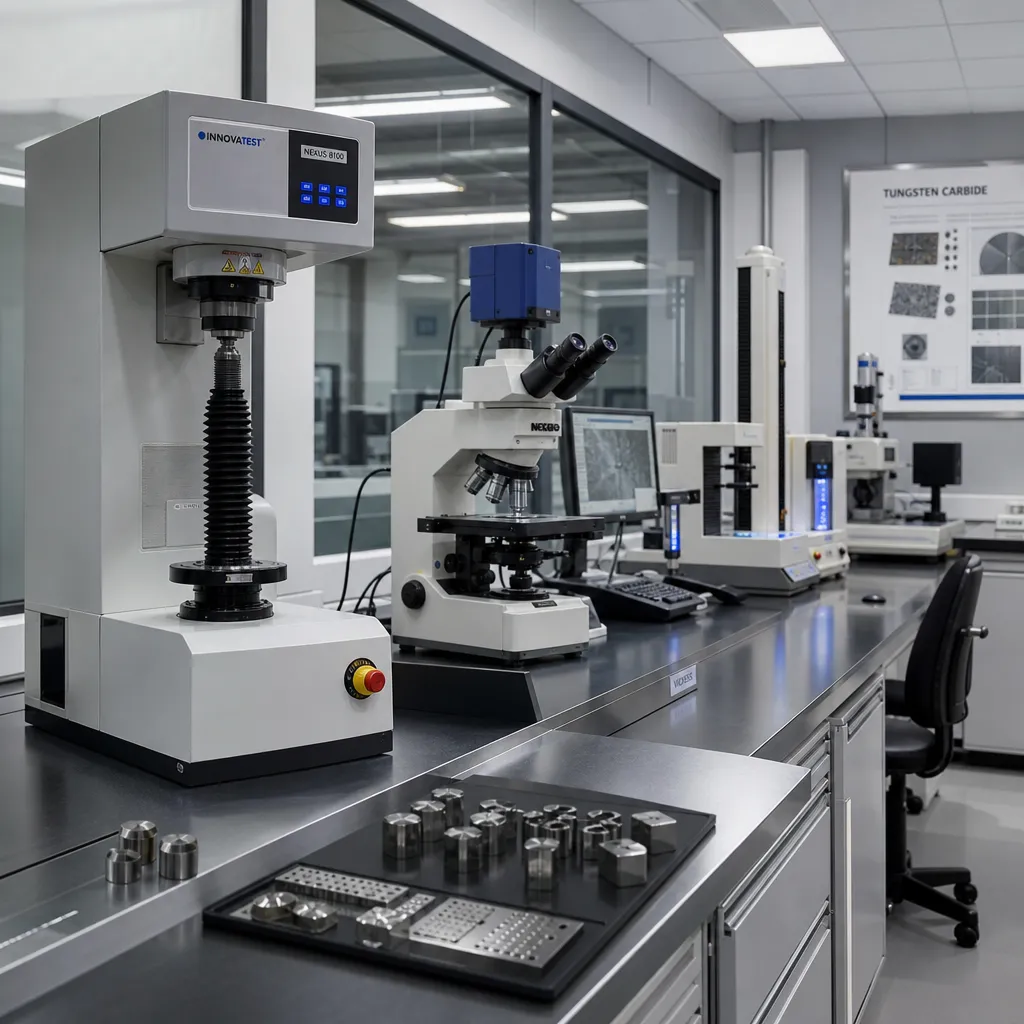
Material performance depends directly on chemical purity, microstructure (WC/Co phase distribution), grain size, and presence of metallic impurities or oxides. These parameters must be controlled at every stage of the value chain: production, shaping, brazing, integration in harsh environments, and recycling.
Without comprehensive testing, manufacturers risk product failures, safety hazards, and costly recalls. Testing enables consistent product quality, structural characterization, material comparison, and property quantification.
What Are the Key Properties of Tungsten Carbide?
Tungsten carbide possesses unique combinations of properties that make it one of the most useful tool materials ever produced. Many properties can be flexibly varied through straightforward changes in composition.
Mechanical Properties
Hardness:
- Can be varied between 1000 HV and 2000 HV
- Mohs hardness close to 9, second only to diamond
- Adjusted by changing cobalt content and WC grain size
Strength:
- Compressive strength: 4-8 kN/mm² (strongest commercial materials available)
- Tensile strength: 2-3 kN/mm²
- Hot Isostatic Pressing (HIP) or SINTERHIP required for highest strength values
Toughness:
- Plane strain fracture toughness: 7-25 MN/m³/²
- Much higher than similar hard materials like ceramics (2-8 MN/m³/²)
Physical Properties
Stiffness:
- Young's modulus about three times that of steel
- One of the stiffest materials known, after diamond
Density:
- Up to 15 Mg/m³ for WC-containing hardmetals
- Lower densities achievable with higher Co contents or cubic carbides
Thermal Properties:
- Melting point: 2870°C
- Thermal conductivity: approximately 100 ± 20 W/m·K
- Thermal expansion: 5-6 × 10⁻⁶ K⁻¹
Wear and Corrosion Resistance
Abrasion Resistance:
- Most wear-resistant material available in severe abrasion environments
- Unique combination of strength, hardness, and toughness
Corrosion Resistance:
- Excellent in non-acidic environments
- Cobalt binder can dissolve in mildly acidic environments
- Nickel-based binders offer improved corrosion resistance
How Is Hardness Testing Performed on Tungsten Carbide?
Hardness testing is one of the most fundamental methods for characterizing tungsten carbide materials. Standard methods include Vickers and Rockwell testing, though results must be interpreted carefully.
Standard Hardness Test Methods
Vickers Hardness (HV):
- Covered by ISO 3878
- Uses diamond pyramid indenter
- Standard loads: HV30 (30 kgf load)
- Suitable for all hardness ranges
Rockwell Hardness (HRC):
- Covered by ISO 3738 and ASTM B294
- Uses diamond cone indenter
- Quick and convenient for routine testing
- Tungsten carbide typically achieves 70 HRC or higher
Understanding Hardness Test Limitations
In a Rockwell test, pressure is applied slowly through a shaped diamond point. This has limited correlation with how carbide performs in real-world applications. It is not uncommon to see carbide grades with lower Rockwell values outwearing grades with higher values.
Tungsten carbide consists of tungsten carbide grains in a cobalt matrix. When testing hardness, you are primarily measuring:
- Amount of cobalt in the material
- Grain size to a certain extent
- Quality of carbide manufacturing
Important Consideration: Official hardness ratings are ballpark estimates and don't necessarily correlate directly with actual performance. When someone asks about carbide hardness, they are typically interested in carbide performance.
High Hardness Hardmetals
For very high hardness materials (above 1800 HV30):
- Careful surface preparation is essential
- Multiple measurements should be averaged
- Proper indentation spacing required
- Higher loads may cause cracking
What Mechanical Tests Evaluate Tungsten Carbide Performance?
Mechanical testing provides critical data for quality control and design applications. Key tests include bend strength, compression testing, and impact resistance.
Bend Strength Testing (Transverse Rupture Test)
Covered by ISO 3227
Bend testing is widely used for quality control and material comparison.
Test Configuration:
- Standard rectangular test pieces
- Three-point or four-point bending
- Support span typically 30 mm
- Loading rate controlled
Factors Affecting Results:
- Surface preparation quality
- Grinding stress removal
- Test piece geometry
- Microstructural defects
Discriminability: The bend test is a relatively poor discriminator between different materials compared to other mechanical tests. However, it remains widely used due to simplicity and established standards.
Compression Testing
Covered by ISO 4506
Compression testing evaluates behavior under compressive loading, relevant for many hardmetal applications.
Key Properties Measured:
- Ultimate compressive strength
- Yield strength in compression
- Deformation behavior
Tungsten carbide exhibits the highest compressive strength of any commercial material, making it ideal for applications like diamond synthesis anvils and hot rolls.
Impact Testing
Impact testing is not standardized for hardmetals but provides useful information for applications involving sudden loading.
Considerations:
- Related to tensile strength and fracture toughness
- Sensitive to surface defects and preparation
- No widely agreed test procedures
- Results depend on geometry and notch preparation
How Does microstructure analysis Characterize Tungsten Carbide?
Microstructure analysis is critical for understanding and controlling tungsten carbide properties. The structure of two-phase WC/Co hardmetals is defined by three key parameters.
Key Microstructural Parameters
WC Grain Size:
- Stoichiometric phase with no internal features
- Can vary from sub-micron to several microns
- Not yet covered by international standard (ISO 4499 under development)
- Mean linear intercept technique recommended
Co Binder Phase Volume Fraction:
- Specified in weight percentage
- Volume fraction calculated from density values
- Can be measured directly by metallography
- Typically ranges from 5-20 wt%
Binder Phase Composition:
- Co-W-C alloy composition
- Can be determined by magnetic and lattice parameter measurements
- Affects properties and performance
Grain Size Measurement Methods
Linear Intercept Method (Heyn Method):
- Count intercept lengths on random lines across polished microstructure
- Plot distribution on cumulative probability paper
- Requires at least 200 individual measurements
- SEM required for fine-grained materials
Area Counting (Jeffries Method):
- Measure number of grains per unit area
- Optical microscopy for coarse-grained materials
- SEM required for fine-grained hardmetals
High-Resolution Techniques:
- Field emission SEM for very fine grains (<0.5 µm)
- Orientation imaging via electron backscatter diffraction (EBSD)
- Provides more accurate grain size data
Microstructural Defects
Porosity:
- Covered by ISO 4505
- Affects mechanical properties
- Types: A-type (small), B-type (larger), C-type (graphite)
Contiguity:
- Measures WC/WC grain contact
- Affects interphase area
- Influences magnetic properties
What Role Do Magnetic Measurements Play in Quality Control?
Magnetic measurements are vital for controlling consistency of tungsten carbide products without destructive testing. Since hardmetals contain cobalt, which is ferromagnetic, magnetic properties provide valuable quality information.
Magnetic Saturation (Moment)
Applications:
- Quality control for cobalt content verification
- Estimation of Co-W-C binder phase composition
- Non-destructive evaluation method
Principle: The magnetic saturation measures the total magnetic moment of the material. This is related to the cobalt content and its composition. Pure cobalt has a specific saturation moment, but when tungsten and carbon dissolve in the cobalt binder, the moment changes.
Interpretation:
- Lower moment indicates higher tungsten in solution
- Can estimate binder phase composition
- Useful for detecting carbon imbalance
Magnetic Coercivity
Covered by ISO 3326
Applications:
- Quality control for grain size estimation
- Non-destructive assessment of structure
- Process control parameter
Principle: Coercive force is primarily related to the Co/WC interphase area. Magnetic domain walls are pinned by phase boundaries. For smaller WC grain size, the interphase area increases, and coercivity increases.
Correlation with Grain Size:
- Inverse relationship between coercivity and grain size
- Affected by Co composition variations
- Cooling rate from sintering affects results
- Deformation increases coercivity
Benefits of Magnetic Testing
Advantages:
- Non-destructive evaluation
- Rapid and inexpensive
- Suitable for routine quality control
- Can be applied to finished products
Limitations:
- Requires calibration for each grade
- Affected by multiple microstructural factors
- Interpretation requires experience
- Not suitable for nickel-based binders
How Is Density Testing Used for Tungsten Carbide Verification?
Density measurement is a practical quality control measure covered by ISO 3369. It provides accurate results with little difficulty and is routinely measured for all hardmetal grades.
Principle and Procedure
Essentially pore-free liquid-phase sintered hardmetals have near-zero porosity. Density measurement provides information about phase volume fractions and composition.
Theoretical Density Calculation:
- Pure WC density: 15.65 Mg/m³
- Pure Co density: 8.95 Mg/m³
- WC/6wt% Co theoretical density: ~14.98 Mg/m³
Factors Affecting Density
Composition Effects:
- Higher cobalt content reduces density
- Carbon content affects W in solution
- Additional elements (Fe, Ni) change density
- Cubic carbides (TiC, TaC) lower density
Measurement Accuracy:
- Resolution of at least 1 part in 500 achievable
- Highly discriminating test method
- Careful measurements repeatable
- Sensitive to composition variations
Applications
Quality Control:
- Verify composition meets specifications
- Detect manufacturing variations
- Establish database for each grade
- Compare against theoretical values
- Identify incorrect composition
- Detect porosity or defects
- Verify sintering quality
- Support material investigation
What Are Abrasion and Wear Resistance Tests?
Abrasion testing evaluates wear resistance under controlled conditions, crucial for applications involving severe wear environments. ASTM B611 is the primary standard for hardmetal abrasion testing.
ASTM B611 Abrasion Test
Test Configuration:
- Rotating steel wheel
- Abrasive slurry (aluminum oxide)
- Specimen pressed against wheel
- Measured volume loss
Test Parameters:
- Applied load
- Test duration
- Abrasive type and size
- Wheel speed and diameter
Wear Resistance Characteristics
Tungsten carbide excels in severe abrasion environments due to its unique combination of:
- High strength
- Extreme hardness
- Superior toughness compared to ceramics
Discriminability: Abrasion testing is extremely good at discriminating between different materials. The test has high discriminability value, making it excellent for material comparison.
Real-World Wear Performance
Laboratory abrasion tests may not fully represent actual service conditions. Different applications involve:
- Different abrasive types and sizes
- Various loading conditions
- Temperature effects
- Impact combined with abrasion
How Is Fracture Toughness Measured in Hardmetals?
Fracture toughness quantifies resistance to crack propagation, critical for applications where failure would be catastrophic. No single standard method is universally accepted, but several techniques are used.
Palmqvist Indentation Toughness
Principle: Uses Vickers hardness indentation to create cracks, then measures crack length.
Advantages:
- Simple and inexpensive
- Uses existing hardness equipment
- Requires small specimens
- Suitable for routine testing
Limitations:
- Empirical calibration required
- Results depend on indentation load
- Surface preparation critical
- Not suitable for very tough materials
Measurement:
- Perform Vickers hardness indentation
- Measure crack lengths from corners
- Calculate toughness from crack length/hardness relationship
Plane Strain Fracture Toughness (SEPB)
Single Edge Notched Beam Method:
Procedure:
- Machine sharp notch in test piece
- Pre-crack by controlled fatigue or bridge loading
- Test in three-point bending
- Calculate KIc from load and geometry
Advantages:
- Directly measures fracture toughness
- Independent of empirical calibrations
- More discriminating than Palmqvist
- Suitable for research and development
Limitations:
- Requires larger specimens
- More expensive and time-consuming
- Requires specialized equipment
- Difficult for very tough grades
Comparison of Methods
| Method | Discriminability | Cost | Complexity |
|---|---|---|---|
| Palmqvist | Moderate | Low | Simple |
| SEPB | High | High | Complex |
How to Identify Authentic Tungsten Carbide Coatings
Authenticating tungsten carbide coatings is crucial for industrial applications where coating quality directly affects product performance. Several methods can identify genuine tungsten carbide coatings.
Visual and Tactile Inspection
Visual Characteristics:
- Dark gray or metallic luster appearance
- Uniform, delicate texture
- No obvious scratches or depressions
- Inferior coatings appear rough with powdering
Tactile Characteristics:
- Solid and smooth feel from high hardness and density
- Rough or loose texture indicates counterfeit
- Uneven particles suggest inferior quality
Hardness Testing
Procedure:
- Test multiple points on surface
- Tungsten carbide typically 70 HRC or higher
- Lower values indicate non-genuine coating
Considerations:
- Requires accurate equipment
- Experienced operator needed
- Multiple measurements recommended
X-ray Fluorescence (XRF) Analysis
Advantages:
- Non-destructive testing method
- Rapid elemental composition analysis
- Verifies tungsten and carbon content
- Suitable for routine inspection
Procedure:
- Aim XRF instrument at coating surface
- Scan and analyze elemental composition
- Compare with standard tungsten carbide composition
Microstructure Analysis
Methods:
- Scanning Electron Microscopy (SEM)
- Transmission Electron Microscopy (TEM)
Characteristics of Genuine Coatings:
- Uniform microstructure
- Regular particle distribution
- No impurities or irregular arrangement
- Consistent particle morphology and size
Performance Testing
Wear Resistance Test:
- Apply friction load to surface
- Genuine coating shows minimal wear
- Counterfeit coatings wear or peel rapidly
Corrosion Resistance Test:
- Immerse in acid/alkali solution
- Genuine coating maintains condition
- Counterfeit coatings corrode or detach
What Standards Govern Tungsten Carbide Testing?
International standards ensure consistent and reliable testing methods worldwide. ISO and ASTM standards are commonly used in Europe and North America.
Widely Used Standards
| Standard | Property | Method |
|---|---|---|
| ISO 4499 | Microstructure | Metallographic examination |
| ISO 4505 | Porosity/C content | Metallographic evaluation |
| ISO 3326 | Magnetic coercivity | Magnetic measurement |
| ISO 3369 | Density | Archimedes method |
| ISO 3878 | Vickers hardness | HV30 indentation |
| ISO 3738 | Rockwell hardness | HRA measurement |
| ISO 3227 | Bend strength | Three-point bending |
| ISO 4506 | Compression strength | Uniaxial compression |
| ASTM B611 | Abrasion resistance | Rotating wheel test |
Standards Under Development
WC Grain Size:
- ISO 4499 modification planned
- Linear intercept method standardization
- Expected completion: 2009 (historical reference)
Research and Development Tests
Tests without standardized methods include:
- corrosion testing
- Erosion testing
- Fatigue testing
- Impact testing
- Hot hardness testing
Choosing a Reliable Testing Laboratory
Selecting a qualified testing laboratory ensures accurate, reliable, and defensible results. Consider accreditation, capability, and experience.
Key Selection Criteria
Accreditation:
- ISO/IEC 17025 laboratory accreditation
- Relevant industry certifications
- Quality management system certification
Technical Capability:
- Modern, calibrated equipment
- Qualified technical staff
- Standardized test methods
- Method validation procedures
Experience:
- Hardmetal and Ceramic testing expertise
- Industry-specific knowledge
- Track record of reliable results
- Technical support capabilities
Services Offered
Physico-Chemical Analysis:
- Elemental impurity determination
- Material characterization
- Failure analysis
Mechanical Testing:
- Hardness, strength, toughness
- Abrasion and wear testing
- High-temperature properties
Microstructural Analysis:
- Grain size measurement
- Porosity evaluation
- Phase identification
Surface Analysis:
- Roughness measurement
- Coating characterization
- Surface integrity assessment
Quality Assurance
Documentation:
- Complete test reports
- Uncertainty statements
- Traceable calibrations
- Technical review process
Conclusion
Comprehensive tungsten carbide testing ensures material quality, consistency, and performance across all industrial applications. From hardness testing to microstructure analysis, from magnetic measurements to fracture toughness evaluation, each test provides critical information for quality control and material selection.
The combination of established international standards and advanced testing methods enables manufacturers to deliver consistent products that meet demanding application requirements. Understanding test methods, their limitations, and proper interpretation of results is essential for effective quality assurance.
As applications for tungsten carbide continue to expand into increasingly demanding environments, the importance of thorough testing will only increase. Investment in proper testing capabilities and qualified laboratory partnerships ensures that tungsten carbide products perform reliably in their critical applications.