What Is Children's Watch Testing and Why Does It Matter?
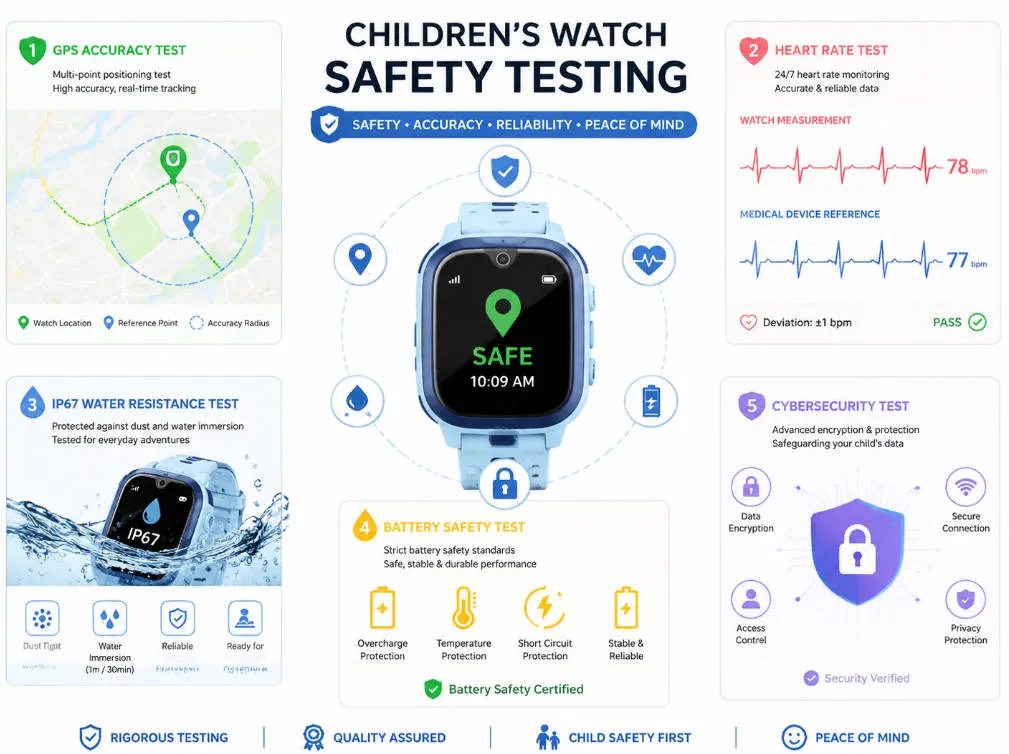
Children's watch testing is the comprehensive evaluation of wrist-worn devices designed for minors — encompassing traditional timepieces, fitness trackers, and smartwatches with GPS, cellular connectivity, and health monitoring features — to verify their safety, performance, and regulatory compliance before market entry. With smartwatch usage among children ranging from 15% to 40% globally depending on country, these devices are no longer niche products. They represent a rapidly growing market that sits at the intersection of consumer electronics, toys, medical devices, and telecommunications.
The stakes are high. A children's smartwatch is simultaneously a toy (subject to toy safety directives), a radio device (subject to EMC and telecom regulations), a product with skin contact (subject to chemical limits), a lithium-ion battery-powered device (fire and explosion risk), and a connected data-collection platform (privacy and cybersecurity concerns). Each domain carries its own regulatory requirements, and a device must satisfy all of them simultaneously.
Recent research has added urgency to health monitoring accuracy. A 2025 scoping review published in Translational Pediatrics found that while smartwatch heart rate measurements generally correlated with standard 12-lead ECG readings, the automated algorithms for arrhythmia detection in children had only 66% accuracy — because they are calibrated for adult heart rate ranges. The number of children presenting to cardiologists with smartwatch-based heart concerns rose from 2 in 2017 to 57 in 2021, with most being false positives. This underscores the need for validated, age-appropriate testing.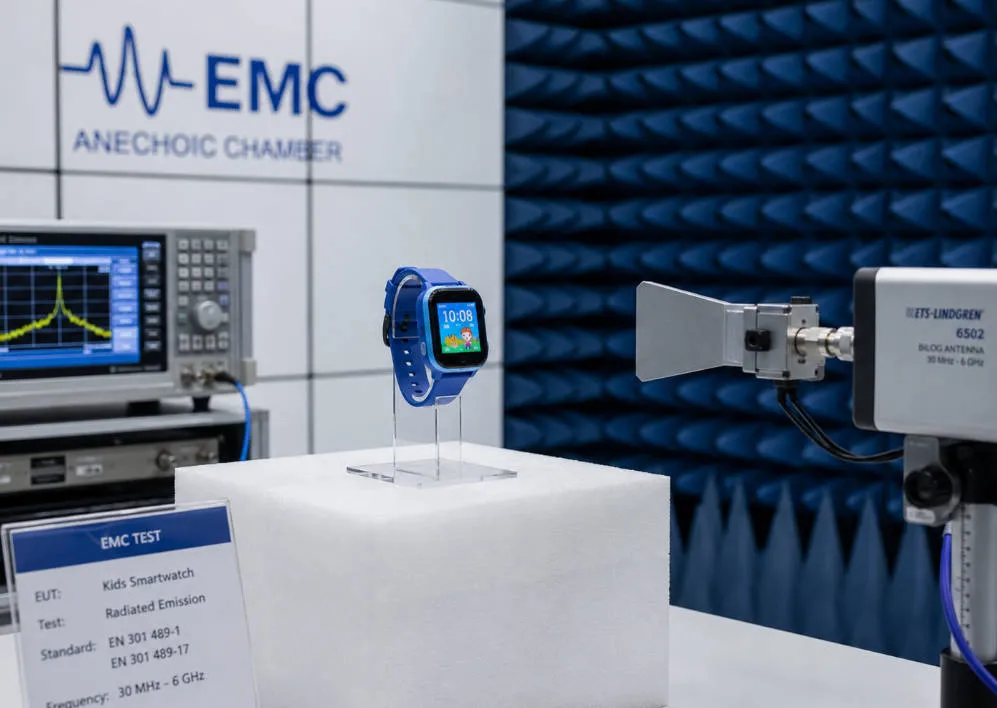
Key Standards and Regulations for Children's Watch Testing
Children's watches fall under multiple regulatory frameworks depending on their features and target age group:
|
Standard / Regulation |
Scope |
Key Requirements |
|---|---|---|
|
EU Toy Safety Directive 2009/48/EC |
Products designed for children under 14 |
Mechanical, chemical, electrical, flammability, hygiene |
|
EN 71 Series |
Toy safety harmonized standards |
Parts 1 (mechanical), 2 (flammability), 3 (migration of elements), 12 (NIT in toys) |
|
EN IEC 62115 |
Electric toys safety |
Maximum voltage, surface temperature, short-circuit protection |
|
IEC 62368-1 |
Audio/video, IT, communication equipment safety |
Electrical, mechanical, thermal, fire hazard-based safety |
|
EU Radio Equipment Directive (RED) 2014/53/EU |
Devices with wireless communication |
EMC, radio spectrum, health and safety |
|
EN 301 489 Series |
EMC for radio equipment |
Emissions and immunity requirements |
|
EN 300 328 / EN 301 511 |
Wi-Fi/Bluetooth and cellular radio standards |
Spectrum usage, transmitter requirements |
|
IEC 62282 / UN 38.3 |
Lithium battery safety and transport |
Overcharge, short circuit, thermal abuse, altitude simulation |
|
EN 16648:2024 |
Connected toys — cybersecurity |
Data protection, access control, communication security |
|
COPPA (US) |
Children's online privacy protection |
Parental consent, data collection limits, retention policies |
|
GDPR (EU) / UK GDPR |
Personal data protection |
Lawful basis, data minimization, right to erasure, DPIA |
|
IEC 60529 (IP Rating) |
Ingress protection |
Dust and water resistance (IP54–IP68 typical for watches) |
|
CEN/CLC/JTC 21 |
Connected consumer products — safety |
Network functionality failures, safety-critical functions |
|
16 CFR Part 1500 (US CPSIA) |
Hazardous substances in children's products |
Lead, phthalates, heavy metals, tracking label |
Mechanical and Physical safety testing
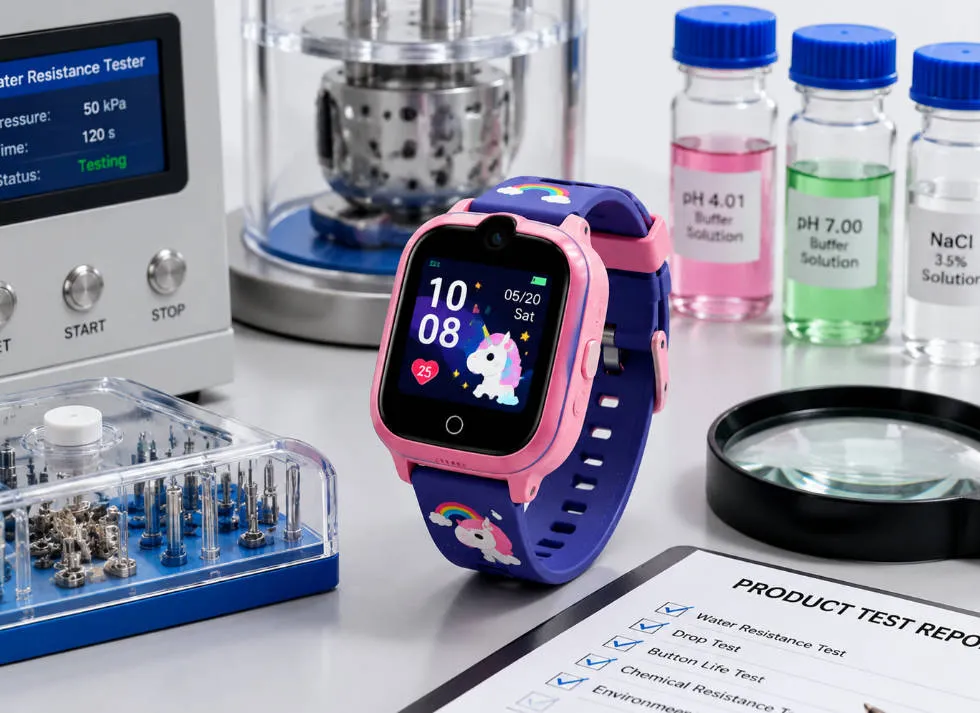
Children's watches must pass rigorous mechanical tests per EN 71-1 and IEC 62368-1:
Small Parts and Choking Hazard Assessment
-
Under 3 years: No detachable small parts (fit within the 31.7 mm × 25.2 mm × 57.1 mm small-parts cylinder)
-
3–6 years: Warning label required if small parts present
-
Band/strap attachments: Pull test at 90N for 10 seconds — no detachment creating small parts
Impact and Drop Testing
-
Free-fall drop: 1.4 m onto 4 mm steel plate (EN 71-1), 4 drops on different faces
-
Impact resistance: 1 kg mass dropped from 1 m onto the watch face
-
Acceptance: No cracking of the display, no exposure of internal components, no creation of sharp edges or points
Strap and Band Tensile Testing
-
Tensile strength: Band must withstand 50–100N (depending on age category) without tearing
-
Pin and spring bar strength: Must not release under 30N lateral force
-
Buckle security: Must not open accidentally under 20N pull
Sharp Edges and Points
-
Per EN 71-1, no accessible sharp edges (tested with sharp-edge tester per 16 CFR 1500.49) or sharp points (16 CFR 1500.48)
Chemical Safety and Material Compliance
Children's watches are in prolonged skin contact and may be mouthed by young children:
|
Test |
Standard |
Limits / Requirements |
|---|---|---|
|
Migration of heavy metals |
EN 71-3 (Category II — toy material) |
Lead: 0.5 mg/kg; Cadmium: 0.3 mg/kg; Mercury: 0.5 mg/kg; Chromium VI: 0.02 mg/kg |
|
Nickel release (strap, case back) |
EN 1811 |
≤ 0.5 µg/cm²/week (prolonged skin contact) |
|
Phthalates (plastic materials) |
CPSIA Section 108 / REACH Annex XVII |
DEHP, DBP, BBP: ≤ 0.1% each (children's toys) |
|
BPA (polycarbonate components) |
EU Regulation 2018/213 |
≤ 0.05 mg/kg (food contact); voluntary limit for toys |
|
Formaldehyde (textile straps) |
EN 71-9 |
≤ 16 mg/kg (Category 1 — under 3 years) |
|
Flame retardants |
REACH Annex XVII |
TCEP, TCPP, TDCP limits in toy materials |
|
Azo dyes (textile/leather straps) |
REACH Annex XVII, Entry 43 |
≤ 30 mg/kg per listed amine |
Skin Sensitization Testing
Extended wear studies assess:
-
Contact dermatitis from nickel, adhesives, or rubber compounds
-
Strap ventilation and moisture trapping under prolonged use (72-hour wear test)
-
Irritation from optical heart rate sensor LEDs (green light, 525 nm typical)
Electrical Safety and Battery Testing
Lithium-Ion Battery Safety (UN 38.3 + IEC 62133-2)
Children's smartwatches use small lithium-ion or lithium-polymer cells (typically 200–600 mAh). Testing per UN 38.3 includes 8 tests:
|
Test |
Conditions |
Pass Criteria |
|---|---|---|
|
T1: Altitude simulation |
11.6 kPa, 6 hours, 20°C |
No leakage, venting, disassembly, fire |
|
T2: Thermal test |
75°C / -40°C, 6 hours each |
No leakage, venting, disassembly, fire |
|
T3: Vibration |
Sinusoidal, 7–200 Hz, 3 axes |
No leakage, venting, disassembly, fire |
|
T4: Shock |
150g / 11ms half-sine, 3 axes |
No leakage, venting, disassembly, fire |
|
T5: External short circuit |
< 0.1Ω, 20°C and 55°C |
Case temperature ≤ 170°C; no fire within 6 hours |
|
T6: Impact / crush |
150g impact or 13 kN crush |
No fire, no explosion |
|
T7: Overcharge |
2× rated voltage, 24 hours |
No fire, no explosion |
|
T8: Forced discharge |
Discharge to 0V |
No fire, no explosion |
Charging Safety
-
USB/port protection: Short-circuit, overcurrent, overvoltage protection
-
Wireless charging (if applicable): Per IEC 62368-1, surface temperature limits
-
Magnetic charger ingestion risk: If magnetic charging cable uses small magnets, must comply with ASTM F963 magnet ingestion requirements
Electromagnetic Compatibility (EMC) Testing
Children's smartwatches with Wi-Fi, Bluetooth, cellular (4G/LTE), or GPS radios must pass EMC testing per the RED:
|
Test |
Standard |
Typical Limits |
|---|---|---|
|
Radiated emissions |
EN 55032 / EN 301 489-1 |
Class B limits (residential environment) |
|
Conducted emissions |
EN 55032 |
150 kHz – 30 MHz, quasi-peak and average |
|
Radiated immunity |
EN 301 489-1 / IEC 61000-4-3 |
3 V/m (80 MHz – 6 GHz) |
|
Electrostatic discharge (ESD) |
IEC 61000-4-2 |
±4 kV contact, ±8 kV air discharge |
|
Specific Absorption Rate (SAR) |
EN 62209-2 (limb) |
≤ 4.0 W/kg (10g tissue, limb) |
|
RF exposure |
ICNIRP 2020 guidelines |
Reference levels for 10 MHz – 300 GHz |
SAR testing for wrist-worn devices uses the limb model, measuring RF energy absorption in the wrist and hand tissue during cellular transmissions.
GPS Location Accuracy and Tracking Performance
GPS tracking is a primary selling point of children's smartwatches — enabling parents to monitor their child's location. Testing must validate:
Static Location Accuracy
-
Open sky: ≤ 3 m CEP (Circular Error Probable)
-
Urban canyon: ≤ 15 m CEP
-
Indoor: Wi-Fi/cellular-assisted positioning, typically 20–50 m
Dynamic Tracking Performance
-
Walking speed (3–5 km/h): Track continuity, update interval (typically 30–60 seconds)
-
Cycling speed (10–20 km/h): Track accuracy during faster movement
-
Geofence alert latency: Time from geofence breach to parent notification (< 60 seconds target)
SOS Mode Testing
-
Activation reliability: Single-button or long-press activation (verify no false triggers)
-
Alert delivery time: From button press to parent app notification (< 30 seconds)
-
Location attachment accuracy: GPS coordinates included in SOS alert, validated against known position
Communication Reliability
-
Voice call quality: MOS (Mean Opinion Score) ≥ 3.5 in typical environments
-
Message delivery confirmation: End-to-end delivery acknowledgment within 10 seconds
-
Approved contacts enforcement: Only pre-authorized numbers can call/text the watch
Health Sensor Accuracy Testing
Many children's smartwatches include optical heart rate sensors, accelerometers, and sleep tracking. Accuracy must be validated against clinical standards:
Heart Rate Accuracy
Per the 2025 scoping review in Translational Pediatrics:
-
Heart rate measurements from smartwatches generally correlated closely with 12-lead ECG
-
Automated arrhythmia detection algorithms had only 66% accuracy in pediatric populations
-
Smartwatch algorithms are calibrated for adult heart rate ranges, failing to account for children's naturally elevated heart rates
Children's normal heart rate ranges:
|
Age |
Normal Range (5th–95th percentile) |
|---|---|
|
Birth to < 6 months |
120–170 bpm |
|
6 months to < 1 year |
110–160 bpm |
|
1 to < 2 years |
100–155 bpm |
|
2 to < 4 years |
95–150 bpm |
|
4 to < 6 years |
80–135 bpm |
|
6 to < 8 years |
80–130 bpm |
|
8 to < 12 years |
70–120 bpm |
|
12 to < 14 years |
65–115 bpm |
|
14+ years |
60–110 bpm |
Testing protocol: Compare smartwatch readings against simultaneous 12-lead ECG in 30+ pediatric subjects across age groups, during rest, activity, and recovery. Report mean absolute error (MAE) and Bland-Altman agreement.
Step Count and Activity Tracking
-
Validate step count against manual tally or gold-standard accelerometer (ActiGraph)
-
Report accuracy across walking, running, and play activities
-
Typical target: ≤ 5% error for continuous walking
Data Privacy and Cybersecurity testing
Children's smartwatches collect highly sensitive data: real-time location, voice recordings, contact lists, and health metrics. Regulatory scrutiny is intensifying:
EN 16648:2024 — Connected Toys Cybersecurity
-
Authentication: Secure pairing between watch and parent app; no default passwords
-
Encryption: TLS 1.2+ for all data transmission; AES-128+ for stored data
-
Access control: Prevent unauthorized remote access to camera, microphone, or GPS
-
Firmware updates: Signed, verified updates; no rollback to vulnerable versions
-
Data minimization: Only collect data necessary for stated functionality
GDPR / COPPA Compliance Testing
-
Parental consent mechanism: Verifiable consent before data collection (COPPA); age-gate for 13+ features
-
Data retention limits: Automatic deletion after defined period
-
Right to erasure: Verify complete data deletion upon account closure
-
Third-party sharing audit: No data sharing with analytics/ad networks without explicit consent
-
Data Processing Impact Assessment (DPIA): Required under GDPR for children's data processing
Known Vulnerability Testing
-
Penetration testing against OWASP IoT Top 10
-
BLE (Bluetooth Low Energy) sniffing and spoofing resistance
-
SIM card cloning protection (for cellular models)
-
Server-side API security testing
Durability and Environmental Testing
Water Resistance
|
IP Rating |
Test Condition |
Typical Application |
|---|---|---|
|
IP54 |
Splash resistant |
Basic children's digital watch |
|
IP67 |
1 m immersion, 30 min (IEC 60529) |
Children's smartwatch (splash/play) |
|
IP68 |
Manufacturer-specified depth/time |
Swim-capable children's watch |
|
5 ATM |
50 m equivalent static pressure |
Swim-proof children's watch |
Temperature and Humidity
-
Operating: -10°C to +45°C (typical)
-
Storage: -20°C to +60°C, 95% RH
-
Thermal shock: -20°C ↔ +60°C, 5 cycles, 30 min dwell each
UV and Sweat Resistance (Straps)
-
UV exposure: 500 hours xenon-arc (ISO 4892-2) — no discoloration, cracking, or embrittlement
-
Artificial sweat immersion: EN 1811 / ISO 3160-2, pH 4.5 and 6.5, 168 hours — nickel release within limits, no material degradation
How to Choose a Children's Watch Testing Laboratory
|
Criterion |
What to Look For |
|---|---|
|
Accreditation |
ISO 17025, CPSC-accepted lab (US), Notified Body status for EU Toy Safety Directive |
|
Scope coverage |
EN 71, IEC 62115, IEC 62368-1, RED, UN 38.3, EN 16648 |
|
EMC chamber |
3m or 10m anechoic chamber with SAR capability |
|
Chemical lab |
ICP-MS, GC-MS for heavy metals, phthalates, azo dyes, formaldehyde |
|
Battery test facility |
UN 38.3 and IEC 62133-2 abuse testing with explosion-proof enclosures |
|
Cybersecurity capability |
Penetration testing, BLE analysis, GDPR/COPPA audit expertise |
|
Age-specific expertise |
Pediatric health sensor validation, age-graded testing protocols |
|
Global market access |
CE, FCC, UKCA, CCC, MIC (Japan), BIS (India) certification support |
Common Challenges in Children's Watch Testing
-
Dual classification as toy and electronics: A children's smartwatch must simultaneously satisfy toy safety (EN 71) and electrical/electronic equipment safety (IEC 62368-1) requirements. Not all test labs are equipped for both.
-
Age-graded heart rate algorithms: Adult-calibrated arrhythmia algorithms produce false positives in children whose normal resting heart rate is 80–150 bpm (depending on age). Testing must validate against pediatric-specific reference ranges.
-
Small battery hazard assessment: While lithium-ion cells in children's watches are small (200–600 mAh), they still pose thermal runaway risk. UN 38.3 abuse testing in explosion-proof chambers is mandatory.
-
Cybersecurity gaps: Many children's smartwatch brands have been found with unencrypted BLE connections, default passwords, and insecure APIs. Independent penetration testing is essential.
-
GPS accuracy vs. battery life trade-off: High-frequency GPS polling drains batteries. Testing must validate that the claimed location update interval is achievable within the advertised battery life.
-
Nickel allergy from watch cases: stainless steel case backs and buckle components may release nickel above EN 1811 limits. Sweating during physical activity accelerates release — extended wear testing is needed.
-
Evolving privacy regulations: GDPR, COPPA, and China's PIPL all have specific provisions for children's data. Products sold globally must navigate multiple, sometimes conflicting, requirements.
Frequently Asked Questions
Q: Is a children's smartwatch classified as a toy? A: In the EU, if the product is designed or clearly intended for children under 14, it falls under the Toy Safety Directive 2009/48/EC regardless of its electronic features. It must also comply with the Radio Equipment Directive (RED) for wireless functions.
Q: What battery tests are required for children's smartwatches? A: UN 38.3 (8 tests covering altitude, thermal, vibration, shock, short circuit, impact, overcharge, and forced discharge) plus IEC 62133-2 for the complete battery system.
Q: How accurate are children's smartwatch heart rate monitors? A: Research shows heart rate measurements generally correlate well with clinical ECG, but automated arrhythmia detection algorithms have only ~66% accuracy in children because they use adult-calibrated thresholds.
Q: What IP rating should a children's smartwatch have? A: Minimum IP54 (splash resistant) for basic models. IP67 or 5 ATM is recommended for active children who may wash hands, play in rain, or swim while wearing the device.
Q: Do children's smartwatches need SAR testing? A: Yes. Cellular-enabled smartwatches must comply with limb SAR limits (≤ 4.0 W/kg over 10g tissue per EN 62209-2) because the device transmits radio frequency energy while in direct contact with the child's wrist.
Q: What cybersecurity standards apply to children's smartwatches? A: EN 16648:2024 (connected toys cybersecurity) in the EU, plus GDPR data protection requirements. In the US, COPPA governs data collection from children under 13. Independent penetration testing against OWASP IoT Top 10 is recommended.
Q: How is GPS accuracy tested on children's watches? A: Static testing at known reference points (open sky, urban canyon, indoor), dynamic testing at walking and cycling speeds, geofence alert latency measurement, and SOS mode location accuracy validation.
Summary
Children's watch testing is uniquely challenging because these devices sit at the crossroads of toy safety (EN 71, CPSIA), electrical safety (IEC 62115, IEC 62368-1), battery safety (UN 38.3, IEC 62133-2), electromagnetic compatibility (RED, EN 301 489), data privacy (GDPR, COPPA, EN 16648), and health sensor accuracy (pediatric-specific validation). The rapid growth of the children's smartwatch market — with usage rates of 15–40% among children globally — demands rigorous, multi-domain testing that few laboratories can provide comprehensively. From small-parts choking hazard assessment to lithium battery abuse testing, from limb SAR measurement to GPS accuracy validation, and from nickel release testing to cybersecurity penetration testing, every aspect must be verified before a children's watch reaches the market.