What Is Electric Bicycle Testing and Why Does It Matter?
Electric bicycle testing is the systematic evaluation of e-bikes and their components — motors, batteries, controllers, frames, brakes, and electronics — against safety, performance, and regulatory standards before products reach consumers.
The global e-bike market is growing rapidly as delivery companies, bike-sharing platforms, and individual riders increasingly adopt e-bikes for transportation, fitness, and environmental reasons. But with this growth comes a critical safety challenge: e-bikes combine the mechanical complexity of a bicycle with the electrical hazards of a motor vehicle. Battery fires, sudden motor failures, and frame collapses under electric-assisted loads have all caused serious injuries and product recalls.
Electric bicycle testing matters because a single battery fire — like the numerous lithium-ion e-bike fires that have devastated apartments in New York City — can be fatal. Between 2021 and 2023, NYC Fire Department reported over 400 e-bike battery fires, resulting in multiple deaths and hundreds of injuries. These incidents were traced to batteries that lacked proper safety certification.
Testing covers mechanical strength, electrical safety, battery integrity, braking performance, electromagnetic compatibility, chemical compliance, and functional safety — ensuring that every component works reliably under real-world conditions, from rain-soaked city commutes to steep mountain trail climbs.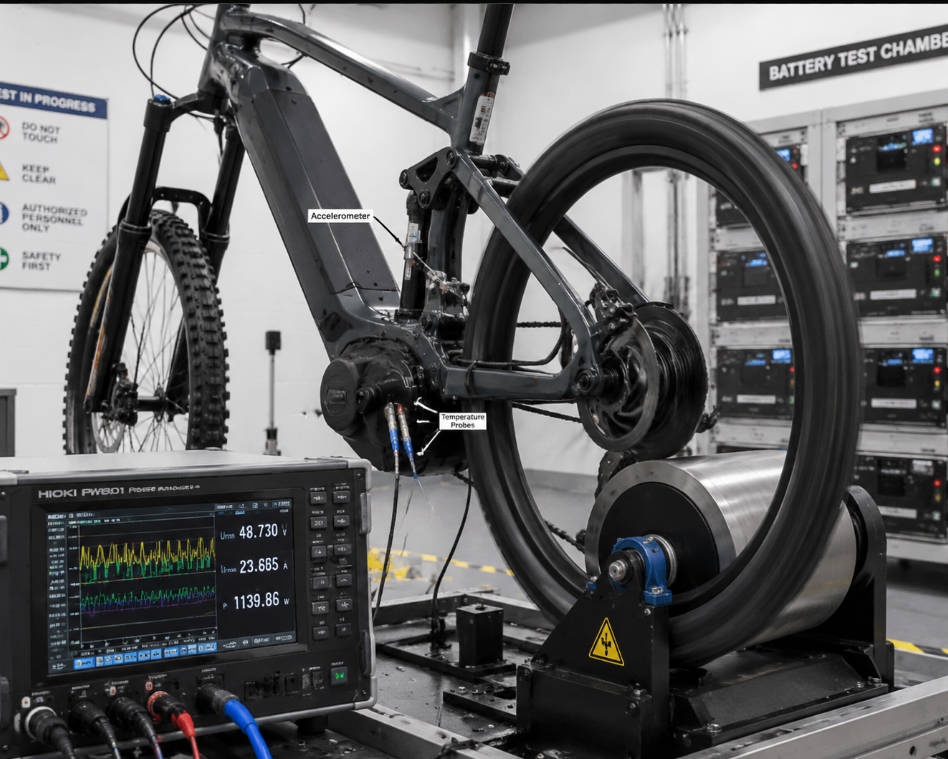
Key E-Bike Testing Standards Worldwide
E-bike testing draws on a complex web of international, regional, and national standards. The table below maps the most critical ones:
|
Standard |
Scope |
Region |
What It Covers |
|---|---|---|---|
|
EN 15194 |
EPAC (Electrically Power Assisted Cycles) |
EU |
Mechanical, electrical, EMC, functional safety |
|
ANSI/CAN/UL 2849 |
Electrical systems for e-bikes |
US/Canada |
Fire safety, electrical system integrity |
|
ANSI/CAN/UL 2272 |
Electrical systems for personal e-mobility |
US/Canada |
E-scooters, hoverboards (overlaps e-bike scope) |
|
ANSI/CAN/UL 2271 |
Batteries for light EVs |
US/Canada |
Battery safety for e-bikes and scooters |
|
UN 38.3 |
Lithium battery transport |
International |
All lithium batteries shipped globally |
|
ISO 4210 |
Bicycle safety |
International |
Mechanical safety for all bicycles (referenced by EN 15194) |
|
ISO 8098 |
Safety requirements for bicycles for young children |
International |
Children's bikes, toy bikes |
|
16 CFR 1512 |
Bicycle requirements |
US (CPSC) |
Mechanical safety, reflectors |
|
DIN 79010 / prEN 17860 |
Cargo bikes |
EU/Germany |
Load capacity, stability for cargo e-bikes |
|
EN 50604-1 |
Light EV batteries |
EU |
Battery safety for e-bikes |
|
ISO 13849 / ISO 12100 |
Functional safety of control systems |
International |
BMS, motor controller safety logic |
|
FCC Part 15 |
EMC / radio emissions |
US |
Wireless controllers, Bluetooth modules |
|
EN 17128 |
Personal e-mobility devices |
EU |
E-scooters and similar devices |
E-Bike Classification by Region
|
Class |
US (Class 1–3) |
EU (EPAC) |
Max Motor Power |
Max Assist Speed |
|---|---|---|---|---|
|
Class 1 |
Pedal-assist only |
EPAC per EN 15194 |
750W (US) / 250W (EU) |
20 mph (US) / 25 km/h (EU) |
|
Class 2 |
Throttle-assist |
Not recognized under EPAC |
750W |
20 mph |
|
Class 3 |
Speed pedelec |
Speed pedelec (L1e-B) |
750W (US) / 4,000W (EU L1e-B) |
28 mph (US) / 45 km/h (EU L1e-B) |
Classification determines which tests apply. A Class 3 speed pedelec in the EU requires type approval under motorcycle regulations (Regulation 168/2013), far more stringent than EN 15194 for standard EPACs.
Mechanical Testing: Frames, Forks, and Structural Integrity
E-bikes are heavier and faster than conventional bicycles, imposing greater mechanical stresses on frames, forks, wheels, and components. Mechanical testing verifies structural integrity under these augmented loads.
Frame and Fork Tests
|
Test |
Standard |
Method |
Pass Criteria |
|---|---|---|---|
|
Static strength (frame) |
ISO 4210 / EN 15194 |
Apply defined forces at pedals, saddle, handlebar |
No visible cracks, permanent deformation within limits |
|
Impact test (frame) |
ISO 4210-6 |
Drop mass onto frame assembly |
No fracture |
|
Fatigue test (frame) |
ISO 4210-6 |
Cyclic loading at defined force levels for 100,000 cycles |
No cracks or failure |
|
Front fork static bending |
ISO 4210-6 |
Apply bending moment to fork blades |
No fracture |
|
Front fork fatigue |
ISO 4210-6 |
Cyclic bending for 100,000 cycles |
No cracks |
|
Drop test (complete bike) |
EN 15194 |
Drop from specified height onto rollers |
No structural failure |
Dynamic Strength Tests
Roller drum testing simulates thousands of kilometers of road use. The e-bike rides on a rotating drum with bumps or obstacles at controlled speeds. This test evaluates:
-
Frame joint integrity under dynamic loading
-
Wheel strength and spoke tension retention
-
Handlebar and stem security
-
Motor mounting durability under vibration
Special Tests
-
Flutter tendency (shimmy): High-speed stability test to detect dangerous front-end oscillations
-
Corrosion resistance: Salt spray exposure per ISO 9227 to verify frame and component durability in wet/salty conditions
-
UV resistance: Accelerated weathering of plastic components (battery cases, fenders, displays)
-
Fitness-for-use (FFU): Real-world riding tests on varied terrain to evaluate holistic performance
Electrical safety testing: Motors, Batteries, and Controllers
Electrical safety testing verifies that the e-bike's electrical system does not pose fire, shock, or injury hazards under normal and fault conditions.
Key Electrical Tests per UL 2849 and EN 15194
|
Test |
What It Evaluates |
Typical Requirement |
|---|---|---|
|
Dielectric strength (HiPot) |
Insulation between live parts and accessible frame |
No breakdown at specified test voltage |
|
Ground continuity |
Protective earth bonding |
< 0.1 Ω resistance |
|
Overcurrent protection |
Fuse/circuit breaker response |
Must interrupt before component damage |
|
Over-temperature protection |
Thermal shutdown of motor/controller |
Must shut down before insulation damage |
|
Short-circuit protection |
Battery short-circuit behavior |
Must not ignite, vent safely |
|
Reverse polarity protection |
Wrong battery connection |
No damage or hazard |
|
Water ingress (IP rating) |
Motor and controller sealing |
IP54 minimum for outdoor use; IP67 for submerged components |
|
Cable routing and abrasion |
Wiring harness durability |
No chafing after flex/vibration test |
motor testing
E-bike motors (hub-drive or mid-drive) undergo:
-
Maximum power output test: Verify motor does not exceed rated power (250W EU / 750W US)
-
Pedal assist cutoff: Motor must stop assisting when rider stops pedaling or reaches maximum assist speed (25 km/h EU / 20 mph US)
-
Throttle response: For Class 2/3 e-bikes, throttle must disengage at max speed
-
Torque measurement: Verify rated torque under load
-
Thermal endurance: Continuous operation at full load until thermal equilibrium or shutdown
Controller Functional Safety
Per ISO 13849, the motor controller's safety logic must be evaluated:
-
Dual-channel speed sensing (redundant)
-
Safe torque off (STO) function
-
Software validation per IEC 61508 (for safety-critical functions)
-
Fault detection and fail-safe behavior
Battery Safety Testing: The Critical Frontier
Lithium-ion battery safety is the most critical and most scrutinized aspect of e-bike testing, driven by the severe consequences of battery fires.
Battery Safety Standards
|
Standard |
Scope |
Key Tests |
|---|---|---|
|
UN 38.3 |
Transport certification for all Li-ion cells |
8 tests: altitude, thermal, vibration, shock, short circuit, overcharge, forced discharge |
|
EN 50604-1 |
Light EV batteries (EU) |
Overcharge, overdischarge, short circuit, thermal shock, crush, immersion |
|
ANSI/CAN/UL 2271 |
Batteries for light EVs (US/Canada) |
Similar to EN 50604-1 plus fire resistance |
|
UL 4200A |
Coin/button cell safety |
Ingestion hazard mitigation |
|
16 CFR 1263 |
Safety standard for e-bike batteries (US) |
CPSC mandatory rule (effective 2024+) |
Critical Battery Abuse Tests
|
Test |
Method |
Pass Criteria |
|---|---|---|
|
Overcharge |
Charge beyond rated voltage with faulty charger |
No fire, no explosion for 24 hours after test |
|
External short circuit |
Short terminals with < 5 mΩ resistance |
No fire, no explosion; case temperature below limit |
|
Crush |
Apply 13 kN force between two plates |
No fire, no explosion |
|
Nail penetration |
Penetrate cell with 3 mm steel nail |
No fire, no explosion |
|
Thermal shock |
Cycle between -40°C and +75°C (5 cycles) |
No leakage, no fire |
|
Drop test |
Drop from 1.0 m onto concrete |
No fire, no leakage |
|
Immersion |
Submerge in water for 30 minutes |
No leakage, functional after drying |
|
Fire resistance |
Expose to external flame |
Controlled venting, no explosion |
Battery Management System (BMS) Validation
The BMS is the battery's brain, and its proper function is essential for safety:
-
Cell voltage monitoring accuracy (±25 mV or better)
-
Over-voltage and under-voltage protection thresholds
-
Temperature monitoring with shutdown logic
-
Cell balancing performance
-
State-of-charge (SOC) accuracy
-
Communication integrity with motor controller (CAN bus, UART)
Braking System Testing
E-bikes are faster and heavier than conventional bicycles, making braking performance critical.
Braking Test Standards and Requirements
|
Test |
Standard |
Requirement |
|---|---|---|
|
Dry braking — front brake |
ISO 4210-5 / EN 15194 |
Stop within defined distance from 25 km/h |
|
Dry braking — rear brake |
ISO 4210-5 |
Stop within defined distance from 25 km/h |
|
Wet braking |
ISO 4210-5 |
Brake performance with wet rims/discs |
|
Heat build-up (descents) |
EN 15194 |
Sustained braking on simulated 6% grade descent |
|
Brake lever force |
ISO 4210-5 |
Maximum lever force within ergonomic limits (≤ 180 N) |
|
Speed-dependent braking |
For Class 3 e-bikes |
Effective braking from 45 km/h (EU) or 28 mph (US) |
Key Considerations for E-Bike Brakes
-
Regenerative braking: Some mid-drive systems add regenerative braking; this must be tested for consistency and failsafe behavior
-
Motor cut-off during braking: Most e-bike regulations require motor power to cut when brakes are applied — this function must be verified
-
Brake fade on long descents: Loaded e-bikes (rider + cargo + battery) generate more heat on descents; disc brake systems must resist fade
-
Wet conditions: Hub motors add rotating mass that affects wet braking dynamics
Electromagnetic Compatibility (EMC) Testing
EMC testing ensures the e-bike's electrical system neither emits harmful interference nor is susceptible to external electromagnetic fields.
EMC Tests per EN 15194 and FCC
|
Test |
Standard |
Purpose |
|---|---|---|
|
Radiated emissions |
EN 15194 / FCC Part 15 |
Ensure motor/controller doesn't interfere with radios, GPS, pacemakers |
|
Conducted emissions |
EN 15194 |
Limit noise injected back into power grid (during charging) |
|
Radiated immunity |
EN 15194 / ISO 11452 |
E-bike must function correctly near cell towers, power lines |
|
Electrostatic discharge (ESD) |
IEC 61000-4-2 |
Display and controls must survive static discharge |
|
Fast transient immunity |
IEC 61000-4-4 |
Controller must handle voltage spikes |
EMC is particularly important because e-bike electronics can interfere with cardiac pacemakers — a documented safety concern that EN 15194 specifically addresses by requiring immunity testing at defined field strengths.
Chemical and Hazardous Substance Testing
E-bike components — grips, saddles, tires, battery casings, paint, and electronics — must comply with hazardous substance regulations in each target market.
Key Chemical Requirements
|
Regulation |
Region |
Restricted Substances |
|---|---|---|
|
REACH (SVHC + Annex XVII) |
EU |
Heavy metals, phthalates, PAH, AZO dyes, DMF, organic tins |
|
RoHS |
EU |
Lead, mercury, cadmium, hexavalent chromium, PBB, PBDE |
|
POPs Regulation |
EU |
PFOA, PFOS, PFAS |
|
CPSIA |
US |
Lead, phthalates in children's products |
|
California Prop 65 |
US (California) |
Carcinogens and reproductive toxins |
|
TSCA |
US |
PFAS restrictions |
|
EN 71-3 |
EU |
Toy safety (children's bikes, toy e-bikes) |
Materials with immediate and prolonged skin contact — handlebar grips, saddles, and hydration systems — require particular attention for PAH (polycyclic aromatic hydrocarbons), plasticizers (phthalates), and heavy metals.
Regulatory Compliance by Market
European Union
EN 15194 is the primary standard for EPACs (Electrically Power Assisted Cycles) under the Machinery Directive (2006/42/EC). Compliance requires:
-
CE marking
-
Declaration of Conformity
-
Technical file with all test reports
-
EMC compliance per EN 15194 Annex A
-
Battery compliance per EN 50604-1
-
Hazardous substance compliance (REACH, RoHS)
-
User manual in local language
Speed pedelecs (>25 km/h, up to 45 km/h) require EU type approval as L1e-B vehicles under Regulation 168/2013 — a far more rigorous process involving automotive-grade testing.
United States
The CPSC regulates bicycle safety under 16 CFR 1512. For e-bikes:
-
UL 2849 certification for electrical systems (voluntary but effectively required by retailers)
-
UL 2271 for battery systems
-
CPSC mandatory e-bike battery standard (16 CFR 1263, effective 2024+)
-
FCC Part 15 for EMC/radio emissions
-
State-level e-bike class laws (Class 1/2/3 definitions vary by state)
was the first OSHA Nationally Recognized Testing Laboratory (NRTL) accredited to test against ANSI/CAN/UL 2849, and their certification is widely accepted.
Canada
Canada generally aligns with US standards (ANSI/CAN/UL 2849 and 2271 are bi-national standards). Provincial regulations define e-bike power and speed limits.
Other Markets
-
UK: UKCA marking post-Brexit; follows EN 15194 equivalent (BS EN 15194)
-
Australia/New Zealand: AS/NZS standards, generally aligned with EN
-
China: GB standards (GB 17761 for e-bikes); mandatory CCC certification
-
Japan: Motor-assisted bicycle regulations under Road Traffic Act
Emerging Trends: Smart E-Bikes, Cybersecurity, and Sustainability
Smart E-Bikes and Connected Features
Modern e-bikes increasingly include Bluetooth, GPS, cellular connectivity, and companion apps. These connected features introduce new testing requirements:
-
Cybersecurity: Protection against remote hacking of motor controls, battery management, or location data
-
Data privacy: GDPR compliance for European markets (GPS tracking, user data)
-
Software update validation: Over-the-air (OTA) updates must not compromise safety functions
-
App-e-bike communication integrity: Bluetooth and CAN bus security
Sustainability and Recycled Materials
E-bike manufacturers increasingly use recycled plastics and metals. Testing must verify that:
-
Recycled materials meet the same mechanical strength requirements as virgin materials
-
No hazardous substances are introduced through recycled feedstock
-
Recyclability claims are substantiated (ISO 14021 environmental labels)
-
Carbon footprint measurement and reporting (Scope 3 emissions)
Cargo E-Bikes
Cargo e-bikes (DIN 79010 / prEN 17860) require additional testing for:
-
Load capacity verification up to 200+ kg total
-
Stability testing (tip-over angle with load)
-
Structural reinforcement validation under cargo loads
-
Brake performance with maximum rated cargo
Battery Technology Evolution
Solid-state batteries and sodium-ion chemistries promise improved safety but require new test protocols. Current standards (UN 38.3, UL 2271, EN 50604-1) are being revised to address these emerging cell types.
Summary
Electric bicycle testing is a multi-domain process covering mechanical integrity (ISO 4210), electrical safety (UL 2849, EN 15194), battery safety (UN 38.3, UL 2271, EN 50604-1), braking performance, EMC, and chemical compliance (REACH, RoHS, CPSIA). The NYC e-bike battery fires of 2021-2023 — over 400 incidents with multiple fatalities — underscore why rigorous battery safety testing is non-negotiable. Whether certifying a 250W European pedelec to EN 15194 or a 750W US Class 3 e-bike to UL 2849, the testing framework ensures that frames don't collapse, batteries don't ignite, brakes stop reliably, and the electrical system won't interfere with a rider's pacemaker. In a market growing at 10%+ annually, compliance is not just a regulatory box to check — it is the foundation of consumer trust.