What Does "Vial Testing" Mean in a Pharmaceutical Laboratory?
In a pharmaceutical context a vial is the small glass (or polymer) container — most commonly a tubular borosilicate vial with a narrow neck, sealed by an elastomeric rubber stopper crimped under an aluminium cap — that holds an injectable (parenteral) drug product: liquid, powder for injection, or lyophilised cake. "Vial testing" is the container-closure system qualification and release testing that proves this vial-plus-stopper-plus-cap assembly will keep the product sterile, contained and usable through its shelf life. It is governed internationally by USP <1207> (Package Integrity Evaluation – Sterile Products), the USP <381>/<382> elastomer chapters, ISO 8362 (injection containers/accessories) and ISO 8536 (infusion equipment closures); in China by the YBB national drug-packaging-material standards and the new ChP 2025 General Chapter 5100 (药品包装用玻璃容器通则). It is distinct from "vial testing" in allergy immunotherapy (the AAOA intradermal skin-wheal tolerance test), which is a clinical procedure, not a laboratory container test.
Why the Vial Is Tested as a System, Not as Components
The decisive shift in vial testing over the last decade is the move from component-level to system-level qualification. Historically the rubber stopper was characterised on its own (USP <381>, where the supplier autoclaved elastomer samples and certified biological reactivity, physicochemical properties and functionality). The new USP <382> Elastomeric Component Functional Suitability in Parenteral Product Packaging/Delivery Systems (effective 1 December 2025) shifts responsibility to the drug manufacturer and requires the whole container-closure system — the actual vial, the actual stopper, the actual seal, processed and capped exactly as production — to be certified as "fitness-for-intended-use functional suitability". The same logic applies in China, where the YBB product standards (e.g. YBB 00032005-2015 钠钙玻璃管制注射剂瓶, YBB 00292005-1-2015 高硼硅玻璃管制注射剂瓶) plus the new ChP 2025 glass-container general chapter 5100 work together. The implication for a test request: the laboratory must test the final assembled vial, not loose stoppers, and the samples must replicate the production capping force, sterilisation and (where relevant) transport conditioning per ASTM D4169.
What Are the Three Mechanical-Functional Tests of the Closure?
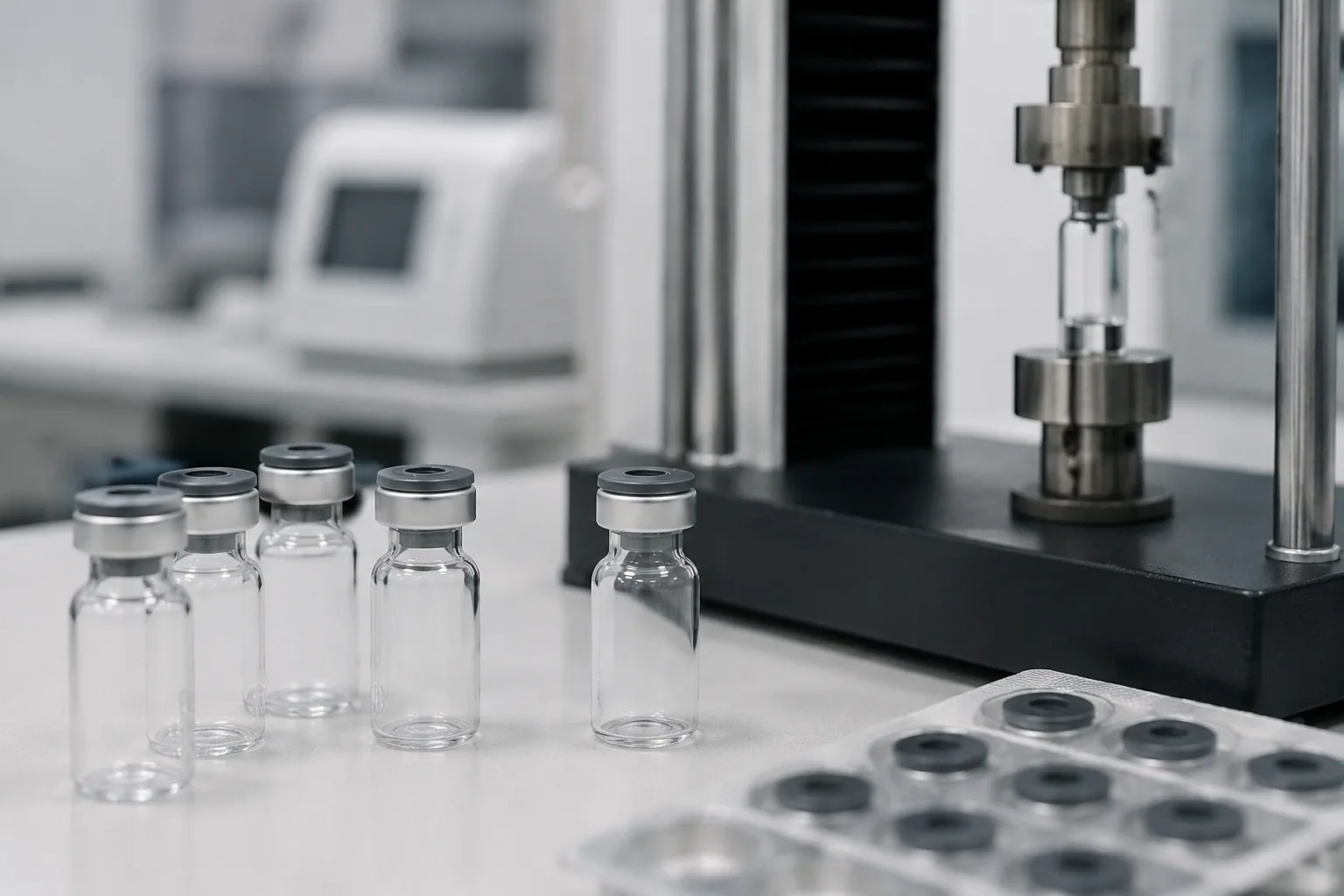
For the stoppered, crimped vial, USP <382> prescribes three functional tests that together characterise whether the closure will perform in clinical use:
- Fragmentation (coring) — when a needle or spike pierces the stopper, does it carve out rubber fragments that fall into the drug? Procedure: pre-pierce a partially water-filled vial with an 18-gauge needle (simulating diluent addition, if applicable), then pierce with a 21-gauge needle (≥4 piercings) or a spike (1 piercing); flush each piercing and filter the water; examine the filter under microscope at 30–110× using USP <788> lighting; report all particles > 150 µm in any dimension. (This is stricter than USP <381>, which used naked-eye counting limited to > 50 µm.)
- Penetration force — how hard must the user push to pierce the stopper? Measured with a 21-gauge needle (or a spike per ISO 8536-2/-6) at a specified piercing rate; the ≤ 10 N limit per USP <381> (carried into the new framework) ensures the drug can be administered and the needle is not blunted.
- Spike-retention / sealability — does the larger spike puncture reseal and hold? Fill the vial with liquid (or proxy), pierce with a spike, invert, hang a 0.5 kg mass from the spike for 4 hours; inspect for spike slippage from the orifice or liquid leakage.
Because pre-piercing (for reconstitution of a lyophilised product) changes the subsequent penetration and coring behaviour, the procedure explicitly requires the pre-pierce step where the product is reconstituted — testing an un-pierced stopper for a reconstituted product is not a representative test.
What Are Residual Seal Force, Torque Retention and Flip-Off Force?
Beyond USP <382>, the capping quality itself is characterised by three mechanical tests referenced in USP <1207.3> and ISO 8362-7:
- Residual Seal Force (RSF) — the compressive force the crimped stopper still exerts against the vial land seal, measured on a universal testing machine: the probe pushes down on the stopper, and the moment the tester overcomes the compressed-stopper "spring" resistance, a discernible kink appears in the force/displacement curve — that kink is the RSF. RSF is the primary indicator of capping-machine performance and the dominant driver of container-closure integrity.
- Torque retention of the aluminium cap — hold the vial, rotate the crimp cap until it breaks loose; low break-loose torque correlates with low RSF and inadequate stopper restraint.
- Flip-off removal force (ISO 8362-7) — the plastic flip-off cap must stay on through production/packing/shipping yet come off easily by hand for syringe access. Too loose → falls off; too tight → may damage retaining lugs or pop a lyophilisation stopper off.
What Is Container Closure Integrity Testing (CCIT), and Which Methods Apply?
CCI testing proves the assembled vial blocks microbial and gas ingress across the shelf life — it has replaced the old sterility-test and dye/microbiological-immersion approaches, which USP <1207> now discourages as non-deterministic. Three deterministic methods dominate vial CCIT:
| Method | Principle | Suitability for vials |
|---|---|---|
| Vacuum decay (USP <1207> deterministic) | Place the vial in a chamber, pull vacuum, monitor pressure decay; a defect lets gas escape and the vacuum decays | The workhorse — non-destructive, rigid/semi-rigid/flexible, high sensitivity, the recommended replacement for dye immersion |
| High-Voltage Leak Detection (HVLD / MicroCurrent HVLD) | Transmit high-voltage microcurrent through the package; a leak lowers resistance and raises current | Liquid/semi-liquid parenteral vials; MicroCurrent limits product voltage exposure to < 5 % of conventional HVLD and reduces ozone |
| Helium leak detection | Fill with helium tracer gas, evacuate, measure helium efflux as a leak rate | Highest sensitivity — for product design, validation, failure analysis; not a routine 100 % release tool |
USP <1207> recommends vacuum decay or HVLD over dye immersion, because they are deterministic, quantitative and reproducible; helium is reserved for the most sensitive design/validation work.
What About the Glass Vial Itself?
The container-closure system is only as good as the glass, and the vial body carries its own standard battery. The Chinese YBB product standards for tubular injection vials (YBB 00032005-2015 钠钙玻璃管制注射剂瓶; YBB 00292005-1-2015 高硼硅玻璃管制注射剂瓶; low-borosilicate equivalents) plus the new ChP 2025 Chapter 5100 (药品包装用玻璃容器通则) require:
- 121 °C particle-method water resistance (glass-grain test) and inner-surface water resistance — to confirm the glass will not leach alkali into the drug.
- Alkali-leach test and chemical-compatibility parameters.
- Mechanical / dimensional — wall thickness, neck finish, verticality, thermal-shock resistance, internal-pressure resistance, hydrostatic-fracture.
- Biological reactivity per the relevant in-vitro/in-vivo chapters.
The vial body and the closure system are reported separately but read together: a perfect seal on a leaching glass body still fails the product.
What Belongs on the Report?
A compliant vial test report states the system tested (the actual final vial-stopper-cap assembly, with sterilisation and transport conditioning noted), the standard (USP <382> for functionality; USP <1207>/<1207.3> for CCI; YBB + ChP 5100 for the glass body), the method (fragmentation/penetration/sealability for closure function; vacuum-decay/HVLD/helium for CCI; RSF/torque/flip-off for capping quality; water-resistance/alkali-leach/mechanical for the glass), and the result against the limit (particles ≤ 150 µm; penetration force ≤ 10 N; 0.5 kg/4 h sealability pass; CCI leak-rate vs sensitivity; YBB water-resistance class).
For the glass-material background, see our Glass testing and Low-borosilicate glass testing; for the clean-environment context, Clean bench testing and cleanroom testing.
FAQ
What does USP <382> change compared with USP <381>?
USP <382> (effective 1 Dec 2025) shifts elastomer functionality testing from the component (supplier-certified loose stopper, USP <381>) to the final assembled system (drug manufacturer's responsibility: actual vial + stopper + seal, processed and capped as production). It also tightens fragmentation to microscope/USP <788> counting of particles > 150 µm (vs USP <381> naked-eye > 50 µm), and adds spike-retention/sealability.
What is Residual Seal Force and why does it matter?
RSF is the compressive force a crimped stopper still exerts against the vial land seal, measured as the kink in the force/displacement curve on a universal tester. It is the primary indicator of capping-machine performance and the dominant driver of container-closure integrity; a low RSF correlates with low torque retention and with CCI failure.
Why has dye immersion been replaced for vial leak testing?
Per USP <1207>, dye immersion is non-deterministic (subjective, poorly reproducible, low sensitivity). The deterministic alternatives — vacuum decay and HVLD — are quantitative and reproducible; helium leak detection is reserved for the highest-sensitivity design/validation work. USP <1207> recommends vacuum decay or HVLD over dye immersion.
What is the difference between testing the stopper and testing the vial system?
Testing the stopper alone (USP <381> legacy) certifies the elastomer component. Testing the vial system (USP <382>) certifies the actual assembled vial-stopper-cap in its final processed configuration — which is what governs real-world performance, because capping force, sterilisation, vial geometry and transport all change the result. The current standard requires the system.
Which Chinese standards apply to a pharmaceutical vial?
The YBB national drug-packaging-material standards for the vial body (e.g. YBB 00032005-2015 钠钙玻璃管制注射剂瓶, YBB 00292005-1-2015 高硼硅玻璃管制注射剂瓶) plus the new ChP 2025 General Chapter 5100 (药品包装用玻璃容器通则) for the glass, alongside the general CCI/functional framework paralleled by USP <1207>/<382>. The vial body and the closure system are reported separately but read together.
Our Testing Capabilities
As an ISO/IEC 17025-accredited third-party laboratory, Beijing ZKGX Research provides pharmaceutical vial container-closure system testing aligned to USP <1207>/<1207.3>, USP <381>/<382>, ISO 8362, ISO 8536, the YBB standards and ChP 2025 General Chapter 5100:
- Closure functional suitability to USP <382> — fragmentation (microscope/USP <788>, particles > 150 µm, with pre-pierce for reconstituted products), penetration force (≤ 10 N, 21-gauge/spike), spike-retention/sealability (0.5 kg / 4 h).
- Capping quality — Residual Seal Force (USP <1207.3>), aluminium-cap torque retention, flip-off removal force (ISO 8362-7).
- Container Closure Integrity — vacuum decay and MicroCurrent HVLD (USP <1207> deterministic), helium leak detection for design/validation.
- Glass vial body — 121 °C particle-method and inner-surface water resistance, alkali-leach, thermal shock, internal-pressure, dimensional, per YBB product standards and ChP 5100.
- System-level test design — final-assembly sample preparation (production capping force, sterilisation, ASTM D4169 transport conditioning) to meet the USP <382> "fitness-for-intended-use" requirement.
Sample types include tubular borosilicate / low-borosilicate / soda-lime injection vials (liquid, powder, lyophilised), elastomeric stoppers, aluminium/flip-off caps, and the complete crimped assembly. If you have a specific product (liquid / lyophilised / powder), target market (US FDA / EU / China NMPA), or standard (USP / ISO / YBB / ChP), contact the laboratory to confirm the exact test set and reporting format befOre testing.